
Karonda (Carissa)
Carissa carandas
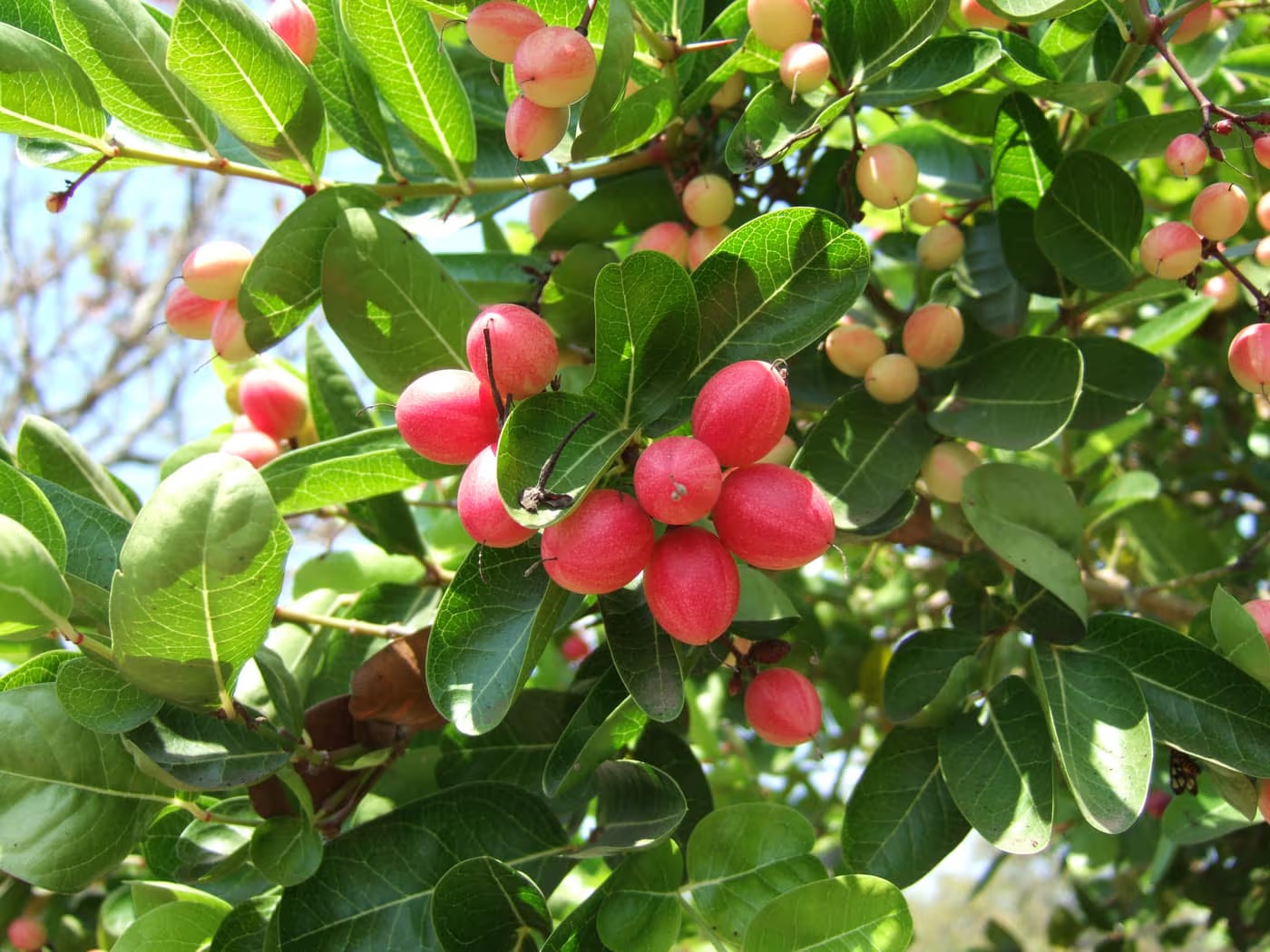
A hardy, thorny evergreen shrub that shrugs off drought, salinity and wasteland soil other fruit crops cannot survive — grown across Maharashtra, Gujarat, Rajasthan and Uttar Pradesh as much for a thorny live fence as for its fruit, where the unripe green berry goes into pickle and chutney and the ripe purple-black one into jam, juice and squash.
Quick Summary
The key points from this page in about two minutes — read it or have it read aloud.
Quick Summary
Karonda (Carissa carandas) is a hardy, thorny, evergreen shrub grown for its small, tart berries across Maharashtra, Gujarat, Rajasthan, Uttar Pradesh and scattered marginal land elsewhere in India. It is one of the very few fruit crops that genuinely thrives on poor, dry, saline or alkaline wasteland where almost nothing else pays — which is exactly why it is planted, often doing double duty as a dense, thorny live fence around a field or orchard as well as a fruit crop in its own right.
The plant asks for very little. Once established it needs minimal irrigation, tolerates a wide pH range, and shrugs off the kind of hot, dry, saline conditions that would kill most fruit trees. Its thorny, densely branched habit that makes it such a good boundary hedge also means pruning and training in the first few years pay off in an easier-to-pick shape later.
Karonda fruit is used at two very different stages. The unripe, still-green berry is hard, sour and starchy, prized specifically in that state for pickle, chutney and vegetable-style curries — a genuinely separate market from the ripe fruit, not simply an early harvest of the same product. The ripe berry turns purple-black, softens and sweetens, and goes into jam, jelly, squash and juice, or is eaten fresh. Pickle-type varieties bred for high acidity (Pant Manohar, Pant Sudarshan, Pant Suvarna) and sweeter, fresh-eating types (Konkan Bold, CHES-K-II-7) are genuinely different plantings for genuinely different end uses, not just a quality spread within one variety.
- Crop type
- Perennial thorny evergreen fruit shrub
- Season
- Planted at monsoon onset (June–July); harvest Jun–Nov
- Suitable states
- Maharashtra, Gujarat, Rajasthan, Uttar Pradesh
- Time to bearing
- 2–3 years (grafted/cutting); 4–5 years (seedling)
- Water requirement
- Very low; drought-hardy once established
- Temperature
- Tropical–subtropical; tolerates strong heat, marginal frost hardiness when young
- Soil type
- Wide tolerance — poor, dry, saline/alkaline wasteland included; pH 6.0–8.5
- Difficulty level
- Easy (fruit fly and shoot webber-cum-borer are the main watch-outs)
- Expected yield
- 8–15 kg fruit per mature bush per year (up to 40 kg for Maru Gaurav)
- Key use
- Doubles as a thorny live fence as well as a fruit crop
Overview
Karonda, or Carissa carandas, is a hardy, thorny, evergreen fruit shrub grown across Maharashtra, Gujarat, Rajasthan and Uttar Pradesh, with scattered plantings on marginal land in many other states. It belongs to the same family as periwinkle and oleander (Apocynaceae) and is one of very few fruit crops that genuinely thrives on poor, dry, saline or alkaline wasteland — soil most orchard fruit simply cannot survive.
This toughness is the whole reason karonda is planted where it is. Once established it needs minimal irrigation, tolerates soils other fruit trees reject outright, and its dense, thorny branching doubles as a genuinely effective live fence around a field, orchard or homestead — many growers plant it explicitly for both roles at once, hedge and fruit crop together.
The fruit is harvested and used at two distinct stages that serve different markets. Unripe, still-green berries are hard, sour and starchy, picked specifically in that state for pickle, chutney and vegetable-style preparations. Ripe berries turn purple-black, soften and sweeten, and go into jam, jelly, squash, juice or fresh eating. Because of this, growers plant pickle-type varieties bred for high acidity (Pant Manohar, Pant Sudarshan, Pant Suvarna from GBPUAT Pantnagar) alongside sweeter fresh-eating types (Konkan Bold from Dr. Balasaheb Sawant Konkan Krishi Vidyapeeth, Dapoli; CHES-K-II-7 and CHES-K-V-6 from ICAR-CHES Chettalli) as genuinely different crops for genuinely different buyers, not simply picking the same fruit earlier or later.
Crop timeline, sowing to harvest
A quick visual map of the season — jump to any section below for the detail behind each stage.
- Year 0
Planting
A grafted or rooted-cutting plant of a named variety is set into a manure-filled pit at the start of the monsoon (June–July), spaced closer if grown as a live fence, wider for a pure orchard block.
- Year 1–2
Establishment & training
The young, thorny shrub is trained and lightly pruned to the desired shape — a dense hedge line or an open, pickable bush — and given occasional watering through its first dry seasons.
- Year 2–3
First bearing
Grafted and cutting-raised plants begin flowering and setting a first small crop of berries; a raw seedling takes longer and gives less predictable fruit.
- March–June
Flowering
Fragrant white, jasmine-like flowers open over several weeks; this is the main window to watch for fruit fly buildup ahead of fruit set.
- June–September
Green-fruit stage
Berries develop and stay hard, green and sour for several weeks — the stage picked specifically for pickle and chutney rather than left to ripen.
- September–November
Ripening & harvest
Fruit left on the bush turns purple-black, softening and sweetening, picked in repeated rounds over several weeks as successive berries ripen for fresh eating, jam and juice.
Suitable states
States where this crop is grown at scale, highlighted below. Your local Krishi Vigyan Kendra is still the final word for your specific block.
- Jammu and Kashmir
- Himachal Pradesh
- Punjab
- Uttarakhand
- Haryana
- Delhi
- Uttar Pradesh
- Rajasthan
- Bihar
- Jharkhand
- West Bengal
- Sikkim
- Assam
- Arunachal Pradesh
- Meghalaya
- Nagaland
- Manipur
- Mizoram
- Tripura
- Gujarat
- Madhya Pradesh
- Chhattisgarh
- Maharashtra
- Odisha
- Goa
- Telangana
- Andhra Pradesh
- Karnataka
- Kerala
- Tamil Nadu
- Puducherry
- Ladakh
- Chandigarh
- Lakshadweep
Grown here
Climate requirements
Karonda's climate tolerance is real, not marketing — this is one of the few fruiting shrubs that genuinely performs on hot, dry, marginal land, which is exactly why it is planted on boundaries and wasteland rather than a farm's best field.
Ideal temperature
A genuinely tropical-to-subtropical shrub that thrives in strong summer heat; young plants have only marginal frost tolerance and need protection in their first winter or two in frost-prone areas, but a mature bush is otherwise very heat-hardy.
Rainfall
Low water need — karonda is grown specifically because it copes well on 400–800 mm of rain a year and needs only occasional watering once established; it does not want a genuinely waterlogged spell at any stage.
Humidity
Tolerates both dry and moderately humid conditions well; prolonged high humidity at flowering can encourage minor fungal leaf-spot but is not a major risk for this crop.
Sunlight
Full sun gives the best flowering, fruit set and fruit colour; karonda is not shade-tolerant and grown in shade produces thin, sparse fruiting.
Soil requirements
Karonda's real value is turning marginal, saline or wasteland soil that would otherwise sit idle into a fruit-and-fence crop — matching it to that kind of land, not competing it against your best field for space, is the point.
Suitable soil
Extremely wide tolerance — grows well on poor, shallow, gravelly, sandy and even saline or alkaline soils that most fruit crops cannot survive at all, alongside better loams where it grows even more vigorously.
pH range
Roughly 6.0–8.5, including the mildly saline-alkaline soils common on the wasteland it is often planted on.
Drainage
Needs reasonable drainage — while drought- and salinity-hardy, a genuinely waterlogged site still causes root problems, so avoid the lowest-lying, standing-water-prone ground.
Organic matter
Low requirement. A manure-filled pit at planting establishes the young plant well; a mature bush on poor land keeps fruiting with only a light yearly manure dose.
Land preparation
Same four steps whichever region you are in — only the timing shifts with the sowing window.
- 1
Decide fence line or orchard block
For a live fence, plant in a single dense row at 1–1.5 m spacing along the boundary; for a pure fruit orchard, space plants at 2–3 m within rows and 3–4 m between rows to let bushes fill out and stay pickable.
- 2
Dig and fill pits with manure
Dig 45–60 cm cube pits a few weeks ahead, and refill with topsoil mixed with 10–15 kg well-rotted farmyard manure per pit before planting.
- 3
Choose marginal land deliberately
Because karonda genuinely tolerates poor, dry or saline soil, it is worth planting specifically on land too marginal for other fruit crops rather than displacing a better crop from good land.
Seed information
How the main varieties compare, so you can pick by duration, yield, disease pressure or what you are growing for.
| Variety | Duration | Yield | Disease resistance | Best state | Suitable for |
|---|---|---|---|---|---|
A GBPUAT Pantnagar (Uttarakhand) release, a pickle-type variety with high acidity and low TSS (roughly 3.0–4.0°B) bred specifically for its green-fruit pickle and chutney quality rather than fresh eating. | Bears from year 2–3 | Good, pickle-grade fruit | No special resistance claimed | Uttar Pradesh, Uttarakhand | Pickle and chutney processing |
A companion GBPUAT Pantnagar release alongside Pant Manohar, also a high-acidity pickle-type selected for consistent green-fruit quality. | Bears from year 2–3 | Good, pickle-grade fruit | No special resistance claimed | Uttar Pradesh, Uttarakhand | Pickle and chutney processing |
The third of GBPUAT Pantnagar's pickle-type releases, bred for the same low-TSS, high-acidity green-fruit profile as Pant Manohar and Pant Sudarshan. | Bears from year 2–3 | Good, pickle-grade fruit | No special resistance claimed | Uttar Pradesh, Uttarakhand | Pickle and chutney processing |
A Dr. Balasaheb Sawant Konkan Krishi Vidyapeeth (Dapoli, Maharashtra) release — a sweet-type variety with 10–12°B TSS, a prolific bearer with notably large fruit, bred for fresh table use rather than pickling. | Bears from year 2–3 | High; prolific bearer | No special resistance claimed | Maharashtra | Fresh eating, table fruit, juice |
An ICAR-Central Horticultural Experiment Station, Chettalli (Karnataka) selection with high TSS (roughly 15–16°B) and good ascorbic acid content, suited to fresh eating and processing where sweetness matters. | Bears from year 2–3 | Good; high sugar and vitamin C | No special resistance claimed | Karnataka | Fresh eating, juice, high-vitamin-C processing |
A very high-yielding ICAR-CAZRI (Jodhpur, Rajasthan) release bred specifically for the hot, arid west — commonly cited at up to about 40 kg of fruit per mature plant, well above most other named varieties. | Bears from year 2–3 | Very high — up to ~40 kg/plant | No special resistance claimed; bred for arid tolerance | Rajasthan, Gujarat | Hot semi-arid dryland orchards, maximum yield |
An ICAR-CIAH (Bikaner, Rajasthan) release with deep red skin colour and high pulp content, bred with processing (juice, squash, colour-rich products) specifically in mind, evaluated at roughly 9.5°B TSS and about 6% total sugar. | Bears from year 2–3 | Good; roughly 13 kg/plant in CIAH evaluation | No special resistance claimed; bred for arid tolerance | Rajasthan | Juice, squash and colour-rich processed products |
- Seed rate
- Grown from grafted plants or rooted cuttings, not a field seed rate: roughly 1,100–1,600 plants/ha for a fence-line hedge at 1–1.5 m spacing, or about 1,000–1,600 plants/ha for a pure orchard block at 2–3 m × 3–4 m spacing.
- Certified seed
- Source grafted plants or rooted cuttings of a named variety from a state horticulture department nursery, GBPUAT Pantnagar, ICAR-CHES Chettalli, ICAR-CAZRI Jodhpur, ICAR-CIAH Bikaner or a registered nursery — a raw seedling is slower to bear and gives unpredictable fruit acidity and size. Decide pickle-type versus sweet-type before buying, since they serve genuinely different markets.
- Spacing
- 1–1.5 m within a dense live-fence row; 2–3 m × 3–4 m for a pickable orchard block.
- Seed treatment
- For rootstock raised from seed: soak seed briefly before sowing in the nursery bed to even out germination. At field planting, dip the root ball of a grafted or cutting-raised plant in a Trichoderma or recommended bio-fungicide slurry before setting it in the pit.
Sowing guide
Deciding fence versus orchard spacing before planting matters more than almost any other single choice — a hedge planted too far apart never closes into an effective barrier, and an orchard planted too close becomes hard to prune and pick within a few years.
- Best time
- Plant grafted or rooted-cutting plants with the first steady monsoon rain, June to July, so roots establish before the first dry season; assured-irrigation sites can also plant in February–March.
- Row spacing
- 3–4 m for an orchard block; a single row for a live fence
- Plant spacing
- 2–3 m within an orchard row; 1–1.5 m for a dense live fence
- Sowing depth
- Set the plant so the root collar (and graft union, if grafted) sits just above the finished soil level; firm the soil and form a watering basin.
- Method
- One plant per pit, lightly staked if needed. For a live fence, plant in a single continuous row and begin training branches to interlock early for a dense, thorn-effective barrier.
Fertilizer schedule
A split dose beats one large dose applied at sowing — nitrogen especially is lost to the air and to leaching if it all goes in on day one.
- 1
Young plants (pre-bearing)
Years 1–2
A light NPK dose (roughly 50 g N, 25 g P, 25 g K per plant in year 1, increased in year 2) split across two doses at monsoon onset and its end, with 5–10 kg farmyard manure per plant per year worked into the basin.
- 2
Bearing plants
Year 3 onward, yearly
About 100–150 g N, 50–75 g P and 100 g K per mature bearing bush per year, plus 10–15 kg farmyard manure, applied in a ring around the base just before flowering and again after fruit set.
- 3
On poor or saline land
As needed
A light gypsum application and a foliar zinc spray before flowering can help on the more strongly saline-alkaline sites karonda is often planted on; confirm the dose with your KVK.
Irrigation schedule
1. Establishment
First 1–2 years
Water every 10–15 days through the dry months for the first one or two summers; this is the main stage at which karonda genuinely needs irrigation.
2. Bearing plants
Year 2–3 onward
Mostly rainfed once established. Where irrigation is available, an occasional watering at flowering and early fruit set improves fruit size, but the bush copes without it far better than most fruit crops.
Critical stages
- First 1–2 years after planting
- Flowering and early fruit set, where any irrigation is available
Water-saving tips
- Karonda is planted specifically because it does not need routine irrigation once established — building a heavy watering schedule around a mature bush defeats the point of choosing this crop for marginal land.
- A basin mulch of leaves or crop residue holds what little rain or watering the plant gets and cuts the number of establishment-stage waterings needed.
- On a live fence, a single shared watering line along the row is enough — there is no need for per-plant drip on an established hedge.
Weed management
Common weeds
Organic control
- Keep a weed-free circle around each young plant by hoeing 2–3 times a year for the first two years; a mature, thorny, densely branched bush shades out most weeds on its own.
- On a live fence, the dense thorny growth itself becomes the main weed suppressant once established, needing very little further weeding.
- Slash Lantana and Prosopis seedlings before they establish, since karonda's own wasteland sites are exactly where these invasive weeds also thrive.
Chemical control
- In the first year, a directed post-emergence herbicide can be used between rows on a larger orchard block, kept off young stems; most growers rely on hand and mechanical weeding given the crop's small scale.
- Confirm any herbicide with your local KVK before spraying near young plants.
Nutrient deficiency identification
What a shortage of each nutrient actually looks like on the plant, so you can tell a deficiency apart from a disease before you spray the wrong thing.
Nitrogen
Visible symptom
Pale, small older leaves and thin new growth, worst on the poor, low-organic-matter wasteland soils karonda is often planted on.
Zinc
Visible symptom
Small, narrow, bunched leaves at shoot tips and reduced flowering, common on the alkaline soils in the crop's typical growing belt.
Iron
Visible symptom
Yellowing between the veins of young leaves while veins stay green, more likely on strongly alkaline or calcareous wasteland sites.
Diseases to watch for
Symptoms, likely cause and what actually treats it — not just a spray name.
Leaf spot
- Symptoms
- Small brown to grey spots on leaves, sometimes with a yellow halo, occasionally merging and causing early leaf drop in a wet spell.
- Cause
- Fungal leaf-spot pathogens favoured by prolonged leaf wetness during humid weather.
- Treatment
- A protective copper or mancozeb spray checks a bad outbreak on young plants; rarely economic to spray a mature bush.
- Prevention
- Avoid overcrowded planting so the canopy dries out between rains, and clear fallen infected leaves.
Dieback
- Symptoms
- Twigs and branches drying back from the tip, sometimes with visible cankers at the point of infection.
- Cause
- Fungal pathogens entering through pruning wounds or stress cracks, worse on stressed, waterlogged or sun-scalded plants.
- Treatment
- Cut back dead wood to healthy tissue and paint large cuts with Bordeaux paste; remove and burn badly affected branches.
- Prevention
- Prune cleanly in the dry season, avoid waterlogging, and protect young stems from sun-scald.
Pests to watch for
What to look for before the damage is visible, and organic options before you reach for a chemical.
Fruit fly
- Identification
- Small maggots inside ripening fruit, with tiny puncture marks on the skin where the female fly laid eggs; affected fruit often drops early or rots from inside.
- Damage
- The single most serious pest of karonda — a heavy infestation can ruin a large share of the ripe, fresh-eating crop, though green fruit picked for pickle before ripening largely escapes it.
- Organic control
- Hang fruit-fly pheromone traps at flowering onset, collect and destroy fallen and infested fruit promptly, and consider bagging fruit clusters on a small planting.
- Chemical control
- A recommended bait spray or insecticide timed to fruit fly activity as fruit begins to ripen, observing the pre-harvest interval.
Karonda shoot webber-cum-borer
- Identification
- A Tortricidae moth caterpillar that webs together tender shoot tips and young leaves and bores inside them, leaving webbed, frass-filled shoot clusters and wilting tips.
- Damage
- Damages and kills young shoot growth, and a heavy infestation across flowering shoots can also reduce flower and fruit set on the affected branches.
- Organic control
- Clip and destroy webbed, infested shoot tips promptly, and spray neem on the flushing growth where the pest is active.
- Chemical control
- A recommended insecticide timed to the young shoot-flush stage where webbing is first noticed.
Scale insects and mealybugs
- Identification
- Brown or waxy-white encrustations along twigs and leaf midribs, tended by ants, with sticky honeydew and sooty mould following.
- Damage
- Sap loss weakens young plants and downgrades fruit appearance where mould develops on the skin.
- Organic control
- Prune out and burn the worst-infested twigs, spray horticultural mineral oil or neem, and conserve ladybird beetles.
- Chemical control
- A systemic insecticide or oil-insecticide mix where the infestation is spreading through a young planting.
Common mistakes to avoid
The mistakes that cost growers the most, ranked by how often they show up in the field — not in the order you might expect.
- 1
Planting an unnamed seedling instead of a grafted plant or rooted cutting of a known variety.
Why it hurts
A seedling is slower to bear and gives unpredictable fruit acidity and size — buyers for pickle or fresh eating both want a known, consistent fruit, which only a named variety reliably gives.
- 2
Not deciding pickle-type versus sweet-type before planting.
Why it hurts
Pickle-type varieties (Pant Manohar, Pant Sudarshan, Pant Suvarna) and sweet fresh-eating types (Konkan Bold, CHES-K-II-7) serve genuinely different markets — planting the wrong type for your intended buyer means a fruit that is hard to sell well either way.
- 3
Ignoring fruit fly control because the plant itself seems so hardy.
Why it hurts
Karonda's toughness is about surviving poor soil and drought, not about pest resistance — fruit fly is a genuinely serious threat to the ripe, fresh-eating crop and needs active management regardless of how easy the plant is otherwise.
- 4
Planting a live fence too far apart to ever close into a real barrier.
Why it hurts
A hedge spaced like an orchard leaves permanent gaps a fence is supposed to close — 1–1.5 m spacing, not orchard spacing, is what makes a karonda fence actually work as one.
- 5
Skipping irrigation entirely, even in the crucial first year or two.
Why it hurts
Karonda is drought-hardy once established, not drought-hardy from day one — a newly planted bush still needs occasional watering through its first one or two dry seasons to root in properly.
Harvesting
Green, unripe fruit for pickle and chutney is picked while still hard and sour, typically June to September; fully ripe fruit for fresh eating, jam and juice is picked as it turns purple-black and softens, typically September to November, in repeated rounds every few days as successive berries ripen.
Signs it is ready
- For pickle: fruit still fully green, hard and unripe
- For fresh use: skin has turned purple-black and fruit has softened slightly
- Fruit comes away easily from the stalk with a gentle pull
Tools
- Hand-picking is the standard method given the shrub's small size and thorns
- Thick gloves, given the plant's genuinely sharp thorns
- Baskets or crates for collecting picked fruit without crushing it
Expected yield
A mature bush typically gives 8–15 kg of fruit a year across both green and ripe pickings; the high-yielding Maru Gaurav has been recorded at up to about 40 kg per plant, and Thar Kamal at roughly 13 kg per plant in CIAH evaluation.
Post-harvest & storage
Storage
Green fruit for pickle can be held a short while in a cool, shaded place before processing; ripe fruit is highly perishable and should be processed (jam, juice, squash) or sold within a day or two of picking.
Packaging
Fresh ripe fruit is packed in shallow, ventilated crates to avoid crushing the soft berries; pickle, jam and squash are packed in standard food-grade jars and bottles once processed.
Transportation
Ripe fruit bruises easily and should be moved promptly and gently; green fruit for pickle is sturdier and tolerates a longer trip to a processing unit.
Shelf life
Fresh ripe fruit keeps only a few days even under cool storage; processed pickle, jam and squash keep for months under normal food-preservation practice.
Market prices
Today's mandi price near you, pulled live from the government's own Agmarknet data.
Live daily mandi prices from the government Agmarknet dataset.
Government mandi price not available for this crop
This crop is not traded through APMC mandis covered by the government’s Agmarknet system, so there is no mandi price to show here.
Weather
Current conditions and a 5-day outlook for your selected location, with one line of stage-aware advice.
Pick your state for current conditions and a 5-day outlook.
Live data from Open-Meteo
Profit calculator
Your own cost sheet, expected yield and selling price — not ours.
Where the money goes
Share of the total cost per acre, using the calculator’s own default cost sheet below — adjust the numbers there to match your field and this picture will no longer apply to you exactly, but the ranking rarely changes.
- Labour35% (₹9,000)
- Land rent28% (₹7,000)
- Pesticide & weedicide10% (₹2,500)
- Fertiliser8% (₹2,000)
- Seed6% (₹1,500)
- Irrigation5% (₹1,200)
- Interest5% (₹1,200)
- Machinery4% (₹1,000)
Official downloads
Government and ICAR documents only — everything below is hosted on an official server.
GBPUAT Pantnagar
Source of the Pant Manohar, Pant Sudarshan and Pant Suvarna pickle-type varieties
ICAR-CIAH, Bikaner
Source of Thar Kamal and arid-zone karonda package of practices
ICAR-CAZRI, Jodhpur
Source of the high-yielding Maru Gaurav variety
Kisan Call Centre — 1800-180-1551
Free crop advice in your language
Frequently asked questions
Is karonda grown mainly for fruit or as a fence?
Genuinely both. Its dense, thorny branching makes it an effective live fence around a field, orchard or homestead, and the same plant bears a real, sellable fruit crop — many growers plant it deliberately for both roles at once, especially on marginal or boundary land.
What is the difference between green and ripe karonda, and does it matter which variety I plant?
Yes, genuinely. Unripe green fruit is hard, sour and used for pickle and chutney; ripe purple-black fruit is soft and sweet, used fresh or for jam and juice. Pickle-type varieties (Pant Manohar, Pant Sudarshan, Pant Suvarna) are bred for high acidity in the green stage, while sweet types (Konkan Bold, CHES-K-II-7) are bred for the ripe, fresh-eating market — decide which market you are growing for before choosing a variety.
Can karonda really grow on saline or wasteland soil?
Yes — this is one of the genuine reasons the crop is grown where it is. Karonda tolerates poor, dry, shallow and mildly saline-alkaline soils that most fruit crops cannot survive at all, which is why it is often planted on marginal land, field boundaries and wasteland rather than a farm's best soil.
What is the biggest pest problem in karonda?
Fruit fly on the ripening, fresh-eating crop is the most serious threat — it can ruin a large share of the crop meant for fresh sale or juice. Green fruit picked early for pickle largely escapes this problem since it is harvested before the fly's window of attack.
Does karonda have an MSP or mandi price?
There is no MSP for karonda, and a direct check of the Agmarknet mandi dataset found no genuine trade records under this or any related name — the crop moves mainly through local and direct sale, and processed pickle, jam and juice channels, rather than through organised APMC mandis.
How long does a karonda bush keep bearing?
A long time for a shrub crop — a grafted or cutting-raised plant starts bearing in 2–3 years and, once mature, a healthy bush keeps fruiting for many years with only light annual maintenance, making it a low-effort, long-term crop for the marginal land it is usually planted on.
Still have questions?
The FAQs above cover the common ones. For anything specific to your field and soil, your nearest Krishi Vigyan Kendra is the authoritative answer.