
Oil Palm
Elaeis guineensis
The highest oil-yielding crop in the world per hectare, and the centrepiece of India's edible-oil self-sufficiency push (NMEO-OP) — but a serious, long commitment: it needs four years and heavy, year-round assured irrigation before the first real harvest, it only pays where you can water it through the dry months, and because the fresh fruit bunches must reach a mill within about a day of cutting, there has to be a processing factory within reach before the first palm goes in the ground.
Quick Summary
The key points from this page in about two minutes — read it or have it read aloud.
Quick Summary
Oil palm (Elaeis guineensis) is the single most productive oilseed crop on earth per unit area — a mature plantation yields several times the oil per hectare of groundnut, mustard or any other Indian oilseed. It is the flagship crop of the National Mission on Edible Oils–Oil Palm (NMEO-OP), the government's big push to cut India's heavy dependence on imported palm oil, and area is being expanded fast across Andhra Pradesh and Telangana (the established belt), Karnataka, Tamil Nadu, Odisha, Chhattisgarh, Gujarat, and the north-eastern states led by Mizoram.
It is a long-term, capital-heavy decision, not a seasonal crop. A palm is planted once and cropped for 25–30 years, but it gives no harvestable fruit for about the first four years (the gestation period), during which the grower earns only from inter-crops grown between the young palms. NMEO-OP exists largely to carry a farmer through this gap, with assistance for planting material, a maintenance grant through the gestation years, and — crucially — a guaranteed price for the fruit linked by formula to the crude palm oil price.
Two facts decide whether oil palm suits a given farm. First, water: unlike most "hardy" plantation crops, oil palm is thirsty — it needs high rainfall or, far more commonly in India, assured drip or basin irrigation right through the dry season (a mature palm can need 150–300 litres a day in peak summer). A plot without secure year-round water is the wrong place for it. Second, the mill: the harvested fresh fruit bunches (FFB) start losing oil quality within hours of cutting and must reach a processing factory within about 24 hours, so oil palm is only planted where a company mill is within economic reach — it is not a crop you can grow and then look for a buyer.
The planting material is always a "tenera" hybrid — a Dura × Pisifera cross that gives the thin-shelled, high-oil fruit the industry runs on — raised from sprouted seed largely imported from established breeders (with ICAR-IIOPR's own hybrids and the released Godavari Ratna adding Indian options). Beyond water and the mill, the crop asks for heavy, regular fertiliser (a mature palm is a big feeder), management of a handful of serious problems — bud rot, Ganoderma basal stem rot, the rhinoceros beetle and the red palm weevil — and disciplined, year-round harvesting of ripe bunches every 10–15 days.
- Crop type
- Perennial oil palm (industrial oilseed), mill-linked
- Season
- Planting: monsoon (June–Sept); harvesting year-round every 10–15 days
- Suitable states
- Andhra Pradesh, Telangana, Karnataka, Tamil Nadu, Odisha, Chhattisgarh, Gujarat, Mizoram & NE
- Growing duration
- First harvest ~year 4; productive life 25–30 years
- Water requirement
- High — needs assured irrigation; a mature palm can take 150–300 L/day in summer
- Temperature
- Warm, humid tropics; best ~24–32°C, needs no cold/frost
- Soil type
- Deep, well-drained loam; tolerates a range but not waterlogging or shallow soil
- Difficulty level
- Moderate–hard — long gestation, heavy water and nutrition, mill dependence
- Expected yield
- 20–30 t fresh fruit bunches (FFB)/ha/year at full bearing (~4–5 t oil/ha)
- Key risk
- Planting without assured year-round water or a mill within a day's reach
Overview
Oil palm (Elaeis guineensis) is a tropical perennial palm grown for the fresh fruit bunches (FFB) that are pressed into crude palm oil and palm kernel oil — together the most-consumed edible oils in India and the highest oil-yielding crop in the world per hectare. It is not a food crop eaten directly but an industrial oilseed crop grown under a mill-linked, contract-style system.
India grows it under the National Mission on Edible Oils–Oil Palm (NMEO-OP), a central scheme to expand area and cut dependence on imported palm oil. Andhra Pradesh and Telangana are the long-established belt; Karnataka, Tamil Nadu, Odisha, Chhattisgarh, Gujarat and the north-eastern states (Mizoram foremost) are the fast-expanding frontier identified under the 2020 IIOPR reassessment.
It is a 25–30-year commitment with a roughly four-year gestation before first harvest, so it turns on three things the farmer must confirm before planting: assured year-round irrigation (it is a thirsty crop, not a drought-hardy one), a processing mill within about a day's reach of the field (cut bunches must be milled within ~24 hours), and the financial staying power — helped by NMEO-OP support and inter-cropping — to carry the first four non-bearing years.
Crop timeline, sowing to harvest
A quick visual map of the season — jump to any section below for the detail behind each stage.
- Year 0 (nursery)
Sprouted seed to seedling
Tenera (Dura × Pisifera) sprouted seed is raised in a nursery for about 10–12 months into a healthy polybag seedling before field planting — buying a raised seedling of a known cross is the usual route.
- Year 1 (monsoon)
Field planting
Seedlings are planted at about 9 m triangular spacing (roughly 143 palms/ha) into large pits at the onset of the monsoon, with irrigation set up from day one.
- Years 1–4
Gestation & inter-cropping
The palm builds its canopy but bears no harvestable crop; growers earn from inter-crops (vegetables, banana, cocoa, pineapple) in the inter-spaces, and NMEO-OP maintenance support helps bridge the gap.
- Year ~4
First harvest
The first commercial fresh fruit bunches are cut; early yields are modest and build year on year.
- Years ~8 onward
Full bearing
The palm reaches peak yield — commonly 20–30 t FFB/ha/year under good irrigation and nutrition — and holds it for many years.
- Every 10–15 days, year-round
Harvest rounds
Ripe bunches are cut on a strict rotation throughout the year; each bunch must reach the mill within about a day of cutting to preserve oil quality.
Suitable states
States where this crop is grown at scale, highlighted below. Your local Krishi Vigyan Kendra is still the final word for your specific block.
- Jammu and Kashmir
- Himachal Pradesh
- Punjab
- Uttarakhand
- Haryana
- Delhi
- Uttar Pradesh
- Rajasthan
- Bihar
- Jharkhand
- West Bengal
- Sikkim
- Assam
- Arunachal Pradesh
- Meghalaya
- Nagaland
- Manipur
- Mizoram
- Tripura
- Gujarat
- Madhya Pradesh
- Chhattisgarh
- Maharashtra
- Odisha
- Goa
- Telangana
- Andhra Pradesh
- Karnataka
- Kerala
- Tamil Nadu
- Puducherry
- Ladakh
- Chandigarh
- Lakshadweep
- Andaman and Nicobar Islands
- Dadra and Nagar Haveli and Daman and Diu
Grown here
Climate requirements
The decisive climate-and-site question is water, not temperature. Oil palm is the opposite of a drought-hardy plantation crop — it must be watered through the dry season every year, so a plot without secure year-round irrigation is simply the wrong place for it, however warm the climate.
Ideal temperature
A warm, humid, equatorial-origin crop that does best around 24–32°C with no cold stress; it needs a frost-free, genuinely tropical climate and does not suit cold or temperate regions. Prolonged cold or dry heat both check growth and cut bunch yield.
Rainfall
Ideally suited to high, evenly-distributed rainfall (well over 2,000 mm a year in its native range). In most of India rainfall alone is not enough, so oil palm is grown under assured irrigation — it is a thirsty crop, and a long dry spell without irrigation sharply reduces bunch number and size and can set the palm back for a year.
Humidity
High humidity suits it; it is a humid-tropics crop. Dry, desiccating winds stress the palm and are best buffered with irrigation and, where needed, windbreaks.
Sunlight
Needs full, strong sunlight for high oil yield — it is a high-light crop, which is why the palms are spaced to avoid shading each other as the canopy develops.
Soil requirements
The ideal is deep, moisture-retentive soil combined with assured irrigation — the crop wants both a soil that holds water and a water source to keep it topped up, which is why river-command and well-irrigated tracts of the southern and eastern belts have been the heart of Indian oil-palm expansion.
Suitable soil
Prefers a deep, fertile, well-drained loam or clay-loam that holds moisture without waterlogging. It tolerates a fair range of soils but not shallow, rocky, or badly-drained land; coastal alluvium and deep red loams in the southern belt suit it well.
pH range
Grows across roughly pH 4.5–7.5, tolerating mildly acidic soils better than strongly alkaline ones; very alkaline or saline soils are poorly suited.
Drainage
Needs good drainage despite its high water demand — it wants plenty of water but not standing water. Low, waterlogging-prone land causes root problems and is unsuitable.
Organic matter
Responds strongly to organic matter; the palm's own pruned fronds and the empty fruit bunches returned from the mill are commonly recycled around the palm to build soil and recycle nutrients, especially potassium.
Land preparation
Same four steps whichever region you are in — only the timing shifts with the sowing window.
- 1
Confirm water and mill first
Before any field work, confirm a secure year-round irrigation source and a processing mill within economic reach — these two decide whether oil palm can be grown at all, not the land preparation.
- 2
Lay out at 9 m triangular spacing
Mark a triangular (equilateral) planting pattern at about 9 m, giving roughly 143 palms per hectare — close enough for full ground cover at maturity, wide enough to avoid mutual shading.
- 3
Dig and enrich large pits
Dig large pits (about 60 cm cube or larger) ahead of the monsoon, refill with topsoil, well-rotted manure and rock phosphate, and set up the drip or basin irrigation before planting the seedling.
Seed information
How the main varieties compare, so you can pick by duration, yield, disease pressure or what you are growing for.
| Variety | Duration | Yield | Disease resistance | Best state | Suitable for |
|---|---|---|---|---|---|
Tenera (Dura × Pisifera) hybrid The planting material for virtually all commercial oil palm — a cross of a thick-shelled Dura mother with a shell-less Pisifera father, giving a thin-shelled, high-mesocarp "tenera" fruit with the most oil per bunch. India raises some of this hybrid seed through ICAR-IIOPR and imports the rest; a farmer almost always buys a raised seedling of a tenera cross rather than selecting among named cultivars. | First harvest ~year 4; productive 25–30 years | 20–30 t FFB/ha/year at full bearing under good management | No special resistance; manage bud rot, Ganoderma and the beetle/weevil pests | All Indian oil-palm states | The standard, essential planting material for any commercial plot |
An ICAR-IIOPR tenera hybrid released for the coastal region of Maharashtra, one of the few formally named-and-released Indian oil palm hybrids, bred for the agro-climate of the western coastal belt. | First harvest ~year 4; productive 25–30 years | High FFB yield in its target coastal agro-climate | No special resistance widely documented | Coastal Maharashtra and similar agro-climates | A named Indian release where available for the region |
The indigenous Dura × Pisifera hybrid seed produced by ICAR-Indian Institute of Oil Palm Research (Pedavegi), supplied for testing and planting across India's oil-palm agro-climatic zones as a home-grown alternative to imported seed. | First harvest ~year 4; productive 25–30 years | Comparable to good imported tenera material in Indian trials | No special resistance widely documented | Across Indian oil-palm zones | Growers preferring indigenous ICAR hybrid seed |
Imported sprouted tenera seed from the long-established Costa Rican breeder ASD, one of the main sources of planting material for Indian plantations, chosen for proven high-oil crosses and reliable germination. | First harvest ~year 4; productive 25–30 years | High, from internationally proven high-oil crosses | No special resistance widely documented | Across Indian oil-palm states | Commercial plantings using imported proven tenera seed |
Imported tenera seed from the Thai breeder Univanich, another major supplier to Indian oil-palm programmes, selected for South/South-East Asian humid-tropic conditions close to much of India's oil-palm belt. | First harvest ~year 4; productive 25–30 years | High, bred for humid-tropic Asian conditions | No special resistance widely documented | Southern and eastern Indian oil-palm belts | Commercial plantings using imported Asian-bred tenera seed |
- Seed rate
- Not sown directly in the field — about 143 raised nursery seedlings are planted per hectare at 9 m triangular spacing, each from a sprouted tenera (Dura × Pisifera) seed raised for 10–12 months in a nursery. Allow for a few extra seedlings to replace any that fail.
- Certified seed
- Only ever plant genuine tenera (Dura × Pisifera) seedlings from an authorised source — ICAR-IIOPR, a state oil-palm programme, or a company nursery supplying under NMEO-OP. Dura or Pisifera seedlings, or unverified "oil palm" seed, give far less oil and are a 25-year mistake that only shows up after the gestation years. Buy only through the NMEO-OP channel or a recognised institute.
- Spacing
- 9 m triangular (equilateral) spacing, about 143 palms per hectare.
- Seed treatment
- Germination and sprouting of oil-palm seed is a specialised process done at breeder/institute level — farmers buy either the sprouted seed or, more usually, the raised polybag seedling, rather than treating seed themselves.
Sowing guide
Never plant into a site without the irrigation already arranged — an oil palm seedling that goes through its first dry season without water is checked badly and may never catch up.
- Best time
- Plant nursery-raised seedlings at the onset of the monsoon (June–September in most of India) so they establish with warmth and moisture, with irrigation in place from the day of planting to carry them through the following dry season.
- Row spacing
- 9 m between rows (triangular pattern)
- Plant spacing
- 9 m between palms (triangular pattern), ~143 palms/ha
- Sowing depth
- Plant the seedling with the collar at soil level, in a large, manure-filled pit; do not bury the base of the stem
- Method
- Set a healthy 10–12-month polybag seedling of a tenera cross into the prepared pit, firm the soil, water immediately, and provide a basin or drip line from the start; plant inter-crops in the wide inter-spaces to earn income through the gestation years.
Fertilizer schedule
A split dose beats one large dose applied at sowing — nitrogen especially is lost to the air and to leaching if it all goes in on day one.
- 1
Young palm (years 1–3)
Split 3–4 times a year
Doses build up each year as the palm grows — a balanced NPK with generous potassium and magnesium, applied in a ring and worked in, plus organic matter; the gestation-year feed sets up the bearing palm.
- 2
Bearing palm (from ~year 4)
Split 3–4 times a year
A mature palm is a heavy feeder — commonly around 1.2 kg N, 0.6 kg P₂O₅ and 1.2–1.8 kg K₂O per palm per year (potassium is the key nutrient for bunch yield and oil), plus magnesium and boron, split across the year and applied in the weeded ring around each palm.
- 3
Recycling
Ongoing
Pruned fronds and the empty fruit bunches returned from the mill are recycled around the palm to return organic matter and, especially, potassium to the soil — a standard, economical part of oil-palm nutrition.
Irrigation schedule
1. Establishment (year 1)
Frequent, through the first dry season
Young palms need regular watering to establish; a first dry season without irrigation badly checks the seedling.
2. Young palm (years 2–3)
Regular, especially in the dry season
Water demand rises as the palm grows; drip or basin irrigation through every dry season is essential, not optional.
3. Bearing palm
Year-round, heaviest in summer
A mature palm can need 150–300 litres a day in peak summer; sustained water through the dry months is what keeps bunch number and size up — water stress now directly cuts the oil crop.
Critical stages
- Establishment of the young palm
- The entire dry season, every year, for a bearing palm
Water-saving tips
- Drip irrigation is the standard and most efficient method for oil palm in India, delivering the large volume the palm needs with far less waste than basin flooding.
- A thick mulch of pruned fronds and empty fruit bunches around the palm conserves soil moisture and cuts irrigation need.
- Oil palm is not a crop to water-ration — unlike drought-hardy plantation crops, skimping on dry-season water directly costs bunch yield, so secure water first and manage it well rather than cutting it back.
Weed management
Common weeds
Organic control
- Keep a clean weeded ring around each palm and mulch it with pruned fronds and empty bunches, which both suppress weeds and feed the soil.
- A leguminous cover crop (such as Mucuna or Pueraria) is often grown in the inter-spaces in the gestation years to smother weeds, fix nitrogen and protect the soil.
- Once the canopy closes over at maturity, shade suppresses most weed growth beneath the palms.
Chemical control
- A cleared, weeded ring is kept around each palm; herbicide may be used in the inter-rows on larger plantations, kept clear of the palm base.
Nutrient deficiency identification
What a shortage of each nutrient actually looks like on the plant, so you can tell a deficiency apart from a disease before you spray the wrong thing.
Potassium
Visible symptom
Orange-yellow spotting and necrosis on older fronds (confluent orange spotting), with reduced bunch number and size — potassium is the nutrient oil palm needs most and is deficient in most Indian soils for this crop.
Magnesium
Visible symptom
Orange-yellow discolouration of older fronds, worst on the sun-exposed side, while younger fronds stay green.
Boron
Visible symptom
Deformed, crinkled or "hook-leaf" new fronds and poor bunch development, more common on light or high-pH soils.
Diseases to watch for
Symptoms, likely cause and what actually treats it — not just a spray name.
Bud rot
- Symptoms
- Rotting of the central spear and growing point, with the spear turning brown and pulling out easily and a foul smell; once the single growing point is killed, the palm dies, as it cannot branch.
- Cause
- Phytophthora and associated organisms, favoured by prolonged wet, humid conditions and waterlogging, often worst in young palms.
- Treatment
- Remove and destroy rotting tissue at the crown early, drench the growing point with a recommended systemic fungicide, and improve drainage; a palm with the growing point fully killed cannot be saved.
- Prevention
- Good drainage, balanced nutrition (avoid lush, soft growth), prompt removal of affected palms, and protective crown drenching in high-risk wet periods.
Ganoderma basal stem rot
- Symptoms
- Progressive rotting of the base of the trunk, with fronds yellowing and collapsing, unopened spears, and eventually bracket-shaped fungal fruiting bodies at the stem base; the palm declines and dies.
- Cause
- The fungus Ganoderma, a soil-borne root-and-stem-base pathogen that spreads through root contact and infected debris, and the most serious long-term disease of oil palm.
- Treatment
- No reliable cure once established — remove and destroy severely affected palms and their stumps/roots to reduce the inoculum reaching neighbours.
- Prevention
- Remove old infected stumps and roots before replanting, avoid injuring the stem base, keep palms well-nourished and unstressed, and do not replant straight into a heavily infected stump.
Spear/leaf rot
- Symptoms
- Rotting and browning of the unopened spear leaf and young fronds, sometimes following boron deficiency or insect/weather damage, checking the palm's growth.
- Cause
- A complex of fungi and bacteria entering the spear, often secondary to nutrient deficiency, pest injury or waterlogging.
- Treatment
- Remove affected spear tissue, correct any boron deficiency, improve drainage, and apply a protective fungicide where the problem is spreading.
- Prevention
- Balanced nutrition (especially boron), good drainage, and control of the pests and weather stress that open the way for the rot.
Pests to watch for
What to look for before the damage is visible, and organic options before you reach for a chemical.
Rhinoceros beetle
- Identification
- Large black beetles that bore into the crown and the base of unopened fronds, leaving characteristic V-shaped or wedge cuts in the fronds when they open out.
- Damage
- Boring into the growing point damages developing fronds and the bud, cutting growth and yield and opening the way for bud rot; a major pest especially of young palms.
- Organic control
- Remove and destroy breeding sites (decaying organic matter, old stumps, manure heaps near the plot), use pheromone traps, and hook out beetles from the crown by hand.
- Chemical control
- Place a recommended insecticide or sand-insecticide mix in the crown/leaf axils of young palms where boring is active; maintaining field sanitation is as important as spraying.
Red palm weevil
- Identification
- Large reddish-brown weevils whose grubs tunnel inside the trunk and crown; early signs are oozing fermented sap, chewed fibre at the crown, and wilting of the central fronds.
- Damage
- Internal tunnelling by the grubs can hollow out and kill the crown — a hidden, often fatal pest, as damage is advanced by the time it shows.
- Organic control
- Pheromone bucket traps to monitor and mass-trap, avoiding fresh wounds on the trunk (which attract egg-laying), and prompt removal of dead/dying palms that breed the weevil.
- Chemical control
- Treat visible entry holes and the crown with a recommended insecticide; because the grubs are inside the palm, prevention through trapping and wound-avoidance matters more than curative spraying.
Bagworms and leaf-feeding larvae
- Identification
- Bagworms and slug caterpillars feeding on the fronds, skeletonising or stripping leaflets; heavy populations leave the canopy ragged and thin.
- Damage
- Loss of green leaf area reduces the palm's photosynthesis and, if severe and repeated, cuts bunch yield.
- Organic control
- Conserve natural parasitoids and predators, hand-remove bagworm cases where practical, and use Bacillus thuringiensis (Bt) sprays against young caterpillars.
- Chemical control
- A recommended insecticide only where defoliation is heavy and spreading; spot-treat affected palms rather than blanket-spraying the plantation.
Common mistakes to avoid
The mistakes that cost growers the most, ranked by how often they show up in the field — not in the order you might expect.
- 1
Planting oil palm without secure year-round irrigation.
Why it hurts
It is a thirsty crop, not a drought-hardy one — a mature palm needs 150–300 litres a day in summer, and a dry season without water slashes bunch yield and sets the palm back. Confirm an assured water source before planting, never after.
- 2
Planting without a processing mill within about a day's reach.
Why it hurts
Cut fresh fruit bunches lose oil quality within hours and must be milled within ~24 hours; with no mill in reach there is nowhere to sell the crop. Oil palm is planted around an existing mill, not the other way round.
- 3
Planting Dura or Pisifera seedlings instead of a true tenera hybrid.
Why it hurts
Only the tenera (Dura × Pisifera) hybrid gives the thin-shelled, high-oil fruit the crop depends on; the wrong palm type yields far less oil, and the mistake only shows up after the four-year gestation. Buy genuine tenera seedlings from an authorised source.
- 4
Under-feeding potassium.
Why it hurts
Oil palm needs more potassium than almost any other nutrient; skimping on it directly cuts bunch number, size and oil content. Recycle empty bunches and fronds and apply the full potassium dose a bearing palm needs.
- 5
Ignoring the rhinoceros beetle and red palm weevil in young palms.
Why it hurts
Both attack the single growing point/crown; by the time wilting shows, the palm may already be lost. Keep field sanitation tight, run pheromone traps, and act early rather than after damage appears.
Harvesting
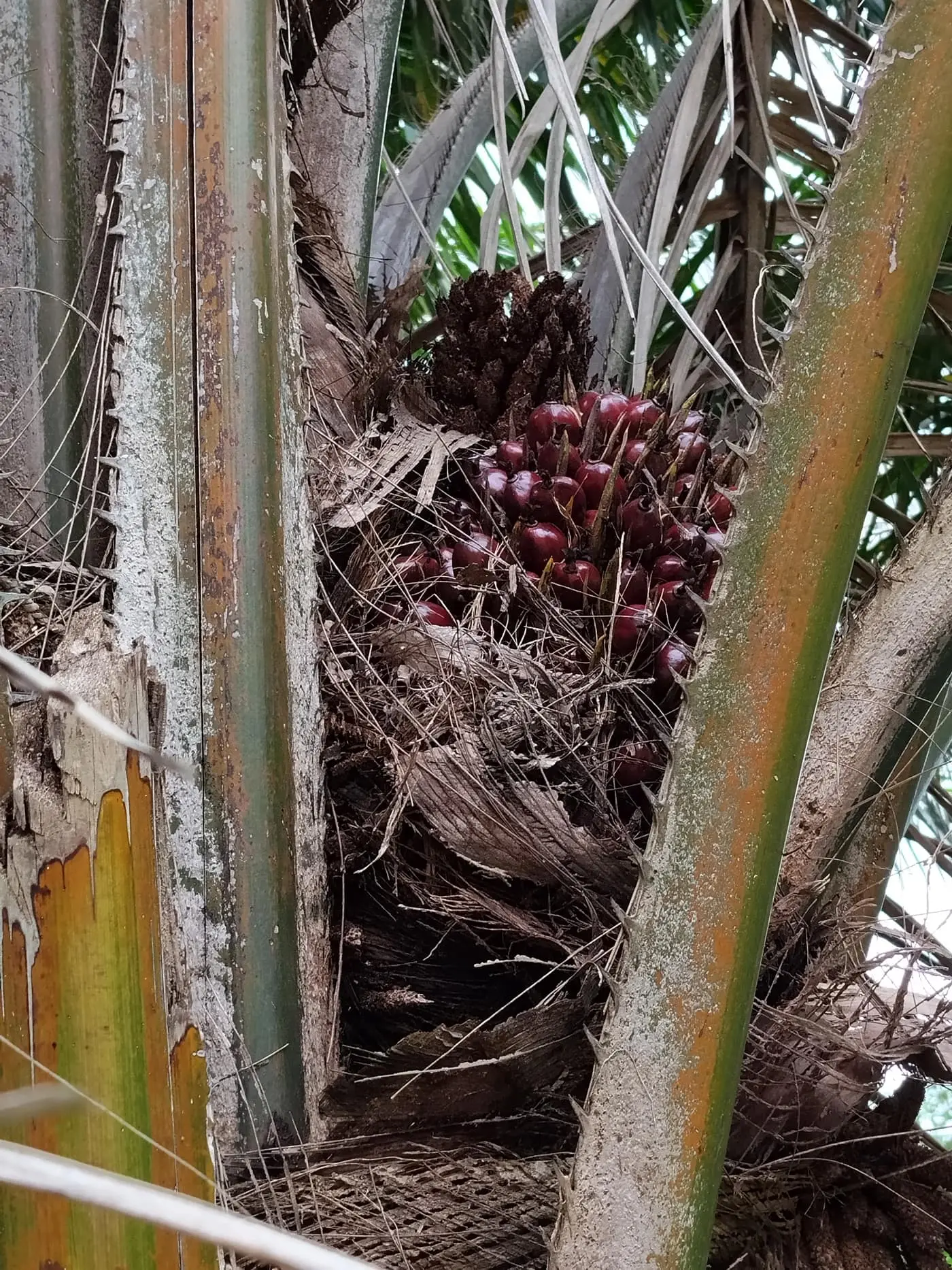
Harvest bunches at the right ripeness on a strict 10–15-day rotation throughout the year. A bunch is ready when a few loose fruits detach and fall naturally — the standard ripeness signal; under-ripe bunches give less oil, over-ripe ones raise free-fatty-acid and are penalised at the mill. Cut the bunch with a chisel (young palms) or a curved sickle on a pole (tall palms) and move it to the mill within about a day.
Signs it is ready
- A few loose, ripe fruits detaching and falling from the bunch naturally
- Fruit skin coloured up (orange-red) for the type
- Bunch at the right stage on the 10–15-day harvest round, not left to over-ripen
- Transport and mill delivery arranged within ~24 hours of cutting
Tools
- A chisel for low, young palms; a curved harvesting sickle on a pole for tall palms
- A hook or spike to move the heavy bunches
- Transport to get the FFB to the mill within about a day
Expected yield
Builds from the first harvest to a full-bearing 20–30 tonnes of fresh fruit bunches per hectare per year under good irrigation and nutrition — equivalent to roughly 4–5 tonnes of oil per hectare, several times any other Indian oilseed.
Post-harvest & storage
Storage
Fresh fruit bunches are not stored on-farm — they begin losing oil quality (rising free fatty acids) within hours of cutting and must reach the mill within about 24 hours. Oil palm has essentially no farm-level storage step; the value chain is harvest-to-mill.
Packaging
Bunches are moved loose in bulk — in trailers, trucks or carts — straight from field to collection point to mill; there is no graded packing step at the farm.
Transportation
Prompt transport to the processing mill is critical; delay directly downgrades the oil. This is why plantations are sited within economic haulage of a mill, and why NMEO-OP ties expansion to mill capacity.
Shelf life
Effectively measured in hours for the fresh bunch — the crop's value is preserved only by quick milling, not by storage.
Market prices
Today's mandi price near you, pulled live from the government's own Agmarknet data.
Live daily mandi prices from the government Agmarknet dataset.
Government mandi price not available for this crop
This crop is not traded through APMC mandis covered by the government’s Agmarknet system, so there is no mandi price to show here.
Weather
Current conditions and a 5-day outlook for your selected location, with one line of stage-aware advice.
Pick your state for current conditions and a 5-day outlook.
Live data from Open-Meteo
Profit calculator
Your own cost sheet, expected yield and selling price — not ours.
Where the money goes
Share of the total cost per acre, using the calculator’s own default cost sheet below — adjust the numbers there to match your field and this picture will no longer apply to you exactly, but the ranking rarely changes.
- Labour24% (₹10,000)
- Fertiliser19% (₹8,000)
- Land rent19% (₹8,000)
- Irrigation14% (₹6,000)
- Seed7% (₹3,000)
- Interest7% (₹3,000)
- Machinery5% (₹2,000)
- Pesticide & weedicide4% (₹1,500)
Official downloads
Government and ICAR documents only — everything below is hosted on an official server.
ICAR-IIOPR, Pedavegi
Indian Institute of Oil Palm Research — tenera hybrids, agronomy and package of practices
NMEO-OP (Department of Agriculture & Farmers Welfare)
National Mission on Edible Oils–Oil Palm: support, FFB price mechanism and state programmes
National Horticulture Board (NHB)
Oil palm area-expansion and planting-material guidance
Kisan Call Centre — 1800-180-1551
Free crop advice in your language
Frequently asked questions
How long before an oil palm starts giving a harvest, and how long does it live?
It is a long commitment. An oil palm gives no harvestable fruit for about the first four years (the gestation period), during which growers earn from inter-crops grown between the young palms and from NMEO-OP maintenance support. It reaches full bearing from around year eight and crops for 25–30 years in all. This is why financial staying power through the early years is as important as the agronomy.
Is oil palm a drought-hardy crop I can grow on dry land?
No — this is the most common and most expensive misunderstanding. Oil palm is a thirsty crop: a mature palm can need 150–300 litres of water a day in peak summer, and a dry season without irrigation slashes the bunch crop. It is grown under assured drip or basin irrigation in India, and a plot without secure year-round water is simply the wrong place for it, however warm the climate.
Why does oil palm need a mill nearby before I can plant it?
Harvested fresh fruit bunches start losing oil quality within hours and must be processed within about 24 hours of cutting. There is no farm-level storage and no open mandi you can carry the bunches to — the crop goes straight to a processing mill under a mill-linked system. So oil palm is only planted where a company mill is within economic reach, and NMEO-OP ties area expansion to mill capacity for exactly this reason.
What planting material should I use — and why does "tenera" matter?
Always a genuine tenera (Dura × Pisifera) hybrid seedling from an authorised source such as ICAR-IIOPR, a state programme or a company nursery under NMEO-OP. The tenera cross gives the thin-shelled, high-oil fruit the whole crop depends on; a Dura, a Pisifera or unverified seed yields far less oil, and because the mistake only shows up after four years of gestation, it is a 25-year error. Godavari Ratna and IIOPR's own hybrids are Indian options alongside imported tenera seed.
Which nutrient matters most for oil palm?
Potassium, by a wide margin — oil palm removes and needs more potassium than almost any other nutrient, and it directly drives bunch number, size and oil content. Most Indian soils are short of potassium for this crop, so a full potassium dose, plus magnesium and boron, and recycling the empty fruit bunches and pruned fronds back around the palm, are central to good yields.
Does oil palm have an MSP or a mandi price?
Oil palm fresh fruit bunches are not traded on APMC mandis and have no MSP in the usual sense. Instead, under NMEO-OP, the government notifies a formula-based price for the fresh fruit bunches linked to the crude palm oil price (the "viability price" mechanism), and growers sell directly to the processing company/mill at that price. Check the current FFB price notified for your state under NMEO-OP rather than looking for a mandi rate.
Still have questions?
The FAQs above cover the common ones. For anything specific to your field and soil, your nearest Krishi Vigyan Kendra is the authoritative answer.