
Jute
Corchorus olitorius
Jute — India's "golden fibre" — is decided twice: once in the field, where sowing date, spacing and thinning set stalk quality, and once after cutting, in the retting tank. Fifteen to twenty days submerged in clean, still water turns cut stalks into bright golden, top-grade fibre; the same stalks left in dirty, stagnant or fast-flowing water come out dark, weak and low-grade — retting water quality swings a farmer's price more than anything done before the crop is even cut.
Quick Summary
The key points from this page in about two minutes — read it or have it read aloud.
Quick Summary
Jute, India’s "golden fibre", is a crop decided twice. Once in the field — where the sowing date, the spacing and the thinning set the quality of the stalk — and once after cutting, in the retting tank. Retting is the controlled rotting of the cut stalks in water, and its outcome swings a farmer’s price more than anything done while the crop is standing: fifteen to twenty days in clean, still water turns stalks into bright, golden, top-grade fibre, while the same stalks left in dirty, stagnant or fast-flowing water come out dark, weak and heavily discounted.
The plant itself is straightforward. It is grown almost entirely on the fertile floodplains of West Bengal, Bihar and Assam, sown just ahead of the monsoon so it is established when the heavy rain arrives, and it then climbs fast on warmth, humidity and steady moisture. Two species go by the same name: tossa jute, the dominant type today, faster-growing and finer-fibred, and white jute, the older, hardier one that suits low-lying land where tossa struggles. Both are grown and priced the same way.
After sowing, the one labour-critical job is the combined weeding-and-thinning that fixes the plant spacing. Cut the crop close to the ground at the small-pod stage — the balance point between fibre quantity and fineness — then ret it, strip the fibre by hand in the water, wash it and sun-dry it before grading and baling. The page below carries the sowing window, the spacing and thinning, nutrient doses, the cutting stage, the full retting and fibre-extraction method, and fibre yields and MSP.
- Crop type
- Cash crop (bast fibre)
- Season
- Kharif (pre-monsoon sown)
- Suitable states
- 6 major states
- Growing duration
- 100–120 days, sowing to cutting
- Water requirement
- Moderate in field; retting needs 15–20 days in standing water
- Temperature
- 24–37°C, with high humidity
- Soil type
- Fertile alluvial loam, tolerant of later waterlogging
- Difficulty level
- Moderate
- Expected yield
- 20–25 q/ha fibre
- MSP (JMS 2026–27)
- ₹5,925 / quintal (raw jute, TD-3 grade)
Overview
Jute is India's other great fibre crop after cotton, and the one that earned the country the nickname "the golden fibre capital of the world." It is grown on close to 0.7 million hectares, almost entirely as a kharif crop of the Ganga–Brahmaputra floodplain, with West Bengal alone accounting for roughly three-quarters of national output — Bihar and Assam follow at a distance, with smaller pockets in Odisha, Meghalaya and Tripura.
Two closely related species are grown under the same name. Tossa jute (Corchorus olitorius) is the dominant type today — faster-growing, higher-yielding and prized for finer, more lustrous fibre — while white jute (Corchorus capsularis) is the older, hardier type, better suited to low-lying or slightly waterlogged land where tossa struggles. Both are sown, thinned, cut and retted the same way, and both are traded and priced on the same TD grading scale.
Unlike almost any other crop on this site, jute's market value is set as much after the harvest as during it. The plant itself just needs a warm, humid, pre-monsoon start and a fertile floodplain soil to grow tall fast; what actually separates a golden, top-grade bale from a dark, discounted one is retting — the controlled rotting of cut stalks in water — done right or done carelessly. This page follows the crop in the order you will actually meet it: land, seed, sowing, nutrition, water, protection, cutting, and — at length — retting and fibre extraction.
Crop timeline, sowing to harvest
A quick visual map of the season — jump to any section below for the detail behind each stage.
- Day 0
Sowing
Line-sown 2–3 cm deep at 30 cm row spacing once pre-monsoon soil moisture allows, from mid-March into April.
- Day 10–15
Germination
Seedlings emerge within a week to ten days in warm, moist soil; gaps are noted here for early gap-filling.
- Day 20–35
Weeding-cum-thinning
Excess seedlings pulled to a final 7–8 cm plant-to-plant spacing, usually combined with the first hand weeding as one operation — jute's single most labour-critical step after sowing.
- Day 35–90
Vegetative growth
Rapid height gain through the monsoon, often 5–8 cm a day at peak — the crop can add over a metre a month once established, feeding off warmth, humidity and steady soil moisture.
- Day 100–120
Cutting (small-pod stage)
Stalks cut close to the ground with a sickle once most plants reach the small-pod (early-flowering) stage — the balance point between fibre quantity and fibre fineness.
- Day 120–140
Retting
Bundled stalks submerged in clean, still water for 15–20 days while microbial action rots away the gummy tissue binding fibre to the woody core — the step that decides the fibre's final grade and colour.
- Day 140–145
Fibre extraction
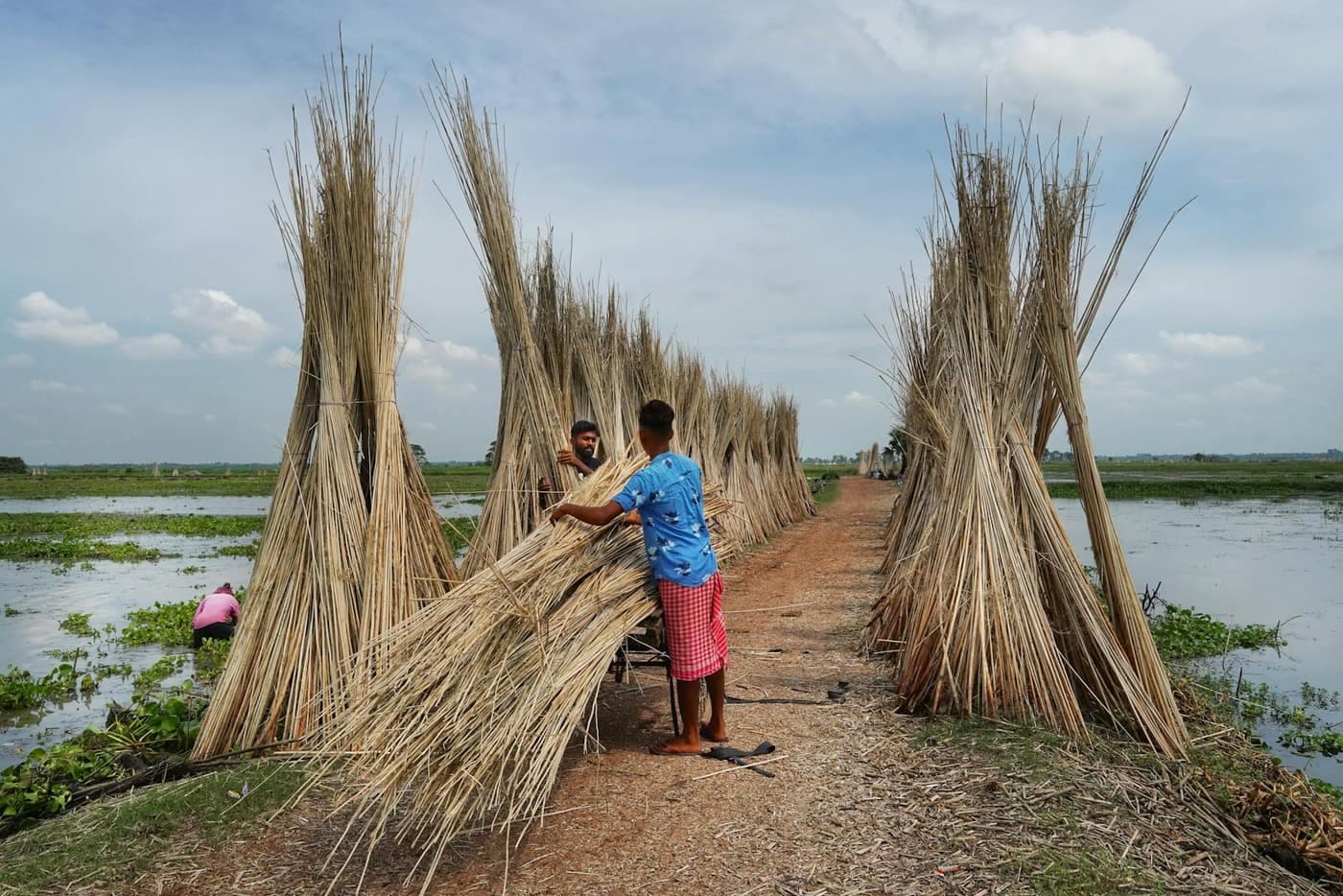
Fully retted fibre stripped from the core by hand in the water, washed clean, then sun-dried on bamboo frames or ropes before grading and baling.
Suitable states
States where this crop is grown at scale, highlighted below. Your local Krishi Vigyan Kendra is still the final word for your specific block.
- Jammu and Kashmir
- Himachal Pradesh
- Punjab
- Uttarakhand
- Haryana
- Delhi
- Uttar Pradesh
- Rajasthan
- Bihar
- Jharkhand
- West Bengal
- Sikkim
- Assam
- Arunachal Pradesh
- Meghalaya
- Nagaland
- Manipur
- Mizoram
- Tripura
- Gujarat
- Madhya Pradesh
- Chhattisgarh
- Maharashtra
- Odisha
- Goa
- Telangana
- Andhra Pradesh
- Karnataka
- Kerala
- Tamil Nadu
- Puducherry
- Ladakh
- Chandigarh
- Lakshadweep
Grown here
Climate requirements
Jute is sown in the dry, warming weeks just before the monsoon so the crop is already established by the time the heavy rains and later floodwaters arrive — sowing too early into cold, dry soil gives poor germination, and sowing too late compresses the vegetative window and pushes cutting into the wettest, most disease-prone weeks of the monsoon.
Ideal temperature
24–37°C through the growing season; germination and early growth are fastest in warm soil above 25°C, and growth stalls below about 20°C
Rainfall
1,000–1,500 mm well distributed through the season suits the crop best; jute is sown just ahead of the monsoon specifically so establishment and early growth are already underway when the heavy rains arrive
Humidity
High humidity (70–90%) through the growing season favours the rapid height gain jute is known for, though the same warm, humid conditions also favour several of its foliar diseases
Sunlight
Full sun through vegetative growth; the crop grows fastest and tallest, and gives the finest fibre, when heat, humidity and day length all peak together in the monsoon months
Soil requirements
This is one of the few crops on this site where standing water late in the season is not automatically bad news — a shallow, controlled flood after establishment is part of how the Bengal delta grows tall, dense jute, and the same nearby ponds, ditches and slow river channels are what the crop is later retted in.
Suitable soil
New, fertile alluvial loam of the Ganga–Brahmaputra floodplain is classic jute country — silty and rich from annual flood deposits, unlike almost any other crop on this site, jute actually benefits from land that floods after the crop is well established
pH range
6.0–7.5, with reasonable tolerance either side on the fertile alluvium jute is usually grown on
Drainage
Well-drained is important only at germination and early establishment; once the crop is 3–4 weeks old and rooted, it tolerates and even benefits from the seasonal waterlogging or shallow flooding common on the Bengal delta — a very different profile from most field crops
Organic matter
Medium to high — the annual silt deposit on floodplain fields does much of this work for free, though fields further from the river benefit from farmyard manure or compost worked in ahead of sowing
Land preparation
Same four steps whichever region you are in — only the timing shifts with the sowing window.
- 1
Deep ploughing and harrowing
Two to three ploughings followed by harrowing and planking break the soil to a fine, clod-free tilth — jute's seed is small and sown shallow, so a rough seedbed directly costs germination.
- 2
Levelling
Careful levelling matters more here than on most crops: an uneven field pools irrigation or early rain unevenly, giving the patchy germination that is one of the most common jute establishment failures.
- 3
FYM or compost incorporation
Working 8–10 tonnes/ha of well-rotted farmyard manure or compost into the final ploughing builds fertility on fields away from the immediate floodplain, where annual silting does less of the work.
- 4
Final harrowing before sowing
A last, light harrowing just ahead of sowing settles the seedbed and firms it enough for even, shallow seed placement.
Seed information
How the main varieties compare, so you can pick by duration, yield, disease pressure or what you are growing for.
| Variety | Duration | Yield | Disease resistance | Best state | Suitable for |
|---|---|---|---|---|---|
A tossa jute (Corchorus olitorius) release recommended for early sowing — tossa gives finer, higher-value fibre than white jute, which is why it now covers most of India's jute area. | 100–120 days | 25–30 q/ha dry fibre | Tolerant to root & stem rot and anthracnose | West Bengal, Bihar, Assam | Early sowing, tossa fibre |
A tossa jute (Corchorus olitorius) release — the 'JBO' prefix marks CRIJAF's tossa releases. Recommended for late sowing because of its bred-in resistance to premature flowering, not because of any special waterlogging tolerance. | 100–120 days | 25–30 q/ha dry fibre | Tolerant to root & stem rot and anthracnose | West Bengal, Bihar, Odisha | Late sowing, premature-flowering resistance |
The most widely grown tossa (Corchorus olitorius) variety in India, bred at CRIJAF from an African × indigenous cross — dependable, high-yielding and the benchmark against which newer tossa releases are measured. | 120–130 days | 32–40 q/ha fibre under good management | Reasonable field resistance to root rot, plus yellow-mite tolerance; no strong bred-in resistance to other diseases | West Bengal, Bihar, Assam | Main-season sowing (mid-March to April), general cultivation |
A high-yielding tossa variety with non-shattering pods and good TD-2-grade fibre quality, suited to slightly later sowing than JRO-524. | 115–125 days | 35–40 q/ha fibre | No specific bred-in resistance — standard exposure to stem rot and leaf spot | West Bengal, Bihar, Odisha | Mid-April to early-May sowing, fine-fibre premium |
An early-sowing tossa variety resistant to premature flowering, which lets it be sown as early as mid-March without bolting before the stalk has bulked up. | 110–120 days | 35–40 q/ha fibre | Bred-in tolerance to premature flowering under early sowing | West Bengal, Assam | Early (mid-March) sowing window |
An early-maturing white jute (Corchorus capsularis) variety suited to low-lying land and early rainfall, sown February–March. | 100–115 days | 18–22 q/ha fibre | Good field tolerance to waterlogged, low-land conditions | West Bengal, Assam, Bihar (low-lying tracts) | Low-land, early sowing |
A white jute variety suited to late sowing on middle to high ground, sown March–April where tossa is less reliable. | 110–125 days | 25–28 q/ha fibre | Standard exposure — no specific bred-in resistance | West Bengal, Bihar (upland tracts) | Late sowing, middle-to-high ground |
- Seed rate
- 5–7 kg/ha for line sowing; broadcasting needs more, typically 7–8 kg/ha, to compensate for the uneven stand it gives. Tossa (Corchorus olitorius) seed is slightly finer and needs marginally less than white jute (Corchorus capsularis) at the same spacing.
- Certified seed
- Use fresh, certified seed with germination above 80% — jute seed loses viability faster than most cereal seed, so seed held over more than a year should be germination-tested before sowing rather than assumed good.
- Spacing
- 30 cm row-to-row; thinned to 7–8 cm plant-to-plant by 30–35 days after sowing
- Seed treatment
- Treat seed with a fungicide such as carbendazim or thiram before sowing to protect against seedling-stage stem rot, which can appear as early as the first few weeks in warm, wet soil.
Sowing guide
Jute seed is small and sown shallow, so seedbed quality does most of the work at this stage — a fine, level, moist seedbed gives quick, even germination, while a cloddy or dry one gives the patchy stand that no amount of later management can fully fix.
- Best time
- Mid-March to April, once pre-monsoon soil moisture allows — sowing depends on the first useful pre-monsoon showers rather than a fixed calendar date, since dry soil gives poor, patchy germination
- Row spacing
- 30 cm
- Plant spacing
- 7–8 cm after thinning
- Sowing depth
- 2–3 cm
- Method
- Line sowing behind a seed drill or country plough, seed dropped in shallow furrows and lightly covered; broadcasting is still common on smaller holdings but line sowing gives a more even stand, easier weeding-cum-thinning, and consistently higher fibre yield
Fertilizer schedule
A split dose beats one large dose applied at sowing — nitrogen especially is lost to the air and to leaching if it all goes in on day one.
- 1
Basal dose
At final land preparation, before sowing
Full phosphorus and potash plus about half the nitrogen — a widely used recommendation is around 60:30:30 kg/ha N:P₂O₅:K₂O, adjusted to soil-test results — worked into the last ploughing.
- 2
First top dressing
At weeding-cum-thinning, 20–25 days after sowing
About a quarter of the total nitrogen, applied right after thinning when the retained plants can use it fully without competition from the seedlings just removed.
- 3
Second top dressing
35–40 days after sowing
The remaining nitrogen, applied during the fastest phase of vegetative growth to sustain the height gain that builds fibre yield.
Irrigation schedule
1. Germination and establishment
Sowing to 20–25 days
A light irrigation at sowing if the pre-monsoon showers were thin, to ensure even germination through this moisture-sensitive window.
2. Vegetative growth
25–90 days after sowing
Once the monsoon sets in, natural rainfall usually meets the crop's needs; a supplementary irrigation in a dry spell during peak growth protects the height gain that sets fibre yield.
3. Pre-cutting
90–120 days after sowing
Irrigation is rarely needed here in a normal monsoon year; moisture stress this late mainly affects stalk uniformity rather than final fibre quality.
Critical stages
- Germination and establishment (0–25 days) — the most moisture-sensitive window of the whole crop
- Peak vegetative growth (30–90 days) — a dry spell here directly caps final stalk height and fibre yield
Water-saving tips
- Jute is largely a rainfed, monsoon-season crop once established — most fields need no more than one or two supplementary irrigations even in a below-normal monsoon year
- Time sowing to the first reliable pre-monsoon showers rather than irrigating a dry field early, which saves both water and the diesel or electricity cost of pumping
- Keep retting water separate from irrigation planning — a clean pond or slow channel reserved for retting is worth more to the final price than any amount of extra field irrigation
Weed management
Common weeds
Organic control
- Weeding-cum-thinning combined as a single operation at 20–25 days after sowing is jute's standard practice and usually the single biggest weed-control step of the season
- A second hand weeding at 35–40 days, before the canopy closes and shades weeds out on its own, is enough on most well-managed fields
- A stale seedbed before sowing knocks down the first weed flush cheaply where herbicide use is being minimised
Chemical control
- Pre-emergence: pendimethalin or fluchloralin applied within 2–3 days of sowing controls the early weed flush during establishment
- Post-emergence grass control where needed, applied carefully since jute seedlings are sensitive in the first few weeks
Nutrient deficiency identification
What a shortage of each nutrient actually looks like on the plant, so you can tell a deficiency apart from a disease before you spray the wrong thing.
Nitrogen
Visible symptom
Pale, yellowing older leaves and slowed height gain — since fibre yield tracks stalk height and girth closely, a nitrogen shortfall shows up directly in the final bale weight.
Phosphorus
Visible symptom
Dark green, stunted seedlings with weak, poorly developed root systems and delayed early growth.
Potassium
Visible symptom
Yellowing and scorching of leaf margins, with thinner, weaker stalks that lodge more easily in wind and heavy rain.
Sulphur
Visible symptom
Pale, yellowish younger leaves and generally slowed growth, most noticeable on light soils cropped intensively without organic manure.
Zinc
Visible symptom
Yellow striping between the veins of younger leaves and shortened internodes, most common on light, deficiency-prone soils away from the immediate floodplain.
Diseases to watch for
Symptoms, likely cause and what actually treats it — not just a spray name.
Stem Rot
- Symptoms
- Blackish streaks on the stem base at the seedling stage; on mature plants, buff-to-black lesions on leaves and petioles followed by dark brown to black lesions at the nodes that spread along the stem until the cortex shreds and fibres are exposed.
- Cause
- Fungus Macrophomina phaseolina, the single most damaging jute disease in India, favoured by warm, humid weather and worsened by close, overcrowded stands.
- Treatment
- Remove and destroy badly affected plants promptly; a recommended fungicide spray at first appearance can slow spread in a standing crop, though there is no full in-season cure.
- Prevention
- Treat seed before sowing, avoid overcrowded stands by thinning on time, and rotate out of jute for a season on fields with a heavy history of the disease.
Black Rot (Root and Collar Rot)
- Symptoms
- Blackening and rotting at the collar and root region, with affected plants wilting and dying in patches, often first visible as scattered dead or dying plants in an otherwise healthy stand.
- Cause
- Fungus Botryodiplodia theobromae and related soil fungi, favoured by waterlogged or poorly drained conditions at germination and early establishment.
- Treatment
- Remove and destroy affected plants; no effective in-season chemical cure once the collar is rotted.
- Prevention
- Ensure the seedbed drains well at germination even though the mature crop later tolerates waterlogging, treat seed before sowing, and avoid sowing into fields that pooled water after the previous rain.
Cercospora Leaf Spot
- Symptoms
- Small, brown, roughly circular spots scattered across the leaf surface that can merge and cause premature leaf drop in a heavy attack.
- Cause
- Fungus Cercospora corchori, favoured by warm, humid weather typical of the monsoon growing season.
- Treatment
- Spray a recommended fungicide such as mancozeb where the attack is heavy enough to threaten leaf area during peak vegetative growth.
- Prevention
- Avoid overcrowded stands, ensure timely thinning for airflow, and rotate out of jute on fields with a repeated history.
Anthracnose
- Symptoms
- Small, sunken, dark brown to black lesions on leaves, stems and pods, which can girdle young stems and weaken the plant at the point of infection.
- Cause
- Fungus Colletotrichum corchori, spread by rain-splash and favoured by wet, humid conditions, and also carried on infected seed.
- Treatment
- Spray a recommended fungicide at first appearance where the attack is spreading through the field.
- Prevention
- Use treated, disease-free seed, avoid overcrowding, and rotate out of jute on fields with a known history.
Corchorus Golden Mosaic
- Symptoms
- Bright yellow mosaic mottling on leaves, with affected plants showing stunted growth and reduced fibre quality.
- Cause
- A whitefly-transmitted virus; incidence tracks whitefly populations through the season.
- Treatment
- Remove and destroy severely affected plants to limit the source of further spread; manage the whitefly vector rather than the virus directly.
- Prevention
- Control whitefly populations early in the season and avoid staggered sowing dates near infected fields, which lets the virus and its vector carry over between plantings.
Pests to watch for
What to look for before the damage is visible, and organic options before you reach for a chemical.
Jute Semilooper
- Identification
- Green, looping caterpillars of the moth Anomis sabulifera, found on the underside of leaves; eggs are laid singly on young leaves and hatch into caterpillars that feed on apical leaves and buds.
- Damage
- Heavy feeding on the growing tip and young leaves stunts height gain during the exact window that sets final fibre yield, and repeated defoliation can force plants to branch, which spoils stalk quality.
- Organic control
- Hand-picking caterpillars in light infestations, conserving natural parasitoids and predators by avoiding unnecessary early sprays, and light traps to monitor and reduce adult moth numbers.
- Chemical control
- A recommended insecticide spray once damage crosses the economic threshold on a meaningful share of plants, timed to early instars for best control.
Bihar Hairy Caterpillar
- Identification
- Densely hairy, dark brown to black caterpillars of the moth Spilosoma (Spilarctia) obliqua, often seen feeding gregariously in large numbers on leaves early in an outbreak before dispersing.
- Damage
- A sudden, heavy outbreak can strip a field of leaves within days, sharply cutting the photosynthetic area the crop needs during peak vegetative growth.
- Organic control
- Collecting and destroying egg masses and young gregarious larvae before they disperse is highly effective while colonies are still concentrated; light traps help monitor adult moth activity.
- Chemical control
- A recommended insecticide spray targeted at young larvae while they are still clustered gives the best control before the population spreads across the field.
Jute Stem Weevil (Apion corchori)
- Identification
- A tiny grey-black weevil; adult females bore into young seedlings through the apical portion of the stem to lay eggs, and the grubs feed inside the stem on the vascular bundles after hatching.
- Damage
- Damage inside the growing tip stunts or kills the seedling outright, and surviving plants often develop weak, forked stems that give patchy, lower-grade fibre at harvest.
- Organic control
- Timely sowing and vigorous early growth reduce the seedling-stage window the weevil exploits; removing and destroying visibly wilted or damaged seedlings limits carryover.
- Chemical control
- A recommended seed treatment or early-stage insecticide spray where the weevil is a known problem in the area, since damage inside the stem is hard to reach once established.
Yellow Mite
- Identification
- Microscopic mites, Polyphagotarsonemus latus, not visible to the eye; infested young leaves become crumpled with the leaf lamina curling backward along the midrib and turning a coppery-bronze colour under a heavy population.
- Damage
- A heavy infestation stunts the growing tip and reduces both height gain and fibre quality, and thrives in exactly the warm, humid conditions that otherwise favour fast jute growth.
- Organic control
- Conserving natural predatory mites by avoiding unnecessary broad-spectrum sprays, and removing and destroying badly affected patches to slow spread within the field.
- Chemical control
- A recommended acaricide spray where infestation is heavy and spreading, since ordinary insecticides give poor control of mites.
Common mistakes to avoid
The mistakes that cost growers the most, ranked by how often they show up in the field — not in the order you might expect.
- 1
Retting in dirty, stagnant-polluted or fast-flowing water instead of clean, still water
Why it hurts
This single choice decides more of the final price than anything done in the field — clean, still water gives bright golden, top-grade fibre, while dirty or fast-flowing water gives dark, weak, low-grade fibre that sells at a steep discount.
- 2
Cutting too late, after the pods have hardened
Why it hurts
Overmature stalks give coarse, woody, harsh fibre that grades down at the mandi, even when the retting itself is done well.
- 3
Cutting too early, before the small-pod stage
Why it hurts
Immature stalks give thin, weak fibre with poor tensile strength and a real loss in total fibre weight per bundle.
- 4
Skipping or delaying weeding-cum-thinning
Why it hurts
An overcrowded stand from unthinned broadcast or thick line sowing gives thin, spindly, uneven stalks, higher disease pressure, and a lower-grade, less uniform fibre lot at retting.
- 5
Under-retting — pulling stalks out before the fibre fully separates
Why it hurts
Fibre stays partly stuck to the woody core, giving poor extraction, patches of unseparated bark, and a lower recovery percentage from the same bundle.
- 6
Over-retting — leaving stalks in the water too long
Why it hurts
Fibre loses tensile strength and becomes weak and discoloured, undoing weeks of good field management in the final step.
- 7
Poor seedbed preparation or uneven land levelling
Why it hurts
Patchy, uneven germination in low or cloddy spots leaves gaps that rarely fill in on their own and cap the field's yield from the very start.
- 8
Sowing before the soil has adequate pre-monsoon moisture
Why it hurts
Sowing into dry soil on a fixed calendar date rather than waiting for the first useful shower gives poor, patchy germination and often forces a costly re-sowing.
- 9
Skipping thorough washing after stripping the fibre
Why it hurts
Residual pith, mucilage and slime left on unwashed fibre darken its colour and lower its grade, even when the retting itself was done correctly.
- 10
Bundling stalks too thick or tight for retting
Why it hurts
Water and microbial action reach the outer layers of an oversized bundle faster than the core, giving uneven, patchy retting within the same bundle and a mixed-grade fibre lot.
Harvesting
When most plants in the field reach the small-pod stage — flower buds just forming or small green pods just set — usually 100–120 days after sowing; this is a deliberate balance point, since cutting later adds a little more fibre weight but at the cost of coarser, harsher fibre, and cutting earlier gives fine fibre but less of it.
Signs it is ready
- Small green pods (or early flower buds) visible on most plants in the field
- Plant height typically 2.5–4 metres, with the lower stem base turning slightly woody
- Lower leaves beginning to yellow and shed, a sign the plant is moving past peak vegetative growth
Tools
- A sharp sickle, cutting stalks close to the ground to capture the full stalk length in fibre
- Leaves are often stripped from the cut stalks in the field before bundling — defoliation speeds retting and the shed leaves return organic matter to the soil
- Cut stalks bundled promptly and moved to the retting site rather than left lying in the field, where delay before retting can itself lower final fibre quality
Expected yield
20–25 quintals per hectare of fibre under normal management; well-managed fields sown on time with a high-yielding variety and low-density spacing can reach 25–28 q/ha.
Post-harvest & storage
Storage
Post-harvest processing for jute is retting, not storage in the usual sense — the whole crop's market value is decided here. Bundled stalks (leaves stripped first where practical) are fully submerged in clean, still or very slow-moving water — a pond, ditch or backwater kept aside for the purpose — weighted down with logs or stones so no part is exposed to air, and left for 15–20 days depending on water temperature. Growers periodically test a stalk by peeling back the bark; retting is complete once the fibre separates cleanly from the woody core along the full stalk length. Retted stalks are then stripped by hand in the water — workers beat and peel the bark away from the core — and the raw fibre is washed thoroughly in clean water to remove residual pith and mucilage, since washing quality shows directly in the final colour grade.
Packaging
Washed fibre is hung to dry on bamboo frames, poles or ropes in the open sun for two to three days until moisture drops to a safe level, then graded by colour, strength and length against the TD (trade description) scale before being pressed into bales for sale.
Transportation
Dried, graded fibre is baled and transported to the local mandi, a jute mill, or a Jute Corporation of India procurement centre; fibre must be fully dry before transport and baling, since residual moisture invites fungal damage and colour loss in transit or storage.
Shelf life
Properly dried and graded fibre stores for a year or more in a dry, ventilated godown; the main risk in storage is moisture regain, which invites fungal staining and weakens the fibre — the same enemy that undoes careless retting shows up again if dried fibre is stored damp.
Market prices
Today's mandi price near you, pulled live from the government's own Agmarknet data.
Live daily mandi prices from the government Agmarknet dataset.
Synced from data.gov.in (Agmarknet). Rates are ₹ per quintal.
Weather
Current conditions and a 5-day outlook for your selected location, with one line of stage-aware advice.
Pick your state for current conditions and a 5-day outlook.
Live data from Open-Meteo
Profit calculator
Your own cost sheet, expected yield and selling price — not ours.
Where the money goes
Share of the total cost per acre, using the calculator’s own default cost sheet below — adjust the numbers there to match your field and this picture will no longer apply to you exactly, but the ranking rarely changes.
- Labour35% (₹9,000)
- Land rent35% (₹9,000)
- Fertiliser10% (₹2,500)
- Machinery8% (₹2,000)
- Pesticide & weedicide6% (₹1,500)
- Seed3% (₹700)
- Interest3% (₹700)
- Irrigation2% (₹500)
Official downloads
Government and ICAR documents only — everything below is hosted on an official server.
ICAR-CRIJAF — Central Research Institute for Jute and Allied Fibres, Barrackpore
Package of practices, variety recommendations and retting advisories from the ICAR institute mandated for jute and allied fibre crops.
Farmer Portal — crop advisories
Government of India's farmer portal, including season-specific advisories and market information.
Soil Health Card portal
Get a free, crop-wise fertilizer recommendation before finalising the fertilizer schedule above.
mKisan — SMS advisory portal
Register for free SMS advisories timed to your crop stage and district.
Frequently asked questions
When should I sow jute?
Mid-March into April, once pre-monsoon soil moisture allows. Sowing depends on the first useful pre-monsoon showers rather than a fixed calendar date — sowing into dry soil gives poor, patchy germination, while sowing too late compresses the vegetative window and pushes cutting into the wettest, most disease-prone weeks of the monsoon.
How much seed do I need per hectare?
5–7 kg/ha for line sowing, or 7–8 kg/ha if broadcasting, which needs more seed to compensate for the uneven stand it gives. Tossa (Corchorus olitorius) seed is slightly finer than white jute (Corchorus capsularis) and needs marginally less at the same spacing.
What is the current MSP for jute?
₹5,925 per quintal for raw jute (TD-3 grade), for the Jute Marketing Season (JMS) 2026–27, as approved by the Cabinet Committee on Economic Affairs — an increase of ₹275 per quintal over 2025–26's ₹5,650. MSP is revised every jute marketing season, so check the current notification before selling.
What does "TD-3 grade" mean?
TD stands for Trade Description — jute's standard fibre-quality grading scale, running from the finest (TD-1) down through coarser grades, based on colour, strength, lustre and cleanliness. TD-3 is the benchmark mid-grade the government uses to set and announce MSP each season; better-retted fibre grades higher than TD-3 and fetches a premium above MSP, while poorly retted fibre grades lower and sells at a discount.
Why does retting water quality matter so much?
Retting is the controlled rotting of cut stalks in water that separates fibre from the woody core, and it is what actually determines the fibre's colour and grade — not anything done in the field. Clean, still water gives bright, golden, top-grade fibre; dirty, polluted or fast-flowing water gives dark, weak, low-grade fibre that sells at a steep discount, even from an otherwise well-grown crop. This is why growers deliberately set aside a clean pond, ditch or slow backwater for retting rather than using whatever water is nearest.
How long should I ret jute stalks, and how do I know it's done?
Usually 15–20 days, depending on water temperature — warmer water retts faster. Check periodically by peeling back the bark on a test stalk; retting is complete once the fibre separates cleanly from the woody core along the full stalk length. Pulling stalks out too early (under-retting) leaves fibre stuck to the core, and leaving them too long (over-retting) weakens and discolours the fibre — both cost grade and price.
What happens if I under-ret or over-ret my jute?
Under-retted stalks give poor fibre extraction, with patches of bark that won't separate cleanly from the woody core, lowering the recovery percentage from each bundle. Over-retted stalks give fibre that has lost tensile strength and turned weak and discoloured. Both mistakes lower the final TD grade and the price the lot fetches, so testing a stalk periodically rather than retting on a fixed number of days is the safer approach.
When should I cut (harvest) jute, and what are the signs?
When most plants reach the small-pod stage — flower buds just forming or small green pods just set — usually 100–120 days after sowing. This is a deliberate balance point: cutting later adds a little fibre weight but coarsens the fibre, and cutting earlier gives finer fibre but less of it.
Should I grow tossa or white jute?
Tossa (Corchorus olitorius) — varieties like JRO-524 (Navin), JRO-66 and JRO-8432 — is the dominant choice today: faster-growing, higher-yielding and finer-fibred, and suits most upland and mid-land fields. White jute (Corchorus capsularis) — varieties like JRC-321 and JRC-212 — is the older, hardier type and remains the better choice on low-lying land that stays wet or lightly flooded longer than tossa tolerates well.
What yield can I realistically expect from jute?
20–25 quintals per hectare of fibre under normal management. Well-managed fields sown on time with a high-yielding variety, timely thinning and low-density spacing can reach 25–28 q/ha, per recent ICAR-CRIJAF trials on low-density sowing.
What fertilizer dose should jute get?
A widely used recommendation is around 60:30:30 kg/ha N:P₂O₅:K₂O, adjusted to your soil-test results. Apply full phosphorus and potash plus about half the nitrogen as a basal dose before sowing, roughly a quarter of the nitrogen at weeding-cum-thinning (20–25 days), and the rest at 35–40 days during peak vegetative growth.
How much irrigation does jute actually need?
Less than most kharif crops, since it is grown through the monsoon on the moisture-retentive Bengal delta. A light irrigation at sowing helps if the pre-monsoon showers were thin, and a supplementary irrigation during a dry spell in peak vegetative growth protects height gain — but once the monsoon sets in, rainfall usually covers the rest of the season.
Why are my jute leaves curling and turning a coppery colour?
This points to yellow mite (Polyphagotarsonemus latus), a microscopic pest that curls young leaves backward along the midrib and turns them coppery-bronze under a heavy population. Ordinary insecticides control mites poorly — use a recommended acaricide where infestation is heavy, and conserve natural predatory mites by avoiding unnecessary broad-spectrum sprays.
How do I identify stem rot early?
Look for blackish streaks near the stem base at the seedling stage, or buff-to-black lesions on leaves and petioles followed by dark, spreading nodal lesions on older plants — caused by Macrophomina phaseolina, the most damaging jute disease in India. There is no full in-season cure, so seed treatment, timely thinning to avoid overcrowding, and crop rotation on badly affected fields are the real defence.
Can I insure my jute crop, and does it qualify for PM-KISAN?
Jute is covered under PMFBY (Pradhan Mantri Fasal Bima Yojana) where it is in your state's notified crop list, with the farmer's premium capped at 2% of the sum insured as a kharif crop. PM-KISAN is not crop-specific — any eligible landholding farmer family qualifies. Check your state's seasonal notification and cut-off dates.
Where can I sell jute, and does MSP procurement actually happen?
Most raw jute is sold in the open market to local traders or mills, where the price often runs above MSP in a good season. Below MSP, the Jute Corporation of India (JCI) is the central government's nominated agency for MSP procurement of raw jute, buying at registered centres in the major producing states. The live mandi price on this page is the most useful real-time signal for deciding when and where to sell.
Still have questions?
The FAQs above cover the common ones. For anything specific to your field and soil, your nearest Krishi Vigyan Kendra is the authoritative answer.