
Curry Leaf (Kadi Patta)
Murraya koenigii
A hardy perennial shrub already growing in nearly every South Indian kitchen garden, now also a genuine commercial leaf-spice crop across Tamil Nadu, Andhra Pradesh, Karnataka and Gujarat — raised from fresh seed or, for named types, root suckers and cuttings, then cut back again and again through the year for its aromatic leaves rather than harvested once.
Quick Summary
The key points from this page in about two minutes — read it or have it read aloud.
Quick Summary
Curry leaf (Murraya koenigii) — kadi patta, karivepaku or karuveppilai depending on the region — is one of the most familiar plants in Indian farming: a small evergreen shrub of the citrus family grown almost everywhere for its aromatic leaves, used fresh in nearly every South Indian and Maharashtrian kitchen. Less familiar is that it has also become a real commercial spice-leaf crop, grown on dedicated blocks across Tamil Nadu, Andhra Pradesh, Karnataka, Kerala, Maharashtra and Gujarat, sold fresh in bundles at the vegetable market besides going into dehydrated leaf powder and essential oil.
Unlike a crop harvested once a season, curry leaf is cut-and-come-again: an established bush is pruned back hard every few months, and each pruning pushes out a fresh flush of tender leaf that is picked for sale, much like tea or moringa leaf. This is also why it can be planted two ways. Fresh seed suits large-scale nursery planting, but it loses its ability to germinate within weeks of ripening, so it must be sown fresh, never stored. Root suckers and stem cuttings from an established bush are the other route, and the only way to keep a named type true to its parent, since a seedling does not reproduce the parent exactly.
The plant is easy to grow — heat-tolerant, moderately drought-hardy once established, and not fussy about soil as long as water never stands around its roots. What most often cuts into leaf quality is a handful of sap-sucking pests, above all the same tiny psyllid that spreads citrus greening, and common fungal leaf spots and stem rots that build up fastest in humid, waterlogged conditions. Neither is hard to manage once recognised, and the crop rewards a farmer who prunes it hard and often with leaf, not fruit, for years on end.
- Crop type
- Perennial shrub (leaf spice)
- Season
- Perennial — leaf picked on a repeat cycle all year
- Suitable states
- Tamil Nadu, Andhra Pradesh, Karnataka, Kerala, Maharashtra, Gujarat
- First leaf harvest
- 8–12 months after planting (light picking)
- Propagation
- Fresh seed, or root suckers/stem cuttings for named types
- Water requirement
- Low to moderate; drought-tolerant but cannot stand waterlogging
- Temperature
- 20–35°C; frost and prolonged cold check growth badly
- Soil type
- Well-drained loam to sandy loam; not fussy on fertility
- Difficulty level
- Easy
- Expected yield
- Roughly 20–100 q/ha green leaf/year, rising as the bush matures
Overview
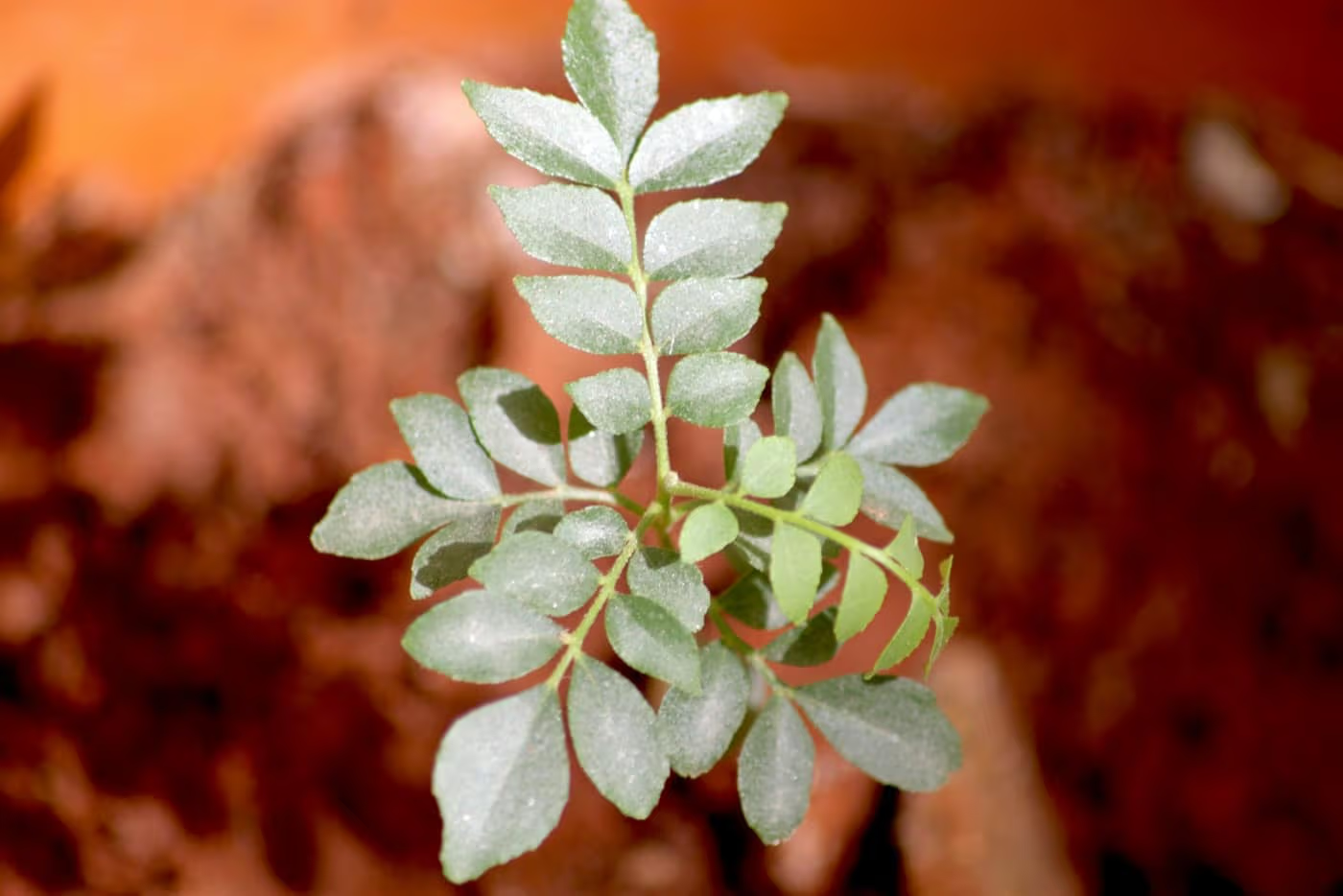
Curry leaf (Murraya koenigii), also called Bergera koenigii, is a small evergreen shrub or small tree of the Rutaceae (citrus) family, native to India and grown in almost every part of the country for its glossy, aromatic, pinnately compound leaves. It is such a familiar kitchen-garden plant that its status as a genuine commercial crop is easy to overlook — but dedicated leaf-spice blocks are grown across Tamil Nadu, Andhra Pradesh, Karnataka, Kerala, Maharashtra and Gujarat, supplying fresh-leaf bundles to vegetable markets as well as feeding a smaller dehydration and essential-oil trade.
The defining fact about curry leaf farming is that it is a repeat, leaf-cutting crop rather than a once-a-season harvest. An established bush is picked and pruned hard, over and over, through the year — every pruning removes the older growth and pushes the plant to put out a fresh, tender flush of leaf, the part that is actually sold. This puts curry leaf in the same harvest rhythm as moringa's leaf-powder blocks or tea, where the skill lies in managing pruning frequency and timing rather than in a single harvest decision.
Curry leaf can be raised two genuinely different ways, and both are used commercially. Fresh seed, sown from fully ripe, purple-black berries within days to a few weeks of collection, is the standard route for raising large numbers of nursery plants cheaply — but the seed loses viability fast, so stored or dried seed rarely germinates well. Root suckers and stem cuttings taken from a good mother plant are the other route, and are the only way to multiply a named, better-flavoured or higher-oil type true to its parent, since seedlings vary and do not reproduce a parent plant's exact quality. Most commercial nurseries and farmers still plant unnamed local seedlings, since very few formally released, named curry leaf varieties exist in India as yet — a gap that ICAR-IIHR's germplasm collection work is aimed at eventually closing.
This page follows the crop in the order a grower actually meets it — planting, establishment pruning, nutrition, water, the pest and disease watch, then the repeat leaf-harvest cycle and what happens to the leaf after picking — so jump straight to whichever stage you are working on.
Crop timeline, sowing to harvest
A quick visual map of the season — jump to any section below for the detail behind each stage.
- Day 0
Planting
Fresh seed sown at a nursery bed or in polybags, or rooted suckers/cuttings transplanted, at the start of the monsoon (June–July) or under irrigation in February–March.
- Month 1–3
Establishment
Slow early growth while the root system establishes; young plants need regular light watering and protection from waterlogging and browsing animals.
- Month 4–6
First pruning / shaping
Topping the young plant forces side branching and keeps it as a manageable, multi-stemmed bush rather than a single tall stem — skipping this step gives a spindly plant with far less leaf-bearing surface.
- Month 8–12
First light leaf harvest
A light first picking of mature leaves once the bush has enough leafy growth to spare; heavy harvesting this early sets the plant back.
- Year 2 onward
Full commercial bearing
The bush reaches full leaf-bearing capacity and is pruned and picked on a repeat cycle for the rest of its productive life, commonly a decade or more with good care.
- Ongoing (every 45–60 days)
Repeat harvest / pruning cycle
Leafy branches are cut back after each flush matures; the bush regrows fresh tender leaf for the next picking, independent of any fixed calendar season.
- Annual
Rejuvenation pruning
A harder pruning once a year, typically after the main flowering/fruiting period, keeps the bush compact, opens it up for light and air, and pushes vigorous new leafy growth for the next cycle.
Suitable states
States where this crop is grown at scale, highlighted below. Your local Krishi Vigyan Kendra is still the final word for your specific block.
- Jammu and Kashmir
- Himachal Pradesh
- Punjab
- Uttarakhand
- Haryana
- Delhi
- Uttar Pradesh
- Rajasthan
- Bihar
- Jharkhand
- West Bengal
- Sikkim
- Assam
- Arunachal Pradesh
- Meghalaya
- Nagaland
- Manipur
- Mizoram
- Tripura
- Gujarat
- Madhya Pradesh
- Chhattisgarh
- Maharashtra
- Odisha
- Goa
- Telangana
- Andhra Pradesh
- Karnataka
- Kerala
- Tamil Nadu
- Puducherry
- Ladakh
- Chandigarh
- Lakshadweep
Grown here
Climate requirements
Curry leaf's single biggest climate limitation is cold, not heat or dryness — this is exactly why its commercial belt sits in the warmer southern and western states rather than further north, even though the plant survives as a smaller, slower-growing kitchen-garden shrub in cooler parts of the country too.
Ideal temperature
A genuinely tropical-to-subtropical shrub that grows best between 20–35°C; it tolerates heat well but frost and prolonged cold weather check growth badly and can kill young plants outright, which is why curry leaf is rarely grown as a field crop outside India's warmer states
Rainfall
Moderately drought-tolerant once established, growing well on 700–2,000 mm of annual rainfall or under irrigation in drier tracts, but it responds strongly to regular watering with faster, more continuous leafy flush — the crop that is actually sold
Humidity
Tolerates both humid coastal conditions and drier inland climates; prolonged high humidity with poor airflow raises the risk of the fungal leaf spots and stem rots that are curry leaf's main disease problems
Sunlight
Grows best in full sun, which gives the densest, most aromatic leafy growth; it tolerates partial shade as a background garden plant but a shaded commercial bush produces thinner, less oil-rich leaf
Soil requirements
Pick the planting site for its drainage first — a technically fertile field that holds water after rain or irrigation is a worse choice for curry leaf than a leaner, well-drained one, since root and collar rot, not poor fertility, is what actually kills most established bushes.
Suitable soil
Well-drained sandy loam to loam is ideal; the shrub also tolerates a fairly wide range of other soils, including moderately poor ones, provided the roots are never left standing in water
pH range
6.0–7.5 (slightly acidic to neutral); the plant tolerates mildly alkaline soils too, though iron-deficiency yellowing becomes more likely as pH rises
Drainage
Good drainage matters far more than fertility — waterlogging around the roots is the fastest route to collar and root rot in this crop, exactly as with many other Rutaceae (citrus-family) trees
Organic matter
Responds well to farmyard manure or compost worked in at planting and topped up around the root zone after each hard pruning, though it is not a particularly heavy feeder compared with fruiting tree crops
Land preparation
Same four steps whichever region you are in — only the timing shifts with the sowing window.
- 1
Raised beds or ridges on heavier soil
On soil that drains slowly, plant on a raised bed or ridge rather than flat ground, since curry leaf's intolerance of waterlogging matters more on heavier, slow-draining soils.
- 2
Pit digging and filling
Dig pits of about 45 cm × 45 cm × 45 cm at the chosen spacing a few weeks ahead of planting, and refill with the excavated topsoil mixed with well-rotted farmyard manure.
- 3
Decide the propagation route before planting
Plan for fresh seed (cheapest, suits bulk nursery raising, but plants vary) or root suckers/cuttings from a good local mother bush (slower to multiply, but true-to-type and often quicker to establish) depending on what planting material is actually available locally.
- 4
Layout for a hedge-row or bush system
Commercial leaf blocks are commonly laid out as close-spaced hedge rows for maximum leaf yield per hectare, or as a more widely spaced bush system that is easier to intercrop and manage by hand — decide this before marking out the field.
Seed information
How the main varieties compare, so you can pick by duration, yield, disease pressure or what you are growing for.
| Variety | Duration | Yield | Disease resistance | Best state | Suitable for |
|---|---|---|---|---|---|
A clonal selection released by the University of Agricultural Sciences (UAS), Dharwad, from germplasm collected in the Western Ghats. Good aroma and leaf quality, but distinctly cold-sensitive, with noticeably poorer growth through the winter months. | Perennial; productive for many years once established | Good under warm conditions; growth and yield fall off in cool weather | — | Karnataka | Warmer tracts without a pronounced cold winter |
The companion UAS-Dharwad clonal selection to DWD-1, also called Suvasini in most references (Suwasini and Suhasini are transliteration variants of the same name seen in some sources). Unlike DWD-1, it tolerates cool weather well and keeps yielding through the winter, which makes it the more widely recommended of the two for general commercial planting. | Perennial; productive for many years once established | Higher than DWD-1 overall, mainly because it keeps growing through cooler weather | — | Karnataka | General commercial planting, including tracts with a cooler winter |
A well-known regional landrace long grown across Tamil Nadu rather than a formally released university variety, valued commercially for its good aroma and notably high leaf-oil content. It is propagated from its own seed like most local curry leaf stands, rather than as a protected clone. | Perennial; productive for many years once established | Good, with a reputation for high oil content specifically | — | Tamil Nadu | Growers in Tamil Nadu's established curry leaf tracts wanting a locally proven, high-aroma type |
- Seed rate
- For direct, seed-based commercial planting, guides commonly cite roughly 150–200 kg of fresh seed per acre sown at a close in-row spacing (15–20 cm) in rows about 2 m apart, later thinned to one healthy seedling per station; nursery-raised polybag seedlings or rooted cuttings need far less material since losses are lower and spacing is set at transplanting.
- Certified seed
- Very few curry leaf varieties in India carry a formal university release — DWD-1 and Suvasini (DWD-2) from UAS Dharwad are the clearest examples, and Senkaampu is a well-regarded but unreleased Tamil Nadu landrace. Most commercial plantings still use unnamed local seedlings or suckers, so ask at your nearest KVK or state horticulture nursery about what named or regionally proven planting material is actually available before committing to a large block.
- Spacing
- Roughly 2 m between rows with 1–1.5 m within the row for a bush system aimed at long-term commercial leaf picking; closer in-row spacing (down to 15–20 cm) is used only for dense, direct-seeded hedge-row plantings that are later thinned.
- Seed treatment
- Use only fresh seed extracted from fully ripe, purple-black berries and sown within days to a few weeks of collection — dried or stored seed germinates poorly to not at all. Remove the fleshy pulp before sowing to reduce damping-off risk in the nursery bed.
Sowing guide
Whichever propagation route is chosen, water lightly and regularly through the first two to three months — this is the stage most sensitive to both drying out and, in the opposite direction, waterlogging around the young roots.
- Best time
- Direct sowing or transplanting nursery-raised seedlings, and planting rooted suckers or cuttings, all suit the monsoon onset (June–July) best; February–March planting under assured irrigation is the alternative in drier tracts
- Row spacing
- 2 m for a standard commercial bush system; closer for dense hedge-row leaf production
- Plant spacing
- 1–1.5 m within the row for a bush system; 15–20 cm for close, direct-seeded hedge rows later thinned to a stand
- Sowing depth
- Sow seed about 1–2 cm deep; transplant nursery seedlings, suckers or rooted cuttings at the same depth they stood in the nursery bag
- Method
- Raise seedlings in a nursery bed or polybags from fresh seed, or root suckers/cuttings from an established mother bush in a shaded nursery bed, before transplanting at the start of the monsoon. Direct seeding at the final site is also practised for close hedge-row systems.
Fertilizer schedule
A split dose beats one large dose applied at sowing — nitrogen especially is lost to the air and to leaching if it all goes in on day one.
- 1
Basal dose (at pit filling)
At planting
Well-rotted farmyard manure or compost mixed into the backfill supports early root establishment; curry leaf is not a particularly heavy feeder at this stage.
- 2
Establishment top-up
2–3 months after planting
A light dose of nitrogen supports the vegetative growth that the first pruning will then branch out into a proper bush.
- 3
Maintenance dose
After each major pruning/harvest cycle
A modest, split dose of N:P:K plus a fresh top-up of farmyard manure or compost around the root zone supports the next flush of leafy regrowth — since the crop is leaf, not fruit, nitrogen matters more here than it would on a fruiting tree.
- 4
Micronutrients
As needed, based on soil/leaf symptoms
Iron chlorosis (yellowing new leaf with green veins) is common on alkaline or calcareous soils in this Rutaceae family shrub; correct on the basis of symptoms or a soil test rather than routinely.
Irrigation schedule
1. Establishment
First 2–3 months
Regular, light watering (roughly weekly, more in hot weather) until the root system is well established — this stage is sensitive to both drought stress and waterlogging.
2. Vegetative growth and repeat leaf flush
Ongoing, all year
Steady, moderate watering supports continuous, tender leafy regrowth after each pruning — the actual product being sold — though the established plant survives on far less if water is short.
3. After each hard pruning
Immediately after pruning
A light irrigation right after a hard pruning helps push the next flush of fresh leaf faster.
Critical stages
- Establishment (first 2–3 months)
- After each pruning, to push the next leaf flush
Water-saving tips
- Drip irrigation suits curry leaf well, delivering steady moisture for continuous leaf flush without the waterlogging risk that flood irrigation carries for this crop.
- Mulching around the base conserves moisture and moderates soil temperature, especially useful through hot, dry spells.
- Once established, err on the side of under- rather than over-watering — root and collar rot from standing water is a far more common cause of a failed planting than drought stress.
Weed management
Common weeds
Organic control
- Mulching around the base with straw or dried leaf litter is the most common and effective weed control, and doubles as moisture conservation.
- Shallow hand weeding or hoeing in the establishment years, before the bush's own canopy shades out most weed growth.
- A well-pruned, regularly picked hedge row shades the ground between plants enough within a year or two to suppress most weeds on its own.
Chemical control
- Herbicide use is uncommon in curry leaf, since it is usually grown as a hand-picked, close-contact leaf crop; where used at all, a pre-emergence herbicide labelled for plantation/hedge crops should be kept well away from the stem and root zone.
- Confirm any herbicide use with your local KVK or state horticulture department, since leaf harvested for direct human consumption calls for extra caution around spray residues.
Nutrient deficiency identification
What a shortage of each nutrient actually looks like on the plant, so you can tell a deficiency apart from a disease before you spray the wrong thing.
Nitrogen
Visible symptom
Pale, uniformly yellow-green older leaves and a slower, thinner leaf flush after pruning — the most direct yield loss in a crop sold by its leaf.
Iron
Visible symptom
Bright yellow young leaves with a fine network of green veins ("iron chlorosis"), most common on alkaline or calcareous soils — a well-documented issue across the Rutaceae (citrus) family that curry leaf belongs to.
Diseases to watch for
Symptoms, likely cause and what actually treats it — not just a spray name.
Leaf spot
- Symptoms
- Small, circular to irregular brown-to-black spots on the leaf, often with a lighter centre and a darker margin; spots enlarge and merge in heavy infections, and badly spotted leaves yellow and drop early.
- Cause
- Several fungi are documented causing leaf spot on curry leaf in India, including Phyllosticta, Cercospora, Alternaria and Colletotrichum species, favoured by warm, humid weather and poor airflow through a dense, unpruned bush.
- Treatment
- A CIB&RC-registered fungicide labelled for leaf-spot diseases, applied at the first sign of spotting and following the pre-harvest interval strictly since the leaf is eaten fresh.
- Prevention
- Prune regularly to open up the bush for better airflow and faster drying after rain or irrigation, avoid overhead wetting late in the day, and remove and destroy badly spotted fallen leaves rather than leaving them to carry the fungus over.
Anthracnose
- Symptoms
- Dark, sunken lesions on leaves and young shoots, sometimes with pinkish spore masses in humid weather, leading to shoot die-back in a bad attack.
- Cause
- Colletotrichum species, a fungus favoured by warm, wet weather, documented on curry leaf as on many other fruit and leaf crops.
- Treatment
- A CIB&RC-registered fungicide for anthracnose, timed to the first symptoms and to periods of wet weather.
- Prevention
- Good airflow through regular pruning, avoiding overhead irrigation in humid weather, and removing infected plant material promptly are the main preventive steps.
Collar rot / stem rot
- Symptoms
- Wilting and yellowing of an otherwise healthy-looking bush, with soft, discoloured tissue at or just below the soil line, sometimes with a white fungal growth visible at the base.
- Cause
- Soil-borne fungi, including Sclerotium rolfsii (also known as Athelia rolfsii, documented causing stem rot on curry leaf in India), that take hold fastest where the root zone stays waterlogged.
- Treatment
- No reliable in-field cure once rot is well established; improve drainage immediately, remove and destroy badly affected plants, and avoid replanting the same spot with curry leaf right away.
- Prevention
- Good site drainage from the start is the real prevention here — this disease is really a drainage failure with a fungal name, exactly as in moringa and many other Rutaceae and tree crops.
Pests to watch for
What to look for before the damage is visible, and organic options before you reach for a chemical.
Citrus psylla (Diaphorina citri)
- Identification
- Tiny (2–3 mm) brownish psyllids resting at a slanted angle on the tender new flush, with yellow-orange nymphs and waxy threads on the underside of young leaves.
- Damage
- Documented feeding directly on curry leaf in Indian field surveys, curling and distorting the tender new flush and coating growth in sticky honeydew and sooty mould. Curry leaf can also host this psyllid as a breeding plant even though the plant itself is not affected by citrus greening disease — a real concern where curry leaf is grown near a citrus orchard, since the psyllid can move between the two.
- Organic control
- Neem-based sprays and a garlic-neem soap formulation on the new flush check moderate populations; conserving natural predators by avoiding unnecessary broad-spectrum sprays helps keep numbers down between prunings.
- Chemical control
- A CIB&RC-registered insecticide targeted at the new flush only where populations are heavy, especially near a citrus planting; confirm the current recommendation with your local KVK.
Aphids
- Identification
- Small, soft-bodied insects clustering on tender new shoots and the underside of young leaves, especially on the fresh flush that follows a pruning.
- Damage
- Sap-sucking weakens and curls new growth and invites sooty mould on the honeydew it excretes, reducing the quality of leaf meant for market.
- Organic control
- A neem-oil spray on the tender growth checks moderate colonies; conserving ladybird beetles and other natural predators helps between prunings.
- Chemical control
- A CIB&RC-registered systemic insecticide only where colonies are heavy and spreading fast on a commercial block.
Whitefly
- Identification
- Tiny white insects that fly up in a cloud when a leafy branch is disturbed, mostly on the underside of tender leaves.
- Damage
- Sap-sucking weakens leafy growth meant for market and coats leaves in honeydew and sooty mould.
- Organic control
- Yellow sticky traps around the block and a neem-oil spray on affected branches.
- Chemical control
- A CIB&RC-registered systemic insecticide only if numbers build up heavily, timed away from any imminent leaf harvest.
Mites (Schizotetranychus baltazari)
- Identification
- Tiny mites on the leaf underside, visible as fine stippling and, in heavy infestations, webbing on the leaf, worst in hot, dry weather.
- Damage
- Documented on curry leaf in Indian field surveys; feeding dulls and bronzes the leaf, reducing the quality of leaf meant for the fresh or dehydrated market.
- Organic control
- A horticultural mineral oil spray, and keeping the block watered through hot, dry spells since mite pressure builds fastest under moisture stress.
- Chemical control
- A CIB&RC-registered miticide only where infestation is heavy — routine spraying is rarely needed on a healthy, well-watered bush.
Common mistakes to avoid
The mistakes that cost growers the most, ranked by how often they show up in the field — not in the order you might expect.
- 1
Sowing dried or stored curry leaf seed instead of fresh seed.
Why it hurts
Curry leaf seed loses viability within weeks of the fruit ripening — dried or stored seed germinates poorly or not at all, wasting a season's planting effort before the crop even establishes.
- 2
Planting on a site that holds water after rain or irrigation.
Why it hurts
Curry leaf tolerates heat and moderate drought well but has little tolerance for waterlogging — collar and root rot can set in and kill an otherwise healthy bush, which costs more plants than every pest and disease on this page combined.
- 3
Skipping the first shaping prune after establishment.
Why it hurts
An unpruned young plant grows as a single tall, spindly stem with far less leaf-bearing surface than a properly branched, multi-stemmed bush on the same land.
- 4
Harvesting leaf too early or too heavily on a young plant.
Why it hurts
A heavy first harvest before the bush has built up enough leafy growth to spare sets the plant back and delays it from reaching full, reliable commercial bearing.
- 5
Letting the bush grow dense and unpruned between pickings.
Why it hurts
Poor airflow through a crowded, overgrown bush is exactly what favours the leaf-spot and anthracnose fungi that spoil market-quality leaf — regular pruning is as much disease control as it is harvesting.
- 6
Assuming any named "improved" curry leaf plant sold locally is a genuine released variety.
Why it hurts
Very few formally released, named curry leaf varieties exist in India — DWD-1 and Suvasini from UAS Dharwad are the clearest examples. A plant sold locally as an "improved" type may just be an unnamed local seedling; buy from a known KVK or university nursery if trueness-to-type genuinely matters.
- 7
Ignoring a psyllid build-up because curry leaf itself does not get citrus greening disease.
Why it hurts
While curry leaf is not damaged by the greening pathogen the way citrus is, it can still host and breed the psyllid that spreads greening — a heavy psyllid population on curry leaf grown near a citrus orchard is a real risk to the citrus, even if the curry leaf plant looks fine.
Harvesting
Leaves are picked repeatedly through the year once the bush is established, roughly every 45–60 days, by cutting back leafy branches after each flush of new growth matures — this is a repeat, cut-and-come-again harvest, not a single seasonal picking. A light first harvest is taken at 8–12 months after planting, with full, reliable picking from the second year onward.
Signs it is ready
- Leaves are dark green, glossy and fully expanded, not the very newest pale flush
- A branch snaps or cuts cleanly rather than bending, showing it has matured past the soft, tender stage
- The bush has clearly regrown since its last pruning, showing it can spare leaf without being set back
Tools
- A sharp sickle or pruning shears to cut leafy branches, since hand-stripping individual leaves is slow and can damage the tender growing tip
- Baskets or jute sacks for fresh leaf, kept out of direct sun and moved to market quickly
- A shaded drying area or dehydrator tray set-up where leaf is being processed into powder rather than sold fresh
Expected yield
Roughly 20–100 q/ha (2–10 tonnes/ha) of green leaf a year, rising steadily as the bush matures over its first four to five years, though these are commercial-guide estimates rather than a confirmed ICAR or state-university trial figure — actual yield varies widely with spacing, pruning frequency, variety and management.
Post-harvest & storage
Storage
Fresh leaf has a short shelf life at room temperature and is best moved to market within a day; refrigeration (kept slightly moist, not wet) extends this to roughly a week. Leaf meant for powder must be dried, not stored fresh: spread thin in a single layer and dry in shade or a low-temperature dehydrator, away from direct sun, dust and moisture, until it crumbles dry to the touch — direct sun-drying bleaches the leaf and destroys much of its aroma and colour.
Packaging
Fresh leaf goes to market loose, bundled, or in ventilated baskets rather than sealed bags, so it does not sweat and spoil faster. Dried leaf is ground into powder, sieved to an even texture, and packed immediately into airtight, light-blocking containers or food-grade pouches, since light, air and moisture all fade a finished batch's colour and aroma over time.
Transportation
Move fresh leaf to market quickly and out of direct sun or heat, ideally the same day it is cut; move finished leaf powder in sealed, moisture-proof packaging, since it readily absorbs ambient moisture and clumps if exposed.
Shelf life
Fresh leaf: a day or two at room temperature, about a week refrigerated. Properly shade-dried, finely ground and airtight-packed leaf powder: commonly several months to about a year in a cool, dark, dry store before aroma and colour noticeably fade.
Market prices
Today's mandi price near you, pulled live from the government's own Agmarknet data.
Live daily mandi prices from the government Agmarknet dataset.
Government mandi price not available for this crop
This crop is not traded through APMC mandis covered by the government’s Agmarknet system, so there is no mandi price to show here.
Weather
Current conditions and a 5-day outlook for your selected location, with one line of stage-aware advice.
Pick your state for current conditions and a 5-day outlook.
Live data from Open-Meteo
Profit calculator
Your own cost sheet, expected yield and selling price — not ours.
Where the money goes
Share of the total cost per acre, using the calculator’s own default cost sheet below — adjust the numbers there to match your field and this picture will no longer apply to you exactly, but the ranking rarely changes.
- Labour49% (₹14,000)
- Land rent28% (₹8,000)
- Fertiliser7% (₹2,000)
- Pesticide & weedicide4% (₹1,200)
- Irrigation4% (₹1,200)
- Interest3% (₹900)
- Machinery3% (₹800)
- Seed2% (₹700)
Official downloads
Government and ICAR documents only — everything below is hosted on an official server.
MIDH — Mission for Integrated Development of Horticulture
Central scheme covering spice and leaf-spice crops including curry leaf — planting material, area expansion and post-harvest support.
ICAR-IIHR (Indian Institute of Horticultural Research), Bengaluru
Holds a curry leaf germplasm field gene bank and leads varietal-improvement research for the crop.
Farmer Portal — crop advisories
Government of India's farmer portal, including season-specific advisories and market information.
Kisan Call Centre — 1800-180-1551
Free crop advice in your language
Frequently asked questions
Should I grow curry leaf from seed or from cuttings/suckers?
Both are used commercially. Fresh seed (sown within days to a few weeks of the berries ripening, since viability drops fast) is the cheaper route for raising large numbers of plants, but seedlings vary in quality. Root suckers or stem cuttings from a good mother bush are slower to multiply but reproduce that plant's exact leaf quality and aroma, and are the only way to plant a named type like Suvasini true-to-type.
Which curry leaf variety should I plant?
Real, formally released varieties are genuinely few. Suvasini (also called DWD-2), from UAS Dharwad, tolerates cool weather well and is the more widely recommended of that university's two releases; its companion DWD-1 has similar leaf quality but grows poorly in winter. Senkaampu is a well-regarded Tamil Nadu regional landrace prized for high leaf-oil content, though it is not a formally released variety. Most farmers still plant unnamed local seedlings, since curry leaf breeding in India is still an early-stage effort.
Why do curry leaf bushes suddenly wilt and die even though the plant is known to be hardy?
Almost always waterlogging, not drought or heat. Curry leaf tolerates dry, hot weather well but has little tolerance for standing water around its roots — collar and root rot can set in and kill an otherwise healthy bush within days of the soil staying saturated. Site drainage matters more than soil fertility for this crop.
Does the psyllid on my curry leaf mean it has citrus greening disease?
No — curry leaf itself is not affected by the citrus greening pathogen even though the same Asian citrus psyllid that spreads greening does feed and breed on curry leaf. The concern is different: a curry leaf bush carrying a heavy psyllid population can act as a source that spreads the psyllid — and therefore the disease risk — to any nearby citrus trees, even though the curry leaf plant itself stays healthy.
How often should I harvest curry leaf, and how much leaf can I expect?
Once established, a bush is pruned and picked on a repeat cycle roughly every 45–60 days rather than at one fixed time of year. Commercial guides commonly cite a range of roughly 20–100 q/ha (2–10 tonnes/ha) of green leaf a year, rising as the planting matures over its first four to five years — treat this as a working estimate rather than a confirmed research figure, since no ICAR or state-university yield trial for curry leaf has been published the way it has for crops like moringa.
Does curry leaf have a Minimum Support Price or a real mandi market?
No MSP — curry leaf is a leaf-spice crop sold fresh at ordinary vegetable/spice market rates, and is not tracked as a distinct commodity in the main national mandi price database. Most of the crop moves through direct sale to local vegetable markets and spice traders rather than a formal, price-quoted mandi system.
Still have questions?
The FAQs above cover the common ones. For anything specific to your field and soil, your nearest Krishi Vigyan Kendra is the authoritative answer.