
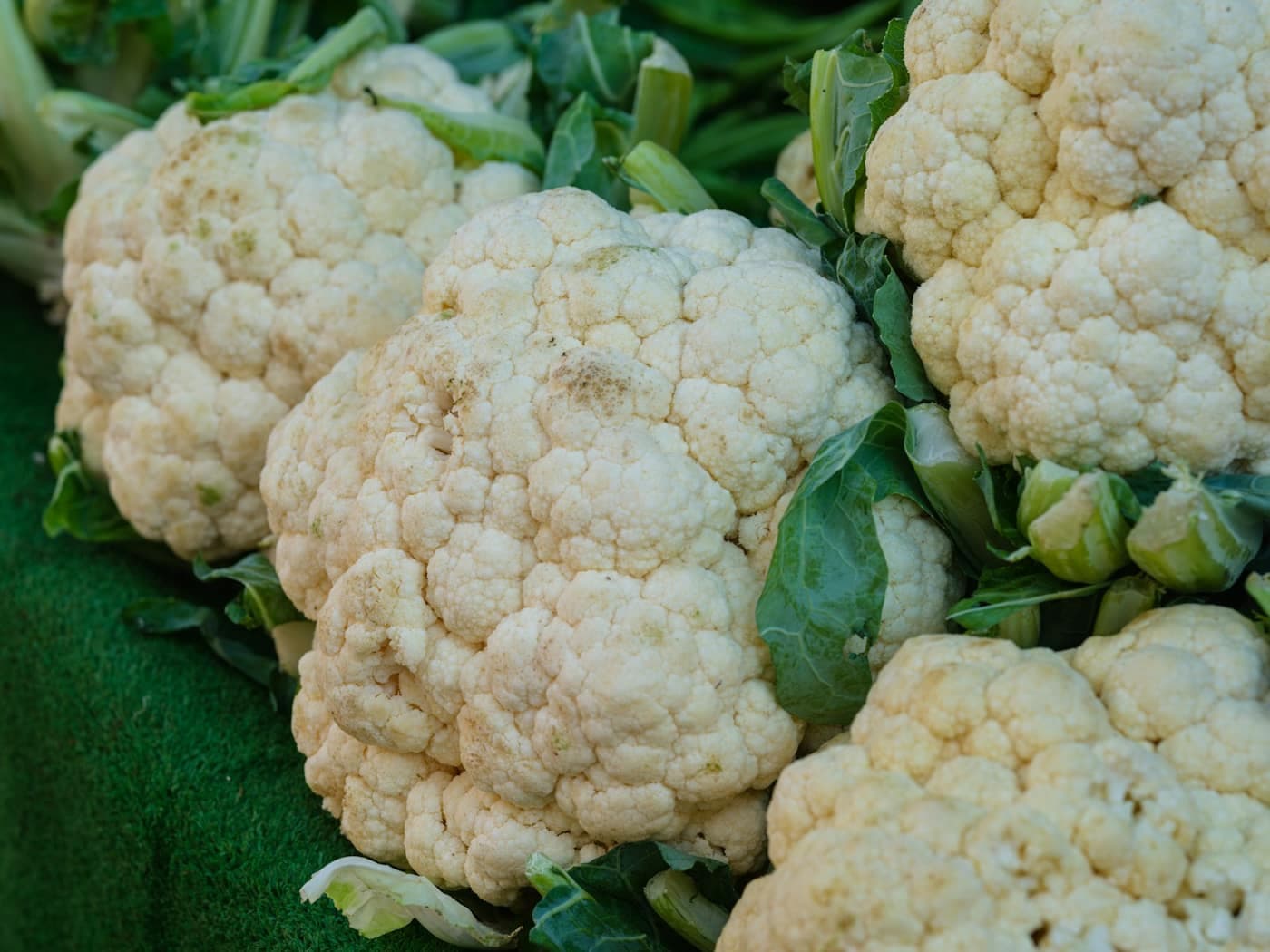
Cauliflower
Brassica oleracea var. botrytis
The one vegetable where matching the variety’s maturity group to your sowing date matters more than anything else — an early type sown late, or a late one sown early, simply refuses to form a proper curd. Boron and molybdenum shortages finish the job as browning and whiptail.
Quick Summary
The key points from this page in about two minutes — read it or have it read aloud.
Quick Summary
Cauliflower is transplanted like cabbage, but it is far fussier about temperature — each variety forms a proper curd only within its own narrow band. That is why it is sold in maturity groups, early, mid and late, and why matching the group to your sowing date is the first and most important decision you make. Get it wrong and the plant either buttons into a tiny, useless curd or never curds at all, no matter how well it is grown otherwise.
Two nutrient shortages finish off crops that timing has already weakened: boron, which browns the curd, and molybdenum, which gives the leaves a narrow "whiptail" look. Both are worth correcting before symptoms appear on soils known to be short of them.
Cauliflower is a heavy feeder, so transplant into a well-manured bed and keep it fed and weed-free while it builds its leaf frame — that frame is what feeds the curd. Once white curds appear, fold a few leaves over them to keep them from yellowing. Keep the moisture steady, and watch for black rot and downy mildew in wet weather and for rot on a mature curd after rain. Cut curds while they are still compact and firm; held too long they go ricey and loose and lose their market grade. The page below carries the maturity-group guidance, nursery details, spacing, nutrient doses including boron and molybdenum, irrigation schedule, crop duration and expected yields.
- Crop type
- Vegetable (cole crop)
- Season
- Rabi (by maturity group)
- Suitable states
- 10+ major states
- Growing duration
- 90–120 days (after transplant)
- Water requirement
- Moderate & steady
- Temperature
- 15–22°C for curding
- Soil type
- Well-drained loam, high organic matter
- Difficulty level
- Moderate
- Expected yield
- 200–300 q/ha
- Key disorder
- Buttoning, whiptail & browning
Overview
Cauliflower (Brassica oleracea var. botrytis) is among India’s most valuable cool-season vegetables, grown from the plains to the hills. Like cabbage it is transplanted, but it is far more temperature-fussy — each variety only curds well within its own narrow temperature band.
That is why cauliflower is sold in maturity groups — early, mid and late — and why choosing the group that matches your sowing date is the first and most important decision. Get it wrong and the plant either buttons into a tiny useless curd or never curds at all.
The other classic cauliflower problems are nutritional — boron deficiency (browning of the curd) and molybdenum deficiency (whiptail leaves) — and the physiological disorders that come from stress and wrong timing. This guide walks through each, because in cauliflower they are the difference between profit and loss.
Crop timeline, sowing to harvest
A quick visual map of the season — jump to any section below for the detail behind each stage.
- Day 0
Transplanting
4–5 week seedlings of the right maturity group set at 45×45 cm into a well-manured bed.
- Day 5–7
Establishment
Roots take hold; gap-fill casualties promptly for an even crop.
- Day 20–35
Vegetative frame
The plant builds the leaf frame that will feed the curd — nitrogen and clean, weed-free growth here are decisive.
- Day 40–50
Curd initiation
The growing point switches to forming a curd; the temperature now must suit the variety, or you get buttoning.
- Day 55–70
Curd development
The curd enlarges; fold a few leaves over white curds to blanch and protect them from yellowing.
- Day 70–90
Curd maturity
The curd reaches full size while still compact and white — the window to cut before it loosens.
- Day 90–120
Harvest
Cut compact, firm curds promptly; held too long they go ricey and loose and lose market grade.
Suitable states
States where this crop is grown at scale, highlighted below. Your local Krishi Vigyan Kendra is still the final word for your specific block.
- Jammu and Kashmir
- Himachal Pradesh
- Punjab
- Uttarakhand
- Haryana
- Delhi
- Uttar Pradesh
- Rajasthan
- Bihar
- Jharkhand
- West Bengal
- Sikkim
- Assam
- Arunachal Pradesh
- Meghalaya
- Nagaland
- Manipur
- Mizoram
- Tripura
- Gujarat
- Madhya Pradesh
- Chhattisgarh
- Maharashtra
- Odisha
- Goa
- Telangana
- Andhra Pradesh
- Karnataka
- Kerala
- Tamil Nadu
- Puducherry
- Ladakh
- Chandigarh
Grown here
Climate requirements
Temperature is everything in cauliflower. A curd forms only when the plant meets the right temperature at the right size — too warm for a late variety and it never curds, too cool too early for an early one and it buttons. Sow the group your season actually suits.
Ideal temperature
Each maturity group has its own band — early types curd at 20–25°C, late snowball types need 15–18°C
Rainfall
Grown mainly on irrigation; rain on a mature curd causes rot and discolouration
Humidity
Moderate; wet leaves favour black rot and downy mildew
Sunlight
Full sun for leaf growth; the curd itself is shaded (blanched) to stay white
Soil requirements
Acidic soils below pH 5.5 lock up molybdenum and cause whiptail; lime such soils. As with all cole crops, avoid growing cauliflower repeatedly in the same field, which builds up club root and shared diseases.
Suitable soil
Well-drained loam and clay-loam rich in organic matter
pH range
6.0–7.0 (molybdenum becomes unavailable below 5.5, causing whiptail)
Drainage
Good drainage with steady moisture — cauliflower dislikes both drought and waterlogging
Organic matter
High; a base of 20–25 t/ha FYM is standard
Land preparation
Same four steps whichever region you are in — only the timing shifts with the sowing window.
- 1
Fine, manured bed
Two or three ploughings with 20–25 t/ha of well-rotted FYM, harrowed to a fine tilth.
- 2
Nursery by maturity group
Raise the nursery on the schedule for the chosen maturity group — the timing is the whole game — and drench against damping-off.
- 3
Basal fertiliser, boron and beds
Apply basal phosphorus, potash, part of the nitrogen and, on deficient soils, borax; form beds or ridges to suit irrigation.
Seed information
How the main varieties compare, so you can pick by duration, yield, disease pressure or what you are growing for.
| Variety | Duration | Yield | Disease resistance | Best state | Suitable for |
|---|---|---|---|---|---|
An early-group variety that curds in the warmer weather of September–October. | 60–75 days (after transplant) | 170–180 q/ha | Susceptible to black rot and downy mildew (used as a susceptible base parent in resistance-breeding studies) | Uttar Pradesh | Early crop, warm curding |
An early-group variety on the same warm-curding line as Pusa Meghna. | 60–75 days (after transplant) | Medium | Moderate | Punjab, Haryana, Himachal Pradesh, Delhi | Early crop, warm curding |
From Pantnagar — an early-season release that curds in the autumn heat, before Pusa Snowball K-1 would set a usable head. | 70–80 days from transplanting | 120–150 q/ha | No built-in resistance — watch for black rot | Uttarakhand, Uttar Pradesh | Early autumn curding |
Mid-group variety with compact white curds for the main season. | 75–90 days | Medium–high | Moderate | Uttarakhand | Mid-season crop |
From ICAR-IARI, New Delhi — a mid-early release (also catalogued as Set-309-1-2) that curds around November–December. | About 80–85 days after transplanting | 240–260 q/ha | No built-in disease resistance identified in sources checked | Uttar Pradesh, Punjab, Haryana, Bihar, West Bengal | Mid-early, November–December curding |
Classic late/snowball variety with large, pure-white, compact curds that need cool weather. | 90–110 days | High | Moderate | Himachal Pradesh | Late crop, cool weather |
Popular late snowball with heavy, white curds for the winter market. | 95–110 days | High | Moderate | Punjab | Late crop, large curds |
F1 hybrids Uniform, high-yielding hybrids available across all maturity groups. | 70–100 days | High | Variable by hybrid | Maharashtra | Commercial, uniform harvest |
- Seed rate
- 350–500 g/ha to raise the nursery for one hectare
- Certified seed
- Buy seed of the correct maturity group for your sowing window from a reputable source — this single choice decides whether the crop curds at all. Do not substitute one group for another to use up leftover seed.
- Spacing
- 45 cm between rows × 45 cm within the row
- Seed treatment
- Treat seed against damping-off with Thiram or Carbendazim, and dip seedling roots at transplanting to protect against early disease and root pests.
Sowing guide
The single most important sowing decision is matching the maturity group to the date. Never sow an early variety late (it will not curd in the cold) or a late variety early (it will not curd in the heat) — the group is chosen by the temperature the curd will meet, not by convenience.
- Best time
- Nursery and transplanting staggered by group: early June–August, mid August–September, late September–October in the plains
- Row spacing
- 45 cm
- Plant spacing
- 45 cm within the row
- Sowing depth
- Transplant to the depth the seedling grew in the nursery
- Method
- Transplant sturdy 4–5 week seedlings in the evening and water in
Fertilizer schedule
A split dose beats one large dose applied at sowing — nitrogen especially is lost to the air and to leaching if it all goes in on day one.
- 1
Basal (at transplanting)
Day 0
Full phosphorus and potash with one-third of the nitrogen on a base of 20–25 t/ha FYM — around 40 N : 60 P₂O₅ : 60 K₂O kg/ha basally.
- 2
Boron & molybdenum
Basal / early
Borax in the soil on boron-poor soils, and lime plus a molybdenum spray on acidic soils, prevent browning and whiptail respectively.
- 3
First top-dressing
Active growth (25–30 days)
One-third of the nitrogen at leaf-frame growth, with irrigation and earthing-up.
- 4
Second top-dressing
Curd initiation (45–55 days)
The remaining nitrogen as the curd starts to form, to size it up.
Irrigation schedule
1. After transplanting
Day 0–7
Light, frequent irrigation to establish seedlings.
2. Vegetative growth
20–40 days
Regular irrigation every 8–10 days to build the leaf frame.
3. Curd development
55–80 days
Keep moisture even and steady while the curd forms; a stress here loosens the curd.
Critical stages
- Vegetative frame (25–40 days)
- Curd initiation and development (45–80 days)
Water-saving tips
- Mulching keeps moisture even, which helps the curd stay compact.
- Drip irrigation delivers steady moisture while saving water and keeping foliage dry, reducing disease.
- Avoid moisture stress at curd initiation, which is a direct cause of small, buttoned curds.
Weed management
Organic control
- Mulching suppresses weeds and holds even moisture, both of which help curd quality.
- Hand weeding with earthing-up at 20 and 40 days keeps the crop clean and steadies the plants.
Chemical control
- Pre-emergence Pendimethalin 1.0 kg a.i./ha after transplanting on moist soil controls early weeds.
- Follow with one or two manual weedings and earthing-up.
Nutrient deficiency identification
What a shortage of each nutrient actually looks like on the plant, so you can tell a deficiency apart from a disease before you spray the wrong thing.
Boron
Visible symptom
Browning of the curd surface (brown rot), hollow, water-soaked stem and cracked petioles — the classic cauliflower deficiency.
Molybdenum
Visible symptom
Whiptail — the leaf blade fails to develop, leaving thin, strap-like, distorted leaves; worst on acidic soils.
Nitrogen
Visible symptom
Pale, small older leaves and a weak plant that buttons into a small curd.
Magnesium
Visible symptom
Interveinal yellowing of older leaves with green veins, on light or acidic soils.
Potassium
Visible symptom
Scorched older leaf margins and poorly filled curds.
Diseases to watch for
Symptoms, likely cause and what actually treats it — not just a spray name.
Black rot
- Symptoms
- V-shaped yellow lesions from the leaf margins with blackened veins; systemic infection blackens the vascular ring and rots the curd.
- Cause
- Xanthomonas campestris, seed- and water-borne, worst in warm, wet weather.
- Treatment
- No systemic cure; remove affected plants, avoid working wet fields, and slow spread with copper sprays.
- Prevention
- Use disease-free or treated seed and tolerant varieties, rotate away from cole crops for 2–3 years and avoid overhead irrigation.
Downy mildew
- Symptoms
- Pale-yellow patches on upper leaves with greyish down beneath; worst on seedlings and in cool, wet weather, and can discolour the curd.
- Cause
- Hyaloperonospora parasitica, favoured by cool, humid conditions.
- Treatment
- Spray Mancozeb or Metalaxyl-Mancozeb at first appearance and repeat as needed.
- Prevention
- Avoid dense nurseries, ensure airflow and treat seed.
Curd blight / bacterial soft rot
- Symptoms
- Soft, watery, foul-smelling rot of the curd, especially after rain or injury, spreading quickly in warm humid weather.
- Cause
- Erwinia and related bacteria entering through wounds and water.
- Treatment
- Remove affected curds; the rot cannot be cured once it starts.
- Prevention
- Avoid injury, harvest dry, do not let mature curds sit in wet weather, and keep the field draining.
Club root
- Symptoms
- Swollen, club-like distorted roots; plants wilt by day, are stunted and curd poorly.
- Cause
- Plasmodiophora brassicae, a persistent soil-borne organism, worst on acidic, wet soils.
- Treatment
- No in-crop cure; remove and destroy affected plants.
- Prevention
- Lime acidic soils, ensure drainage and rotate cole crops out for several years.
Pests to watch for
What to look for before the damage is visible, and organic options before you reach for a chemical.
Diamondback moth
- Identification
- Small green caterpillars on the leaf underside that skeletonise leaves and bore into the curd, wriggling backwards when touched.
- Damage
- The main cauliflower pest — feeding on the curd itself makes it unsaleable.
- Organic control
- Bt sprays, pheromone traps, neem and conserving natural enemies by avoiding early broad-spectrum sprays.
- Chemical control
- Rotate recommended insecticides based on scouting; the pest resists single chemicals used repeatedly.
Cabbage aphid
- Identification
- Grey-green colonies on leaf undersides and hidden in the curd.
- Damage
- Sap loss stunts plants and colonies in the curd ruin its grade.
- Organic control
- Neem oil, yellow sticky traps and conserving ladybirds.
- Chemical control
- A recommended insecticide directed at the leaf underside when colonies build.
Tobacco caterpillar (Spodoptera)
- Identification
- Gregarious young caterpillars skeletonising leaves in patches, later large and night-feeding.
- Damage
- Rapid defoliation of young plants.
- Organic control
- Destroy egg masses and gregarious larvae, use pheromone traps and NPV.
- Chemical control
- Spot-spray infested patches before larvae disperse.
Cabbage butterfly / leaf webber
- Identification
- Larger green caterpillars chewing large holes and sometimes webbing leaves.
- Damage
- Defoliation and frass contamination.
- Organic control
- Hand-pick the conspicuous caterpillars and spray Bt.
- Chemical control
- A recommended insecticide when damage crosses threshold.
Common mistakes to avoid
The mistakes that cost growers the most, ranked by how often they show up in the field — not in the order you might expect.
- 1
Sowing the wrong maturity group for the season.
Why it hurts
An early type in the cold, or a late type in the heat, either buttons into a tiny curd or never curds at all — the crop is lost before it starts.
- 2
Letting the young plant suffer nitrogen or moisture stress.
Why it hurts
A checked plant "buttons" — it forms a premature, thumb-sized curd on a small plant that can never grow into a marketable head.
- 3
Ignoring boron on a deficient soil.
Why it hurts
The curd surface browns (brown rot) and the stem goes hollow — the head is downgraded or unsaleable even though the plant looked healthy.
- 4
Growing on an acidic soil without liming.
Why it hurts
Molybdenum locks up and the plant develops whiptail — thin, strap-like leaves that cannot feed a curd.
- 5
Not blanching white curds.
Why it hurts
Sunlight yellows the exposed curd and it loses its bright-white premium; a few leaves folded over keep it white.
- 6
Leaving the curd too long before cutting.
Why it hurts
The compact curd goes ricey and loose, the florets separate, and the market grade collapses.
- 7
Repeatedly cropping cole vegetables in the same field.
Why it hurts
Club root and black rot build up in the soil until the field can no longer grow a clean crop.
- 8
Transplanting old, checked seedlings.
Why it hurts
Stressed transplants button early and give small curds — sturdy, unchecked 4–5 week seedlings are essential.
- 9
Harvesting wet or bruised curds and packing them warm.
Why it hurts
Bacterial soft rot sets in fast; curds must be cut dry, kept cool and moved to market quickly.
- 10
Guessing the fertiliser instead of a soil test.
Why it hurts
Boron and molybdenum needs vary sharply by soil — without a test the two commonest and most damaging cauliflower disorders go unaddressed.
Harvesting
When the curd is full-sized, compact, firm and still white — before it starts to loosen and go ricey, usually 90–120 days after transplanting depending on the group. Cut in the cool of the morning with a few jacket leaves to protect the curd.
Signs it is ready
- Curd reached full size for the variety
- Curd still compact and tight, not loosening
- Curd bright and white (if blanched)
Tools
- Sharp knife to cut with a ring of jacket leaves
- Crates for gentle handling
- Shade for holding before transport
Expected yield
200–300 q/ha for a well-managed crop; hybrids at the upper end
Post-harvest & storage
Storage
Cauliflower is highly perishable — it keeps only 3–4 days at room temperature but 3–4 weeks near 0°C with high humidity. Leave a ring of jacket leaves on to protect the curd and keep it out of the sun.
Packaging
Pack curds with their jacket leaves in crates, avoiding pressure on the curd, which bruises and rots.
Transportation
Move to market quickly and in the cool; a bruised or warm curd rots within a day.
Shelf life
A few days at room temperature; a few weeks in cold storage — best sold fresh.
Market prices
Today's mandi price near you, pulled live from the government's own Agmarknet data.
Live daily mandi prices from the government Agmarknet dataset.
Synced from data.gov.in (Agmarknet). Rates are ₹ per quintal.
Weather
Current conditions and a 5-day outlook for your selected location, with one line of stage-aware advice.
Pick your state for current conditions and a 5-day outlook.
Live data from Open-Meteo
Profit calculator
Your own cost sheet, expected yield and selling price — not ours.
Where the money goes
Share of the total cost per acre, using the calculator’s own default cost sheet below — adjust the numbers there to match your field and this picture will no longer apply to you exactly, but the ranking rarely changes.
- Labour32% (₹15,000)
- Land rent19% (₹9,000)
- Fertiliser13% (₹6,000)
- Pesticide & weedicide12% (₹5,500)
- Irrigation8% (₹4,000)
- Seed6% (₹3,000)
- Machinery5% (₹2,500)
- Interest5% (₹2,200)
Official downloads
Government and ICAR documents only — everything below is hosted on an official server.
Frequently asked questions
Why did my cauliflower form a tiny curd (buttoning)?
Buttoning happens when a young plant is checked — by the wrong maturity group for the season, nitrogen or moisture stress, or transplanting old seedlings — and forms a premature, thumb-sized curd it can never grow out of. Choose the right group for your sowing date and keep the young crop growing steadily without stress.
What are whiptail and browning in cauliflower?
They are the two classic nutritional disorders. Whiptail is molybdenum deficiency — thin, strap-like distorted leaves, worst on acidic soils, fixed by liming and a molybdenum spray. Browning (brown rot) of the curd and hollow stem is boron deficiency, fixed by applying borax. A soil test tells you which your field needs.
How do I keep cauliflower curds white?
By blanching — folding two or three of the plant’s own leaves over the curd, or tying them, once it starts to form. This shades the curd from sunlight, which would otherwise yellow it and cut the premium price a bright-white curd earns.
Which cauliflower variety should I grow?
Choose by maturity group to match your sowing date: early varieties for warm September–October curding, mid-group for the main season, and late/snowball types (like Pusa Snowball K-1) for the coldest weather. The group must suit the temperature the curd will meet, or it will not form.
How is cauliflower different from cabbage to grow?
They are close cousins and grown much the same way — nursery-raised and transplanted at 45×45 cm — but cauliflower is far fussier about temperature (each variety curds only in its own band) and much more prone to boron and molybdenum disorders. Cabbage is the more forgiving of the two.
When is cauliflower ready to harvest?
When the curd is full-sized, compact, firm and still white — before it loosens and goes ricey, usually 90–120 days after transplanting. Cut promptly; a curd left too long separates into florets and loses its grade.
Still have questions?
The FAQs above cover the common ones. For anything specific to your field and soil, your nearest Krishi Vigyan Kendra is the authoritative answer.