
Rice
Oryza sativa
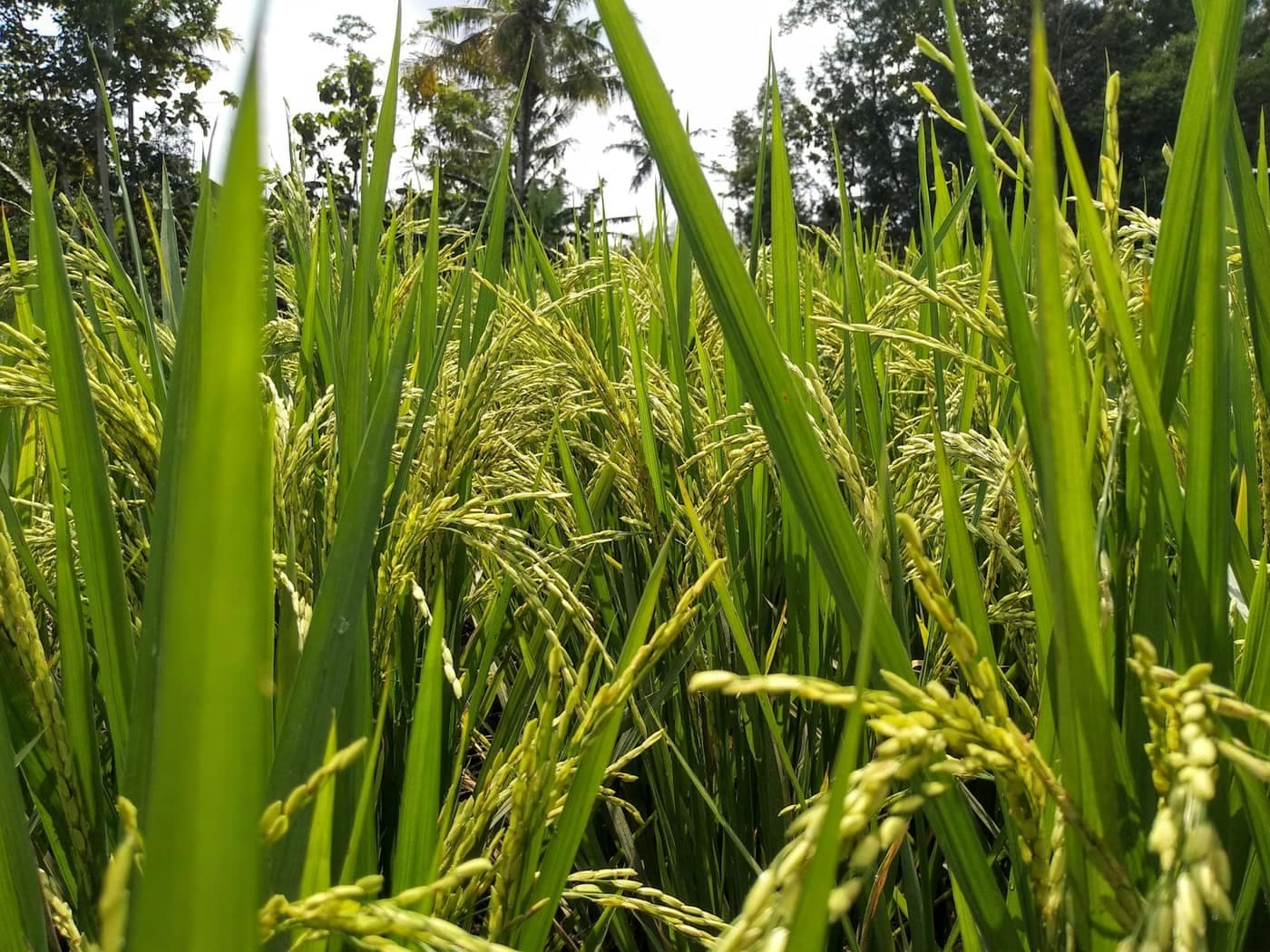
India’s principal kharif cereal and the staple food of over half the country. Water management — not seed or fertilizer — is now the single biggest lever on cost and profit, from the nursery to the day the field is drained before harvest.
Quick Summary
The key points from this page in about two minutes — read it or have it read aloud.
Quick Summary
Rice is India’s main kharif cereal and the everyday food of more than half the country. It is grown almost entirely with the monsoon — seedlings raised in a nursery, then moved into a flooded main field as the rains arrive, and cut before winter. It wants a heavy, water-holding soil; the poor natural drainage that would trouble most crops is an advantage here, because it lets the field keep a shallow, even sheet of standing water.
Water is now the biggest lever on cost and profit — more than seed or fertiliser. Puddle and level the field well, transplant young seedlings, and hold standing water through tillering: that water is what smothers weeds, not just what feeds the crop. The stages around panicle initiation and flowering are the most sensitive — moisture stress then leaves empty grains that no later irrigation can undo. Late in the season the field is drained deliberately, a week or so before harvest.
With groundwater falling and labour dearer, direct-seeded rice, SRI and alternate wetting-and-drying are spreading — they cut water and labour rather than raise the yield ceiling, and direct seeding in particular trades away the free weed control that flooding gives, so it only pays where weeds are planned for.
Choose a variety by its duration and the diseases common in your area, use fresh certified seed and treat it before the nursery. Split the nitrogen; on long-flooded land a zinc shortage is common and is easily mistaken for a nitrogen one. Watch for blast, bacterial leaf blight, sheath blight and stem borer, planthopper and leaf folder. The page below carries the exact temperatures, seed rates, spacing, nutrient doses, water schedule, crop durations, expected yields and current MSP.
- Crop type
- Cereal
- Season
- Kharif
- Suitable states
- 14 major states
- Growing duration
- 120–150 days
- Water requirement
- High (standing water most of the season)
- Temperature
- 20–35°C
- Soil type
- Water-retentive clay loam
- Difficulty level
- Moderate
- Expected yield
- 50–65 q/ha (irrigated, transplanted)
- MSP (KMS 2026–27)
- ₹2,441 / quintal (common)
Overview
Rice (Oryza sativa) is grown across roughly 44 million hectares in India, the largest rice area of any country, almost entirely as a kharif crop transplanted with the monsoon and harvested before winter.
The economics have shifted in the last decade. With groundwater falling fast in Punjab and Haryana and transplanting labour getting scarcer and costlier everywhere, direct-seeded rice (DSR), the SRI method and Alternate Wetting and Drying (AWD) are spreading precisely because they cut water and labour cost, not because they raise the yield ceiling.
This page follows the crop in the order you will actually meet it — nursery, land, transplanting, nutrition, water, protection, harvest, sale — so you can jump straight to whichever stage you are at.
Crop timeline, sowing to harvest
A quick visual map of the season — jump to any section below for the detail behind each stage.
- Day 0
Nursery sowing
Seed sown on a raised, puddled nursery bed covering about one-tenth of the area to be transplanted.
- Day 25–30
Transplanting
25–30-day-old seedlings moved into the puddled main field, timed to the monsoon onset.
- Day 35–55
Active tillering
About 5 cm standing water is held through this window — it is what actually suppresses weeds, not just what feeds the plant.
- Day 65–75
Panicle initiation
The single most water-sensitive stage of the crop — any stress here cuts spikelets per panicle directly.
- Day 90–100
Flowering
Moisture stress at flowering causes spikelet sterility and empty grains that no later irrigation can fix.
- Day 115–130
Grain-filling (dough stage)
The field is drained 7–10 days before harvest — the one deliberate dry spell in the whole schedule.
- Day 120–150
Harvest
When 80–85% of grains on the panicle turn golden-yellow, timing depending on the variety’s duration.
Suitable states
States where this crop is grown at scale, highlighted below. Your local Krishi Vigyan Kendra is still the final word for your specific block.
- Jammu and Kashmir
- Himachal Pradesh
- Punjab
- Uttarakhand
- Haryana
- Delhi
- Uttar Pradesh
- Rajasthan
- Bihar
- Jharkhand
- West Bengal
- Sikkim
- Assam
- Arunachal Pradesh
- Meghalaya
- Nagaland
- Manipur
- Mizoram
- Tripura
- Gujarat
- Madhya Pradesh
- Chhattisgarh
- Maharashtra
- Odisha
- Goa
- Telangana
- Andhra Pradesh
- Karnataka
- Kerala
- Tamil Nadu
- Puducherry
- Ladakh
- Chandigarh
Grown here
Climate requirements
Rice is the one major Indian cereal built to grow in standing water — that single fact decides almost everything else on this page, from puddled land preparation to why a rice field is flooded rather than furrow-irrigated.
Ideal temperature
20–35°C through the season; 25–35°C is optimal for tillering and grain-filling
Rainfall
1,000–1,500 mm over the crop cycle, split between monsoon rainfall and irrigation
Humidity
High humidity suits vegetative growth, but the same humidity around flowering raises blast and bacterial blight risk
Sunlight
Full sun for at least 6 hours a day; extended cloud cover at flowering cuts grain-filling
Soil requirements
A soil test still matters — zinc deficiency (khaira disease) is common on soils kept continuously flooded for decades, and is easily mistaken for a nitrogen problem.
Suitable soil
Heavy clay to clay loam that holds standing water; deltaic and Indo-Gangetic alluvial soils are closest to ideal
pH range
5.5–6.5, though rice tolerates a wider range than most cereals
Drainage
Poor natural drainage is actually an advantage here — it is what lets puddling hold a shallow water layer across the field
Organic matter
Medium to high; continuous flooding depletes organic matter faster than in an unflooded field, so green manuring or FYM between crops matters more here than in most cereals
Land preparation
Same four steps whichever region you are in — only the timing shifts with the sowing window.
- 1
Nursery bed preparation
A raised, well-puddled nursery bed on about one-tenth of the area to be transplanted, ready to sow 25–30 days before the main field is needed.
- 2
Puddling
Repeated ploughing of the main field under 5–7 cm of standing water, two to three times, breaks the soil into a fine slurry that seals the field against percolation and buries the first flush of weeds.
- 3
Levelling
Precise levelling right after puddling is what lets a shallow, even depth of standing water be held across the whole field — an uneven field drowns seedlings in the low corners and dries out the high ones.
- 4
Bund repair
Strengthen and plaster the field bunds before transplanting — a field that cannot hold standing water loses the single biggest advantage puddling gives it.
Seed information
How the main varieties compare, so you can pick by duration, yield, disease pressure or what you are growing for.
| Variety | Duration | Yield | Disease resistance | Best state | Suitable for |
|---|---|---|---|---|---|
One of the most widely grown rice varieties in eastern India; reliable under rainfed and shallow lowland conditions, though its long duration keeps the field occupied later into the season. | 145–150 days | 45–55 q/ha under rainfed lowland | Tolerant to bacterial leaf blight; susceptible to sheath blight | West Bengal, Odisha, Bihar | Table (medium-to-low land) |
A short-duration Andhra Pradesh release valued for freeing the field early enough for a rabi crop behind it, with a long slender grain millers prefer over Swarna’s bolder grain — but noticeably more exposed to bacterial blight. | About 120 days | 55–65 q/ha under irrigated conditions | Highly susceptible to bacterial blight; only moderate blast tolerance; good brown planthopper tolerance | Andhra Pradesh, Telangana, Karnataka | Table (short-duration, frees field for rabi) |
A high-yielding, widely adapted variety grown across several states; a long track record but needs current blast-race screening in some zones. | 115–120 days | 55–60 q/ha | Resistant to bacterial blight and brown planthopper; blast resistance varies by zone | Tamil Nadu, Karnataka, Andhra Pradesh | Table (widely adapted) |
A premium basmati variety known for its exceptionally long, slender cooked grain and strong demand in export markets. | 140–145 days | 35–40 q/ha | Highly susceptible to bakanae; susceptible to bacterial blight | Punjab, Haryana, western Uttar Pradesh | Basmati (transplanted, irrigated) |
An early-maturing basmati that uses noticeably less water than older basmati lines — useful where the sowing window or water supply is tight. | 120–125 days | 40–48 q/ha | Moderate — the newer Pusa Basmati 1847 line adds blast and bacterial blight resistance on the same background | Punjab, Haryana, western UP | Export / aromatic (basmati) |
A short-duration, drought-tolerant variety bred for rainfed uplands and areas with an unreliable monsoon. | 100–110 days | Up to 40 q/ha (rainfed) | Resistant to blast; bred primarily for drought tolerance | Odisha, Jharkhand, Chhattisgarh | Rainfed uplands |
- Seed rate
- 20–25 kg/ha for transplanting (nursery raised on about one-tenth of the main field area); 20–25 kg/ha drill-sown for direct-seeded rice (DSR)
- Certified seed
- Use certified seed no more than 2–3 generations from breeder seed — farm-saved seed beyond that carries more seed-borne disease and drifts from the variety’s stated duration.
- Spacing
- 20 × 15 cm (row × hill) for transplanting, 2–3 seedlings per hill; wider spacing (25 × 25 cm or more) for the SRI method
- Seed treatment
- Treat seed with carbendazim or a bio-agent (Pseudomonas fluorescens / Trichoderma) before sowing the nursery — the main defence against seedling blight in a wet nursery bed.
Sowing guide
DSR saves water, labour and 7–10 days of crop duration, but it drops the standing-water weed suppression that transplanting gives for free — it only pays off where weed control is planned as carefully as the sowing itself.
- Best time
- Nursery sown mid-May to mid-June; seedlings transplanted 25–30 days later, from late June into July, timed to the monsoon onset across most of India
- Row spacing
- 20 cm
- Plant spacing
- 15 cm, 2–3 seedlings per hill
- Sowing depth
- 2–3 cm at transplanting; seed sown at a similar depth for direct-seeded rice
- Method
- Manual or mechanical transplanting into puddled, standing water is still dominant; direct-seeded rice (DSR) with a seed drill into unpuddled soil is spreading fast in Punjab and Haryana specifically to cut groundwater use
Fertilizer schedule
A split dose beats one large dose applied at sowing — nitrogen especially is lost to the air and to leaching if it all goes in on day one.
- 1
Basal dose
At last puddling, just before transplanting
Full dose of phosphorus and potash plus about half the nitrogen (a common recommendation is 100:50:50 kg/ha N:P₂O₅:K₂O for irrigated transplanted rice), worked into the puddled soil.
- 2
First top dressing
~20–25 days after transplanting, at active tillering
About one-quarter of the nitrogen dose, applied into standing water — this is the stage that sets tiller number, the upper limit on panicles per hill.
- 3
Second top dressing
~40–45 days after transplanting, at panicle initiation
The remaining nitrogen. Panicle initiation is the most nitrogen-responsive stage after the basal dose — missing it costs more grains per panicle than missing any other top dressing.
- 4
Micronutrient / foliar spray
Basal, if the soil test shows deficiency, or as a foliar spray if khaira symptoms appear
Zinc sulphate (25 kg/ha basal, or a 0.5% foliar spray) corrects khaira disease — a zinc deficiency common on soils kept continuously flooded for years, easily mistaken for poor nitrogen response.
Irrigation schedule
1. Transplanting to establishment
0–10 days after transplanting
Shallow standing water, 2–3 cm — deep enough to protect young seedlings without submerging them.
2. Active tillering
~10–25 days after transplanting
Maintain about 5 cm standing water; this is what actually suppresses weeds during this window.
3. Panicle initiation
~40–45 days after transplanting
The single most water-sensitive stage of the crop — any stress here cuts spikelets per panicle directly.
4. Flowering
~65–70 days after transplanting
Moisture stress at flowering causes spikelet sterility and empty grains that no later irrigation can fix.
5. Dough / grain-filling stage
~90–100 days after transplanting
Drain the field 7–10 days before harvest — the one deliberate dry spell in the whole schedule, and it firms the ground for harvesting.
Critical stages
- Panicle initiation
- Flowering
- Active tillering (for weed suppression, not just yield)
Water-saving tips
- Alternate Wetting and Drying (AWD) — let standing water drop about 15 cm below the surface before re-flooding — cuts irrigation water 15–30% with no measurable yield loss outside the two critical stages above
- The SRI method (young single seedlings, wide spacing, intermittent rather than continuous flooding) cuts both water and seed use, at the cost of more precise water control
- Direct-seeded rice (DSR) skips puddling and continuous flooding almost entirely — the biggest water saving available, if weeds are managed without relying on standing water
Weed management
Common weeds
Organic control
- Maintaining 5 cm standing water through active tillering is the main non-chemical weed control transplanted rice gets — it is why puddling and levelling matter as much as any herbicide
- One or two hand weedings, or a mechanical conoweeder pass, at 20–25 days after transplanting where standing water alone is not enough
- A stale seedbed before sowing or transplanting — flood, let the first weed flush germinate, then destroy it — cuts the in-season weed load significantly, especially in DSR
Chemical control
- Pre-emergence: butachlor or pretilachlor within 3 days of transplanting (or of sowing, for DSR)
- Post-emergence, mixed weed flora: bispyribac-sodium at 15–20 days after transplanting — effective on grasses, sedges and many broadleaf weeds in one spray
- DSR fields need this programme followed more strictly, since there is no standing water doing suppression work for free
Nutrient deficiency identification
What a shortage of each nutrient actually looks like on the plant, so you can tell a deficiency apart from a disease before you spray the wrong thing.
Nitrogen
Visible symptom
Uniform yellowing starting on older leaves, with poor tillering and a thin, sparse stand.
Phosphorus
Visible symptom
Stunted growth with dark green, unusually narrow leaves and delayed, sparse tillering.
Potassium
Visible symptom
Yellowing and scorch along the tips and margins of older leaves, with weaker stems more prone to lodging near maturity.
Zinc (khaira)
Visible symptom
Brown blotches and streaks on the midribs of younger leaves with stunted, bronzed growth about 2–3 weeks after transplanting — the classic sign of khaira disease on long-flooded soil, and it does not respond to more nitrogen.
Iron
Visible symptom
Interveinal yellowing on the youngest leaves, most common in high-pH or alkaline soils where flooding locks up the iron that is otherwise present.
Diseases to watch for
Symptoms, likely cause and what actually treats it — not just a spray name.
Blast
- Symptoms
- Spindle-shaped lesions with a grey centre and brown margin on leaves; at the neck stage, a blackened band at the panicle base that can snap the whole panicle.
- Cause
- Fungus Magnaporthe oryzae, favoured by high humidity, cloudy weather and excess nitrogen; spreads fast enough to move from a few leaf spots to neck blast within two to three weeks.
- Treatment
- Spray tricyclazole at first sign of leaf lesions, and again at boot-leaf or neck stage in a high-pressure season.
- Prevention
- Grow a variety currently rated blast-resistant for your zone, avoid excess nitrogen, which thickens the canopy that favours the fungus, and start with treated seed.
Bacterial Leaf Blight
- Symptoms
- Water-soaked lesions starting at the leaf tip or margin, turning yellow-white and drying with a wavy edge, usually after a storm or heavy wind-driven rain.
- Cause
- Bacterium Xanthomonas oryzae pv. oryzae, entering through wounds (including clipped seedling tips at transplanting) and spreading through standing irrigation water.
- Treatment
- No effective in-season chemical cure; a copper-based bactericide can slow spread, and briefly draining the field reduces further spread through the water.
- Prevention
- Resistant varieties, balanced nitrogen (excess nitrogen worsens severity), and avoiding tip-clipping of seedlings at transplanting.
Sheath Blight
- Symptoms
- Oval, greenish-grey lesions on the leaf sheath near the waterline, climbing up the plant in a dense canopy as the season progresses.
- Cause
- Fungus Rhizoctonia solani, favoured by close spacing, high humidity and excess nitrogen — conditions a lush, over-fertilized crop provides on its own.
- Treatment
- Hexaconazole or validamycin spray at first appearance of sheath lesions.
- Prevention
- Avoid excess nitrogen and overly dense spacing; good airflow through the canopy is the cheapest prevention available.
Brown Spot
- Symptoms
- Small, oval brown spots with a yellow halo on leaves, and similar spotting on the grain itself at maturity.
- Cause
- Fungus Bipolaris oryzae (Helminthosporium oryzae), favoured by nutrient-deficient soil and moisture stress rather than by high humidity alone.
- Treatment
- Mancozeb or propiconazole spray where spotting is spreading on the upper leaves.
- Prevention
- Balanced fertilization, particularly potash, and avoiding drought stress — this disease is often a symptom of a poorly fed crop more than a pure pathogen problem.
False Smut
- Symptoms
- Individual grains on the panicle replaced by a greenish-yellow to black powdery ball, visible only from panicle emergence onward.
- Cause
- Fungus Ustilaginoidea virens, favoured by high humidity and excess nitrogen close to flowering.
- Treatment
- No in-season cure once the balls appear; a propiconazole spray at boot stage in a known high-risk field reduces incidence.
- Prevention
- Resistant or tolerant varieties, avoiding excess late nitrogen, and removing infected panicles at harvest to cut spore carryover to next season.
Pests to watch for
What to look for before the damage is visible, and organic options before you reach for a chemical.
Yellow Stem Borer
- Identification
- Moth larvae bore into the stem, causing a dead central shoot (“deadheart”) in the vegetative stage or an empty, white panicle (“whitehead”) after heading.
- Damage
- Dead tillers or empty panicles directly cut yield, and pressure tends to build in fields under continuous rice cropping.
- Organic control
- Pheromone traps for monitoring and mass-trapping, hand-removal of egg masses, and conserving Trichogramma parasitoid wasps by limiting early broad-spectrum spraying.
- Chemical control
- Cartap hydrochloride or chlorantraniliprole, as granules or spray, once deadheart or whitehead incidence crosses about 5%.
Brown Planthopper
- Identification
- Brown, sap-sucking insects clustering at the base of the plant near the waterline, easy to miss until damage is already visible.
- Damage
- “Hopper burn” — patches of the field drying and collapsing suddenly — can destroy a field within days once populations build up.
- Organic control
- Avoid excess nitrogen, which produces the lush growth the hopper favours; briefly draining the field disrupts the population; conserve spiders and mirid-bug predators by minimizing early insecticide use.
- Chemical control
- Overusing imidacloprid actually flares brown planthopper populations — use a hopper-specific insecticide such as pymetrozine, and only once populations at the plant base cross the economic threshold.
Leaf Folder
- Identification
- Caterpillars fold a leaf lengthwise and feed inside it, leaving visible white or transparent streaks on the folded blade.
- Damage
- Reduces the leaf’s photosynthetic area, but rice tolerates moderate folding without much yield loss, unlike stem borer or planthopper damage.
- Organic control
- Conserve natural parasitoids by minimizing insecticide use early in the season — leaf folder rarely needs spraying on its own.
- Chemical control
- Chlorantraniliprole spray only if folded leaves exceed about 10% of the crop at a critical growth stage.
Common mistakes to avoid
The mistakes that cost growers the most, ranked by how often they show up in the field — not in the order you might expect.
- 1
Transplanting overgrown seedlings, past 30–35 days old
Why it hurts
Establishment is weaker and tillering is delayed compared with fresh 25–30 day seedlings, and the crop rarely fully makes up the lost time.
- 2
Skipping bund repair before transplanting
Why it hurts
A field that cannot hold standing water loses puddling’s free weed suppression and even moisture control, the two biggest advantages transplanting gives it.
- 3
Switching to direct-seeded rice (DSR) without a tighter weed programme
Why it hurts
DSR has no standing water doing weed suppression for free — without a stricter pre- and post-emergence herbicide schedule, weeds outcompete the crop.
- 4
Applying all nitrogen at puddling instead of splitting it
Why it hurts
A large share is lost into the standing water before the crop can use it, and the rest produces a lush canopy that raises blast and brown planthopper risk.
- 5
Keeping the field continuously flooded all season with no drainage
Why it hurts
Depletes soil organic matter faster than necessary, worsens zinc lockup (khaira), and burns more water than Alternate Wetting and Drying would for the same yield.
- 6
Overusing imidacloprid against early-season sap-sucking pests
Why it hurts
Actually flares brown planthopper populations by killing off the spiders and predators that keep them in check — turning a minor pest into a field-destroying one.
- 7
Draining the field too early or too late before harvest
Why it hurts
Too early stresses grain-filling and shrinks grain weight; too late leaves the ground too soft for clean harvesting and heavier lodging.
- 8
Growing the same rice variety on the same field season after season
Why it hurts
Builds up stem borer and blast pressure specific to that variety over time — even a simple variety rotation cuts this carryover.
- 9
Storing paddy above 14% moisture
Why it hurts
Grain heats up and discolours within days, cutting the milling quality and price a mill will pay even when the grain is otherwise sound.
- 10
Choosing a variety without matching duration to your water and labour availability
Why it hurts
A 145–150 day variety like Swarna in a water-short zone competes directly with the following wheat crop’s sowing window, when a shorter-duration variety would have fit better.
Harvesting
When 80–85% of grains on the panicle turn golden-yellow and moisture drops to 20–25%, roughly 120–150 days after sowing depending on variety.
Signs it is ready
- Panicles droop and turn golden-yellow
- Grain hardens enough to resist a thumbnail dent
- Lower leaves senesce while the flag leaf is still just green
Tools
- Combine harvester — increasingly standard in Punjab, Haryana and coastal Andhra Pradesh
- Sickle for manual harvesting on small holdings, still the majority nationally
- Thresher where cutting and threshing are separate operations
Expected yield
50–65 q/ha (irrigated, transplanted); over 65 q/ha achievable with best management on a high-yielding variety
Post-harvest & storage
Storage
Dry paddy to below 14% moisture before storage — wetter grain heats up and discolours within days. A hermetic bag controls storage-pest loss without any chemical fumigant.
Packaging
Jute or high-density polypropylene (HDPE) bags for market sale; paddy stores considerably better than milled rice, since the husk protects the grain.
Transportation
Cover loads during transport — rain-wetted paddy discolours and loses milling quality, which cuts the price a mill will pay even when the grain itself is otherwise sound.
Shelf life
6–12 months in good on-farm bag storage; considerably longer as unmilled paddy in a proper warehouse, which is why many farmers store paddy rather than mill it before selling.
Market prices
Today's mandi price near you, pulled live from the government's own Agmarknet data.
Live daily mandi prices from the government Agmarknet dataset.
Synced from data.gov.in (Agmarknet). Rates are ₹ per quintal.
Weather
Current conditions and a 5-day outlook for your selected location, with one line of stage-aware advice.
Pick your state for current conditions and a 5-day outlook.
Live data from Open-Meteo
Profit calculator
Your own cost sheet, expected yield and selling price — not ours.
Where the money goes
Share of the total cost per acre, using the calculator’s own default cost sheet below — adjust the numbers there to match your field and this picture will no longer apply to you exactly, but the ranking rarely changes.
- Land rent28% (₹12,000)
- Labour21% (₹9,000)
- Machinery14% (₹6,000)
- Irrigation13% (₹5,500)
- Fertiliser11% (₹4,800)
- Pesticide & weedicide5% (₹2,200)
- Seed4% (₹1,600)
- Interest4% (₹1,500)
Official downloads
Government and ICAR documents only — everything below is hosted on an official server.
ICAR-IIRR — Indian Institute of Rice Research
Package of practices, variety releases and season-wise advisories from the ICAR institute mandated for rice.
Farmer Portal — crop advisories
Government of India’s farmer portal, including season-specific advisories and market information.
Soil Health Card portal
Get a free, crop-wise fertilizer recommendation for your own field before finalising the fertilizer schedule above.
mKisan — SMS advisory portal
Register for free SMS advisories timed to your crop stage and district.
Frequently asked questions
When should I sow the rice nursery?
Mid-May to mid-June across most of India, so that 25–30-day-old seedlings are ready to transplant with the monsoon onset from late June into July. Direct-seeded rice follows a similar window but skips the nursery stage entirely.
Should I transplant or direct-seed (DSR) my rice?
Transplanting into puddled soil is still dominant and gives standing water’s weed suppression for free. DSR saves water, labour and 7–10 days of crop duration, but needs a tighter weed-control programme since there is no standing water doing that work automatically — it pays off best where water or labour, not weeds, is the binding constraint.
How much seed do I need per acre?
About 8–10 kg per acre (20–25 kg/ha) for a nursery raised to transplant one acre of main field, and roughly the same for drill-sown direct-seeded rice.
How much water does rice actually need?
Considerably more than wheat — roughly 1,000–1,500 mm over the season against wheat’s 450–650 mm — because transplanted rice is grown under standing water for most of its life. Alternate Wetting and Drying (AWD) or the SRI method can cut that 15–30% without a measurable yield loss.
What fertilizer dose should I use for rice?
A common recommendation for irrigated transplanted rice is 100:50:50 kg/ha of N:P:K — full phosphorus and potash plus about half the nitrogen worked in at last puddling, with the rest split between active tillering and panicle initiation. Your own soil test, free under the Soil Health Card scheme, can adjust this for your field.
Why are my rice leaves turning yellow?
Two common causes that look alike: nitrogen deficiency (uniform yellowing, fixed by a top dressing) and khaira disease — zinc deficiency common on soils kept continuously flooded for years, which often does not respond to more nitrogen at all. A soil test tells the two apart faster than guessing.
What is the current MSP for rice?
₹2,441 per quintal for the common variety, KMS 2026–27, as notified by the Government of India. MSP is revised every kharif marketing season, so check the current notification before selling.
How do I identify rice blast early?
Look for spindle-shaped leaf lesions with a grey centre and brown margin in humid, cloudy weather. Catching it before it reaches the neck (where it can snap the whole panicle) is what keeps one fungicide spray from becoming a lost panicle.
What yield can I realistically expect from rice?
50–65 quintals per hectare for an irrigated, transplanted crop under normal management; over 65 q/ha is achievable with a high-yielding variety and no major disease or hopper pressure. A rainfed crop yields meaningfully less.
When should I harvest rice?
When 80–85% of grains on the panicle turn golden-yellow and moisture drops to 20–25% — usually 120–150 days after sowing depending on variety. Grain that resists a thumbnail dent is ready.
How should I store harvested paddy at home?
Dry it to below 14% moisture before bagging, and use a hermetic (sealed) storage bag if holding it for more than 2–3 months — it controls storage pests without any chemical fumigant. Paddy keeps noticeably better than milled rice, since the husk protects the grain.
Does growing rice qualify me for PM-KISAN?
PM-KISAN is not crop-specific — any landholding farmer family meeting the scheme’s land-record and eligibility criteria qualifies, rice or otherwise. See the Related schemes section below.
Can I insure my rice crop?
Yes, under PMFBY (Pradhan Mantri Fasal Bima Yojana). Rice is a kharif food crop, so the farmer’s premium is capped at 2% of the sum insured. Enrolment is seasonal — check your state’s cut-off date before transplanting is complete.
What are AWD and SRI, and should I use them?
Alternate Wetting and Drying (AWD) lets the field dry until standing water drops about 15 cm below the surface before re-flooding, cutting water use 15–30% with no measurable yield loss outside panicle initiation and flowering. SRI (System of Rice Intensification) uses young single seedlings at wide spacing with intermittent rather than continuous flooding — it cuts water and seed use further but demands more precise field management.
Is rice a heavy water user compared to other crops?
Yes — roughly 1,000–1,500 mm over the season, well above wheat’s 450–650 mm, because transplanted rice grows under standing water for most of the crop cycle. This is exactly why AWD, SRI and direct-seeded rice are spreading fastest in the states where groundwater is falling.
What should I do with the rice straw after harvest?
Baling and selling it as fodder, using a Happy Seeder to sow the next wheat crop directly into the standing stubble, or sending it to a biomass plant are all more profitable than burning it — and avoid the air-quality and soil-health cost of stubble burning, which is also legally restricted in several states.
Which rice variety gives the highest yield?
Among the varieties on this page, Swarna (MTU 7029) and IR 64 top out highest under good management — 50–65 q/ha and 55–60 q/ha respectively — while a basmati like Pusa Basmati 1509 trades yield for the export premium it earns. The right choice depends on your water, duration and market goal as much as raw yield potential.
How many bags of seed do I need per acre?
Roughly one 8–10 kg bag per acre (20–25 kg/ha) for a nursery raised to transplant one acre of main field, and about the same for drill-sown direct-seeded rice.
Why is my milled rice grain chalky or breaking a lot?
Chalky, opaque grain and a high breakage rate at milling usually trace back to high temperature during grain-filling, or moisture stress right at flowering — both interrupt starch deposition inside the grain. Harvesting promptly once grain moisture hits 20–25%, rather than letting the crop stand and dry further in the field, also reduces breakage at milling.
Can rice be grown without standing water (aerobic rice)?
Yes — direct-seeded rice (DSR) grown without continuous flooding, sometimes called aerobic rice, is spreading in Punjab and Haryana specifically to cut groundwater use. It trades away the free weed suppression standing water gives transplanted rice, so it only works with a properly planned herbicide programme alongside it.
What causes empty or chaffy grains in rice panicles?
Moisture stress or extreme temperature right at flowering (~90–100 days after sowing) is the most common cause — it causes spikelet sterility that no amount of irrigation afterward can reverse. Brown planthopper feeding at the base of the plant can also cause a similar-looking empty panicle, so check the plant base before assuming it is a water issue.
Which fungicide controls rice blast?
Tricyclazole, sprayed at the first sign of leaf lesions and again at boot-leaf or neck stage in a high-pressure season. Starting with a blast-resistant variety for your zone and avoiding excess nitrogen both reduce how often you need to reach for it.
Is basmati rice grown the same way as regular rice?
Largely yes — the land preparation, transplanting and irrigation schedule on this page apply to basmati too. The differences are mainly at the input end: basmati varieties like Pusa Basmati 1509 use less water and mature faster than older basmati lines, and are managed for grain quality and aroma at the price of a somewhat lower yield ceiling than a high-yielding variety like Swarna.
Still have questions?
The FAQs above cover the common ones. For anything specific to your field and soil, your nearest Krishi Vigyan Kendra is the authoritative answer.