
Ajwain (Carom Seeds)
Trachyspermum ammi
A hardy rabi seed spice grown mainly in Gujarat and Rajasthan on a very light seed rate — and the mistake that kills more ajwain crops than any disease is standing water. Its taproot cannot survive waterlogging and starts rotting within about 48 hours of the soil staying saturated.
Quick Summary
The key points from this page in about two minutes — read it or have it read aloud.
Quick Summary
Ajwain (carom seed, Trachyspermum ammi) is a rabi seed spice grown mainly in Gujarat and Rajasthan, and also across Madhya Pradesh and Uttar Pradesh, for its small, pungent, thymol-rich seed. It is a notably hardy, drought- and heat-tolerant crop that is "generally less affected by insect-pests and diseases" — so the biggest risk to the crop is not a pest at all, it is drainage.
Ajwain's taproot cannot survive standing water: root rot sets in within roughly 48 hours of the soil staying saturated, most often showing up as sudden yellowing in 30–45-day-old plants. Growers who flood the field "to be safe" or sow on low, flood-prone land lose the crop to this single cause more than to any insect or fungus. Get the drainage right — well-drained loam or clay loam, never sandy or waterlogging-prone land, raised beds where the field is heavy — and ajwain is one of the more forgiving spice crops to grow.
Its one real disease of consequence is powdery mildew, a whitish fungal growth on the leaves that builds in humid, cloudy weather and is controlled cheaply with sulphur dusting or a wettable-sulphur spray at flowering. Aphids are the main insect to watch, mostly at the vegetative stage. Duration runs wide by variety — from an early type maturing in about 123 days to a long-duration one taking 175–180 days — so the choice of variety is really a choice about how long you can hold the field. The page below carries the exact seed rate, spacing, fertiliser schedule, irrigation limits and expected yield.
- Crop type
- Spice (seed)
- Season
- Rabi
- Suitable states
- 8+ major states
- Growing duration
- 123–180 days (variety-dependent)
- Water requirement
- Low; never waterlogs
- Temperature
- 20–30°C; tolerates dry heat well
- Soil type
- Well-drained loam/clay loam
- Difficulty level
- Easy
- Expected yield
- 4–15 q/ha (rainfed–irrigated)
- Key practice
- Never let water stand on the field
Overview
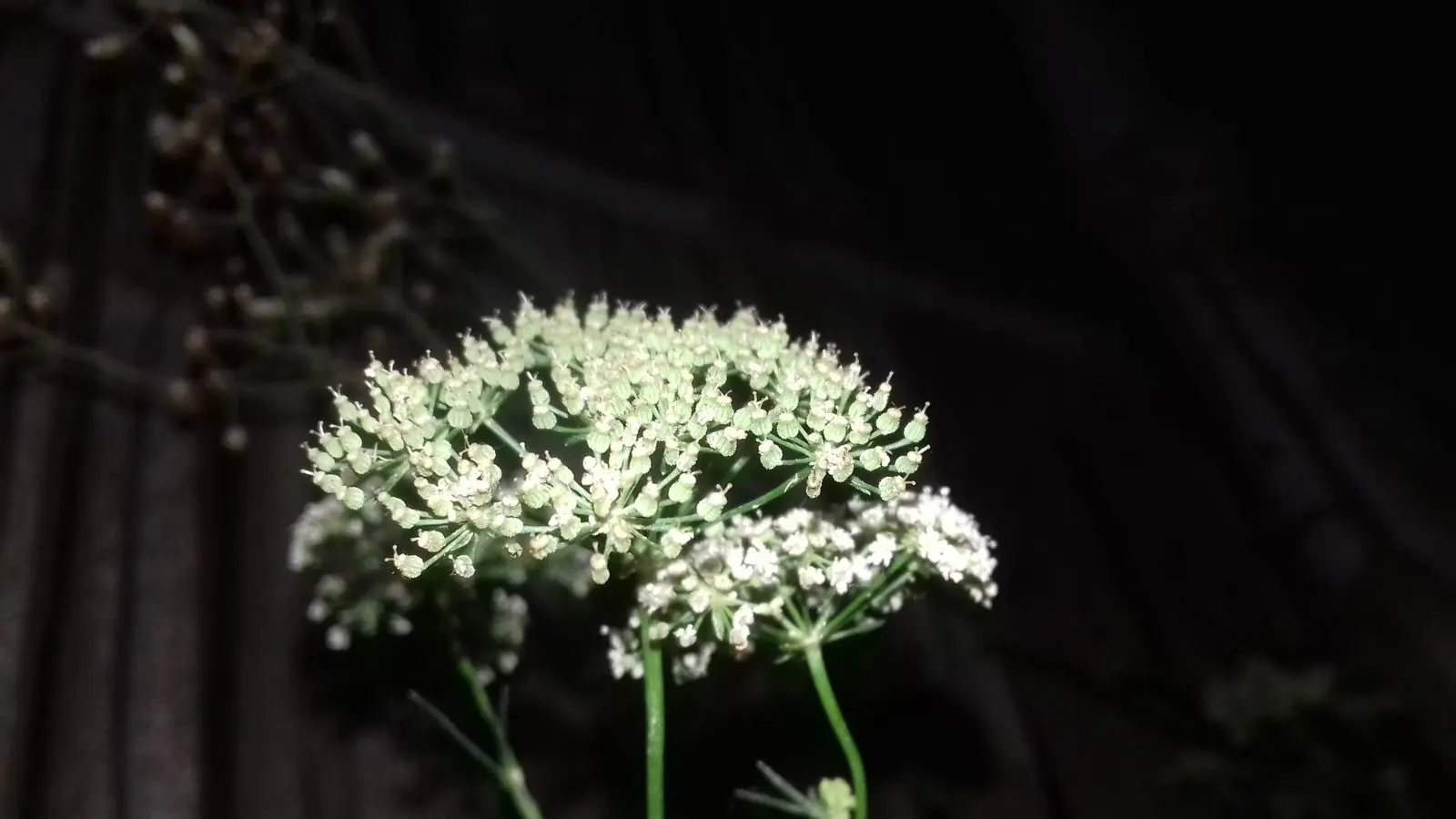
Ajwain (Trachyspermum ammi), also called carom seed or bishop's weed, is a rabi seed spice of the Apiaceae (carrot/coriander) family, grown mainly in Gujarat and Rajasthan and also in Madhya Pradesh and Uttar Pradesh, for its small, intensely pungent, thymol-rich seed.
The crop is unusually hardy: it tolerates dry heat and light soils, and is "generally less affected by insect-pests and diseases" compared with most spice crops. Its real weak point is not a pest but drainage — the taproot cannot survive standing water, and root rot sets in within about 48 hours of the soil staying saturated.
Beyond drainage, the only disease of real consequence is powdery mildew, cheaply controlled with sulphur, and the main insect to watch is aphids at the vegetative stage. This guide follows the crop with drainage, the sulphur spray timing, and the wide spread of variety durations in mind.
Crop timeline, sowing to harvest
A quick visual map of the season — jump to any section below for the detail behind each stage.
- Day 0
Sowing
Small seed drilled shallow in rows 45 cm apart into a fine, well-drained rabi seedbed — raised beds on heavy land.
- Day 8–15
Emergence
Slow, small-seeded germination typical of seed spices; thin the stand to 20–30 cm within the row.
- Day 20–45
Vegetative growth
Leafy growth builds; keep the field weed-free now and watch for aphids on the tender growth.
- Day 45–60
Flowering begins
The first sulphur dusting or spray against powdery mildew belongs here, before symptoms show, repeated 15 days later.
- Day 60–110
Seed set & fill
Only light, careful irrigation from here — this is also when root rot from any standing water does the most damage.
- Day 110–140
Maturation
Seed colour turns from green to greyish-brown as the plant dries; lower leaves yellow.
- Day 123–180
Harvest
Cut when seed has hardened and greyed — anywhere from ~123 days (an early variety) to 175–180 days (a long-duration one).
Suitable states
States where this crop is grown at scale, highlighted below. Your local Krishi Vigyan Kendra is still the final word for your specific block.
- Jammu and Kashmir
- Himachal Pradesh
- Punjab
- Uttarakhand
- Haryana
- Delhi
- Uttar Pradesh
- Rajasthan
- Bihar
- Jharkhand
- West Bengal
- Sikkim
- Assam
- Arunachal Pradesh
- Meghalaya
- Nagaland
- Manipur
- Mizoram
- Tripura
- Gujarat
- Madhya Pradesh
- Chhattisgarh
- Maharashtra
- Odisha
- Goa
- Telangana
- Andhra Pradesh
- Karnataka
- Kerala
- Tamil Nadu
- Puducherry
- Ladakh
- Chandigarh
- Lakshadweep
- Andaman and Nicobar Islands
- Dadra and Nagar Haveli and Daman and Diu
Grown here
Climate requirements
Ajwain is a hardy, relatively drought- and heat-tolerant seed spice — its real vulnerability is wet feet, not dry weather. The taproot cannot survive waterlogging and starts rotting within about 48 hours of the soil staying saturated, so drainage matters far more than rainfall or irrigation totals in deciding whether the crop lives or dies.
Ideal temperature
20–30°C suits growth; the crop tolerates dry heat well, but frost at flowering is damaging
Rainfall
A dry rabi season on a few light irrigations suits it best — standing water at any stage is the crop's worst enemy, not drought
Humidity
Low humidity is preferred; humid, cloudy spells at flowering favour powdery mildew
Sunlight
Full sun through the season for good flowering, seed-fill and aroma
Soil requirements
Choose a well-drained field first and a soil type second. Ajwain will grow in loam, clay loam or even fairly light soils, but no soil recommendation matters if the field holds water after rain or irrigation — that is the one condition this crop cannot forgive.
Suitable soil
Grows in most soil types but yields best on well-drained loam and clay loam; avoid pure sandy soil, which holds too little moisture and nutrients
pH range
6.5–8.0; tolerates the mildly alkaline soils common across its main Gujarat and Rajasthan belt
Drainage
Good drainage is the single most important soil condition for this crop — low-lying or heavy plots that hold standing water bring on root rot within days
Organic matter
Moderate; this modest feeder does well on the residual fertility of a well-manured previous crop
Land preparation
Same four steps whichever region you are in — only the timing shifts with the sowing window.
- 1
Fine, well-drained seedbed
Two or three ploughings and planking to a fine tilth for the tiny seed, on a plot that is known to drain — not merely convenient.
- 2
Raised beds on heavy land
Where the field is heavy clay or prone to standing water, sow on raised beds or ridges rather than flat land, so excess water runs off instead of pooling around the root.
- 3
Basal FYM and fertiliser
Work 8–10 t/ha of farmyard manure plus the full phosphorus and potash dose into the bed before sowing.
Seed information
How the main varieties compare, so you can pick by duration, yield, disease pressure or what you are growing for.
| Variety | Duration | Yield | Disease resistance | Best state | Suitable for |
|---|---|---|---|---|---|
Developed at ICAR-NRCSS, Ajmer through recurrent selection from Pratapgarh local germplasm. A long-duration, high-yielding release suited to both irrigated and rainfed cultivation. | ~165 days | 14.26 q/ha irrigated, 5.8 q/ha rainfed | Not specifically documented | Rajasthan | Both irrigated and rainfed fields |
Developed at ICAR-NRCSS, Ajmer through selection from local germplasm for earliness. A national-check variety for both irrigated and rainfed cultivation, and the more mildew-tolerant of the two Ajmer releases. | ~147 days | 12.83 q/ha irrigated, 5.2 q/ha rainfed | Powdery mildew tolerant | Rajasthan | Both irrigated and rainfed fields; mildew-prone tracts |
An early-maturing release from ICAR-NRCSS, Ajmer, flowering in just 46 days — 30–40 days ahead of normal-duration cultivars. Its erect plant type allows a higher planting density, which helps offset its lower per-plant yield, and it resists lodging caused by dew. | ~123 days | Lower per plant than normal-duration types; raised via higher plant population | Not specifically documented | Rajasthan and other ajwain tracts needing a short-duration option | A tight rabi window; dew-lodging-prone fields |
Released by Sardarkrushinagar Dantiwada Agricultural University (SDAU), Jagudan, Gujarat. A long-duration variety giving about 25% more yield than the local Gujarat type. | 175–180 days | ~25% higher than local Gujarat type | Not specifically documented | Gujarat, Rajasthan | A long rabi season, main Gujarat growing tracts |
Released by SDAU, Jagudan, Gujarat, after multi-location trials. Gives 12.9% and 4.5% higher seed yield than the national checks AA-1 and AA-2 respectively, with bold, uniform, attractive, more pungent and aromatic seed. | Medium duration | Average 1035 kg/ha across trials; bold seed (1.15 g test weight) | Not specifically documented | Gujarat, Rajasthan, Haryana, Andhra Pradesh, Uttar Pradesh, Chhattisgarh | A higher yield ceiling and premium, more pungent seed grade |
- Seed rate
- 1.5–2.5 kg/ha for drilling in rows; broadcasting takes a little more
- Certified seed
- In a mildew-prone tract, a tolerant variety such as AA-2 is a genuine help — but whichever variety you sow, the field's own drainage matters more than the seed packet. Even a mildew-resistant variety still rots in standing water.
- Spacing
- 45 cm between rows, thinned to 20–30 cm within the row
- Seed treatment
- Treat the seed with Thiram or Carbendazim plus a bio-agent such as Trichoderma before sowing, to guard the slow-germinating seed against damping-off in a cool, moist seedbed.
Sowing guide
Get the field's drainage right before worrying about the exact sowing date — a well-timed sowing on a plot that pools water after irrigation still loses the crop to root rot. If the soil is on the dry side at sowing, a light irrigation 4–5 days later helps even germination.
- Best time
- October–November for the main rabi crop; some warmer tracts sow a little earlier, from September
- Row spacing
- 45 cm
- Plant spacing
- 20–30 cm within the row
- Sowing depth
- 1–2 cm
- Method
- Drill the small seed shallow into a fine, moist, well-drained bed and cover lightly; on heavy or flood-prone land, sow on raised beds or ridges instead of flat ground
Fertilizer schedule
A split dose beats one large dose applied at sowing — nitrogen especially is lost to the air and to leaching if it all goes in on day one.
- 1
Basal (at land preparation)
Before sowing
8–10 t/ha farmyard manure plus the full phosphorus and potash and part of the nitrogen — a total of about 80 N : 50 P₂O₅ : 50 K₂O kg/ha for the season.
- 2
First top-dressing
45 days after sowing
A share of the remaining nitrogen, applied with an irrigation.
- 3
Second top-dressing
Just before flowering
The last share of nitrogen — do not push nitrogen once flowering is underway, as soft growth then invites aphids and mildew.
Irrigation schedule
1. Germination
Day 0–10
If the seedbed is on the dry side at sowing, one light irrigation about 4–5 days later evens up germination of the small seed.
2. Vegetative growth
25–45 days
One or two irrigations at roughly 15–25-day intervals build the crop; keep them light, not heavy.
3. Flowering & seed fill
60–110 days
Light, careful irrigation only — this is the stage when standing water does the most damage through root rot.
Critical stages
- Flowering
- Seed filling
Water-saving tips
- Ajwain needs only about 5–6 light irrigations across the whole season, spaced 2–3 weeks apart — more water does not raise yield, it only raises root-rot risk.
- Never irrigate a field that will not drain within a day; on heavy soils, sow on raised beds so excess water runs off instead of pooling around the root.
- Sowing into good residual moisture after a well-irrigated previous crop can save the first irrigation.
Weed management
Organic control
- One or two hand weedings up to 30–40 days, before the canopy closes in.
- A clean, well-drained seedbed germinates more evenly and gives the crop a head start on weeds.
Chemical control
- Pre-emergence Pendimethalin on moist soil right after sowing controls early weeds in this slow-starting crop.
- One hand weeding at around 30–35 days keeps the crop clean through its most vulnerable stretch.
Nutrient deficiency identification
What a shortage of each nutrient actually looks like on the plant, so you can tell a deficiency apart from a disease before you spray the wrong thing.
Nitrogen
Visible symptom
Pale, small older leaves and a thin, weak plant with few umbels.
Phosphorus
Visible symptom
Stunted plants with dull, dark leaves and delayed flowering.
Zinc
Visible symptom
Small, pale new leaves and stunted growth on light or alkaline soils.
Boron
Visible symptom
Poor seed set and hollow, cracked stems on deficient soils.
Iron
Visible symptom
Yellowing of the youngest leaves with green veins, common on the alkaline soils of the main ajwain belt.
Diseases to watch for
Symptoms, likely cause and what actually treats it — not just a spray name.
Powdery mildew
- Symptoms
- A whitish, powdery fungal growth over leaves and stems, worst in humid, cloudy weather, cutting seed fill and aroma.
- Cause
- A powdery-mildew fungus favoured by cloudy, humid conditions, especially around flowering.
- Treatment
- Dust with sulphur (about 25 kg/ha) or spray wettable sulphur at 0.1% at flowering, and repeat 15 days later.
- Prevention
- Time the first sulphur application to flowering, before symptoms show, rather than waiting for visible mildew — this is the crop's one disease of real consequence.
Root rot
- Symptoms
- Sudden yellowing of foliage, most often in 30–45-day-old plants, with the taproot rotting below ground.
- Cause
- Soil-borne fungi that take hold once the soil stays saturated — the root cannot survive standing water and rot can set in within about 48 hours of waterlogging.
- Treatment
- No in-crop cure once rot has set in; improve drainage immediately and avoid any further standing water.
- Prevention
- The single most important preventive step for this crop: never let water stand on the field. Sow on raised beds on heavy land, use treated seed, and avoid low, flood-prone plots altogether.
Pests to watch for
What to look for before the damage is visible, and organic options before you reach for a chemical.
Aphids
- Identification
- Small soft insects clustering on leaves and tender stems, mainly at the vegetative stage.
- Damage
- The main insect pest of ajwain — heavy colonies sap the plant, and affected leaves and tender stems become devitalised and dry out.
- Organic control
- Neem Seed Kernel Extract at 5%, or neem oil at 2%, sprayed as soon as colonies begin building.
- Chemical control
- A recommended systemic insecticide such as imidacloprid or dimethoate during infestation, with a second spray about 10 days later if numbers are still high — timed away from pollinator activity.
Jassids (leafhoppers)
- Identification
- Small green, wedge-shaped hoppers on the leaf underside, moving sideways when disturbed.
- Damage
- A sporadic sap-sucking pest of ajwain, alongside aphids — usually minor but worth scouting for during the vegetative stage.
- Organic control
- Yellow sticky traps and neem-based sprays; keep field borders clean of alternate hosts.
- Chemical control
- A recommended insecticide only if populations build to a damaging level.
Common mistakes to avoid
The mistakes that cost growers the most, ranked by how often they show up in the field — not in the order you might expect.
- 1
Sowing on low-lying or flood-prone land.
Why it hurts
Ajwain's taproot cannot survive standing water — root rot can set in within about 48 hours of waterlogging, killing the crop far faster than any pest or disease.
- 2
Irrigating heavily or too often "to be safe".
Why it hurts
The crop needs only 5–6 light irrigations all season; extra water does not raise yield, it only raises root-rot risk.
- 3
Waiting for visible powdery mildew before spraying.
Why it hurts
By the time the whitish growth is visible, the fungus has already spread — the first sulphur dusting or spray belongs at flowering, before symptoms show, repeated 15 days later.
- 4
Sowing the tiny seed too deep or into a rough, cloddy bed.
Why it hurts
Ajwain seed is small like most seed spices and needs a fine, shallow-covered bed to establish an even stand — sown deep or into clods, germination is slow and patchy.
- 5
Pushing nitrogen once flowering has begun.
Why it hurts
Late nitrogen gives soft, lush growth that invites aphids and mildew and delays maturity — the crop's last nitrogen share belongs just before flowering, not after.
- 6
Growing ajwain after ajwain, or after another seed spice, on the same field.
Why it hurts
Root rot and other soil-borne problems build up in the soil until the crop starts failing in patches — rotate with a cereal or an unrelated crop.
- 7
Choosing a long-duration variety in a tight rabi window.
Why it hurts
A long type like GA-1 needs 175–180 days; where the season is short, an early variety like AA-93 (about 123 days) fits, even though its lower per-plant yield needs a higher planting density to compensate.
- 8
Harvesting too early or letting the crop over-stand in the field.
Why it hurts
Seed cut too early is unripe and loses pungency and aroma; seed left too long shatters and drops in the field — cut once the seed has hardened and turned greyish-brown.
Harvesting
Cut when the seed has hardened and turned from green to greyish-brown, typically 130–180 days after sowing for most varieties, or as early as about 123 days for an early type like AA-93. Cutting too late loses seed to shattering.
Signs it is ready
- Seed colour turning grey-brown and hard
- Umbels drying while the stem still holds some green
- Lower leaves yellowing and drying
Tools
- Sickle for cutting whole plants
- Tarpaulin or a clean threshing floor for drying and threshing
- Shade or mild sun for curing, to protect aroma and pungency
Expected yield
4–6 q/ha under rainfed conditions; 12–15 q/ha under irrigation with a high-yielding variety such as AA-1, AA-2 or GA-3
Post-harvest & storage
Storage
Dry the threshed seed to a safe, low moisture and store it in a cool, dry, airy store; well-dried ajwain holds its pungency and aroma for months.
Packaging
Pack clean, fully-dried seed in clean bags kept off the floor in a dry store.
Transportation
Move only fully-dried seed, protected from moisture — damp seed moulds quickly in transit.
Shelf life
Many months to about a year for well-dried, properly stored seed.
Market prices
Today's mandi price near you, pulled live from the government's own Agmarknet data.
Live daily mandi prices from the government Agmarknet dataset.
Synced from data.gov.in (Agmarknet). Rates are ₹ per quintal.
Weather
Current conditions and a 5-day outlook for your selected location, with one line of stage-aware advice.
Pick your state for current conditions and a 5-day outlook.
Live data from Open-Meteo
Profit calculator
Your own cost sheet, expected yield and selling price — not ours.
Where the money goes
Share of the total cost per acre, using the calculator’s own default cost sheet below — adjust the numbers there to match your field and this picture will no longer apply to you exactly, but the ranking rarely changes.
- Land rent35% (₹8,000)
- Labour24% (₹5,500)
- Irrigation11% (₹2,500)
- Fertiliser10% (₹2,200)
- Machinery9% (₹2,000)
- Pesticide & weedicide5% (₹1,200)
- Interest3% (₹800)
- Seed3% (₹700)
Official downloads
Government and ICAR documents only — everything below is hosted on an official server.
Frequently asked questions
Why is waterlogging so dangerous for ajwain?
Ajwain has a taproot that cannot survive standing water. Once the soil stays saturated, root rot can set in within about 48 hours, most often showing up as sudden yellowing in 30–45-day-old plants. This single cause kills more ajwain crops than any pest or disease — which is why good drainage, and raised beds on heavy land, matter more than almost any other decision you make on this crop.
What is the main disease of ajwain and how do I control it?
Powdery mildew — a whitish, powdery fungal growth on the leaves and stems — is ajwain's one disease of real consequence, worst in humid, cloudy weather around flowering. Control it cheaply by dusting sulphur at about 25 kg/ha, or spraying wettable sulphur at 0.1%, timed to flowering before symptoms show and repeated 15 days later.
How much water does ajwain need?
Very little — about 5–6 light irrigations across the whole season, spaced roughly 2–3 weeks apart, is enough. Unlike most crops, giving ajwain extra water "to be safe" does not raise yield; it only raises the risk of root rot, since the crop's taproot cannot tolerate standing water at any stage.
Which ajwain variety should I choose?
It depends on your season and field. AA-2 is a good all-rounder with some powdery-mildew tolerance. AA-93 matures in about 123 days — useful where the rabi window is short, though its per-plant yield is lower and needs a higher planting density to compensate. GA-1 and GA-3 are longer-duration, higher-yielding Gujarat releases, with GA-3 also prized for its bold, more pungent, aromatic seed.
When should I harvest ajwain?
Cut once the seed has hardened and turned from green to greyish-brown — typically 130–180 days after sowing for most varieties, though an early type like AA-93 is ready in about 123 days. Cutting too early loses pungency and aroma; leaving the crop too long lets the seed shatter and drop in the field.
Does ajwain have an MSP?
No. Ajwain is a market seed-spice crop with no Minimum Support Price — its price is set by mandi and spice-market demand and can swing widely between years and seasons. Use the live mandi prices and the profit calculator on this page when planning the crop and deciding when to sell.
Still have questions?
The FAQs above cover the common ones. For anything specific to your field and soil, your nearest Krishi Vigyan Kendra is the authoritative answer.