
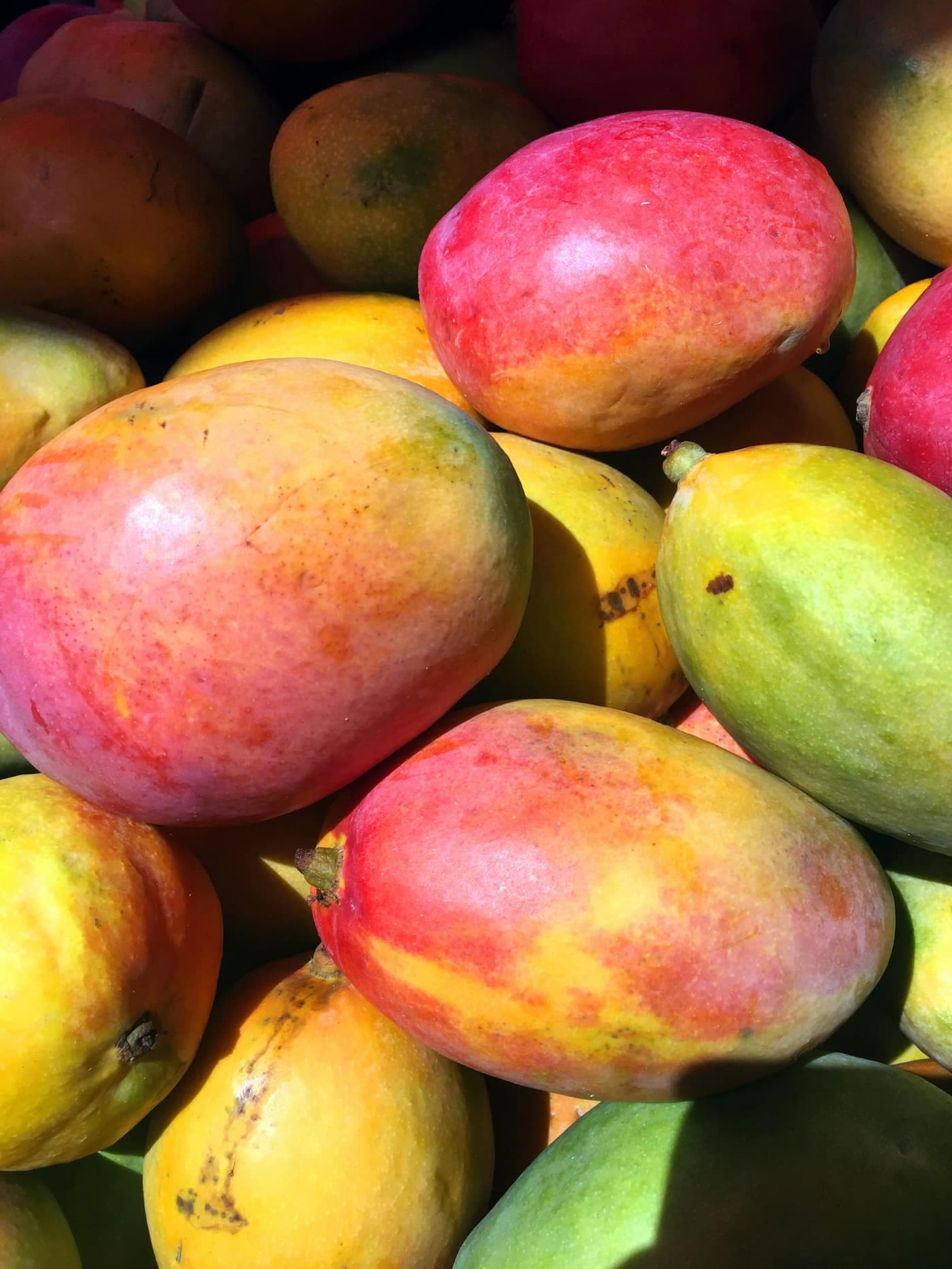
Mango
Mangifera indica
The king of fruits and India’s defining orchard crop, alternate-bearing by nature. The flowering-time spray against hopper and powdery mildew — timed before the panicles open — decides most of the season’s fruit, and good drainage decides whether the tree lives to a ripe old age.
Quick Summary
The key points from this page in about two minutes — read it or have it read aloud.
Quick Summary
Mango is India’s defining orchard crop and a decades-long commitment. A grafted tree of a known variety takes four to five years to bear, and once it does it is naturally alternate-bearing — a heavy "on" year followed by a light "off" one — a rhythm that good nutrition and canopy management can soften but never fully remove. Every mango region has its own prized varieties.
The season turns on one short window: flowering in the cool, dry winter. The sprays against mango hopper and powdery mildew have to go on before the panicles open — do that and you protect the set; miss it and a tree in full bloom can still end with almost no fruit. The single climatic rule behind this is dry weather at flowering: rain, cloud or a warm spell then spreads mildew and anthracnose, washes off pollen and wrecks the set.
Two other levers run through the year. Fruit fly attacks the developing and ripening fruit, so trap and monitor for it, and good drainage all year is what decides whether the tree lives to a ripe old age — mango does not tolerate waterlogging. Young trees are frost-sensitive and are trained to a strong low frame for the first few years with no crop taken. Pick the fruit mature-green with a short stalk once the shoulders fill and the first fruit colours, region by region from April in the south to July in the north. The page below carries the planting layout, the flowering-spray timing, the nutrition and canopy plan for alternate bearing, the harvest indices and bearing-tree yields.
- Crop type
- Perennial orchard fruit
- Flowering
- Dec–Feb (cool, dry)
- Suitable states
- 15+ major states
- First bearing
- 4–5 years (grafted)
- Water requirement
- Low–moderate; dry at flowering
- Temperature
- 24–30°C; frost-sensitive when young
- Soil type
- Deep, well-drained loam
- Difficulty level
- Moderate
- Expected yield
- 60–100 q/ha (bearing)
- Key practice
- Flowering-time spray timing
Overview
Mango (Mangifera indica) is India’s most important fruit crop by area and by cultural weight — Uttar Pradesh, Andhra Pradesh, Bihar and Karnataka lead a very long list of mango states, each with its own prized varieties, from Dashehari and Langra to Alphonso, Kesar and Banganapalli.
A mango orchard is a decades-long commitment. Grafted trees of a known variety take four to five years to bear, and the crop is naturally alternate-bearing — a heavy “on” year followed by a light “off” one — a rhythm good nutrition and canopy management can soften but never fully erase.
The season turns on a short window: flowering in the cool, dry winter. Get the hopper and powdery-mildew sprays in before the panicles open and you protect the set; miss them and a full bloom can still end in almost no fruit. Fruit fly at the other end, and drainage all year, are the other levers this guide follows.
Crop timeline, sowing to harvest
A quick visual map of the season — jump to any section below for the detail behind each stage.
- Year 0
Planting
A grafted sapling of a known variety set in a large pit at 10 × 10 m at the start of the monsoon, staked and basin-irrigated.
- Year 1–4
Training & framing
The young tree is trained to a strong low frame; no crop is taken while the canopy is built and roots go deep.
- Dec–Feb
Flowering
In a bearing tree, panicles emerge over the cool, dry winter — the make-or-break window for hopper and mildew control.
- Feb–Mar
Fruit set
A tiny fraction of flowers set into pea-sized fruit; a spray and a light irrigation guard the fragile set.
- Mar–Apr
Fruit development
Fruit swells over the warming spring; steady moisture and fruit-fly watch keep the crop clean and sized.
- Apr–Jun
Maturity
Shoulders fill, the fruit’s specific gravity rises and the first fruit colours — the sign it is ready to pick mature-green.
- Apr–Jul
Harvest
Fruit is clipped mature-green with a short stalk, region by region from April in the south to July in the north.
Suitable states
States where this crop is grown at scale, highlighted below. Your local Krishi Vigyan Kendra is still the final word for your specific block.
- Jammu and Kashmir
- Himachal Pradesh
- Punjab
- Uttarakhand
- Haryana
- Delhi
- Uttar Pradesh
- Rajasthan
- Bihar
- Jharkhand
- West Bengal
- Sikkim
- Assam
- Arunachal Pradesh
- Meghalaya
- Nagaland
- Manipur
- Mizoram
- Tripura
- Gujarat
- Madhya Pradesh
- Chhattisgarh
- Maharashtra
- Odisha
- Goa
- Telangana
- Andhra Pradesh
- Karnataka
- Kerala
- Tamil Nadu
- Puducherry
- Ladakh
- Chandigarh
Grown here
Climate requirements
The one climatic rule that governs mango is dry weather at flowering. A cool, dry, frost-free winter gives a good bloom and set; rain, cloud or a warm spell during flowering brings mildew and flower drop and can turn a full bloom into a near-empty tree.
Ideal temperature
24–30°C suits growth and fruiting; a cool, dry, frost-free winter is needed for good flowering, and young trees are frost-sensitive
Rainfall
Grows well from 600 to 2,500 mm, but rain or cloud during flowering is damaging — it spreads mildew, washes off pollen and wrecks the set
Humidity
Moderate; dry weather at flowering is essential, while humid, cloudy spells then bring on powdery mildew and anthracnose
Sunlight
Full sun for flowering, fruit colour and sugar; a crowded, shaded canopy flowers and fruits poorly on the inside
Soil requirements
Mango wants depth and drainage above richness. A deep, well-drained loam lets the roots go down and the tree live for decades; a shallow or waterlogged soil gives early decline whatever you feed it. Match the variety to the region — many are strongly local.
Suitable soil
Deep (at least 1–2 m), well-drained loam or alluvium; avoid shallow, rocky, waterlogged or highly calcareous/saline soils
pH range
5.5–7.5
Drainage
Good deep drainage is essential — mango is a deep-rooted tree that declines and dies back in waterlogged or hardpan soils
Organic matter
Moderate; the tree responds to FYM and does well on fertile alluvium, but over-rich, over-watered soil pushes leaf at the expense of flower
Land preparation
Same four steps whichever region you are in — only the timing shifts with the sowing window.
- 1
Layout & large pits
Mark a 10 × 10 m grid and dig large pits well ahead of the monsoon, refilling with topsoil, FYM and a little phosphorus.
- 2
Drainage & windbreak
Ensure the block drains freely and plant a windbreak on exposed sides — young mango is easily wind-rocked and frost-nipped.
- 3
Graft selection
Source true-to-type grafted saplings of a known, region-suited variety from a reliable nursery before planting.
Seed information
How the main varieties compare, so you can pick by duration, yield, disease pressure or what you are growing for.
| Variety | Duration | Yield | Disease resistance | Best state | Suitable for |
|---|---|---|---|---|---|
North India’s leading mid-season table mango — sweet, fibreless, heavy-bearing; the backbone of the UP belt. | Mid-season (Jun–Jul north) | High | Moderate; alternate-bearing | Uttar Pradesh | Table, north India |
A classic late-season green-skinned north-Indian variety with rich flavour. | Late-season | High | Moderate | Uttar Pradesh / Bihar | Table, north India |
The premium export mango of the Konkan — saffron pulp, superb flavour, but strongly alternate-bearing and fussy. | Early-mid (Apr–May) | Medium | Prone to spongy tissue | Maharashtra | Export, premium table |
Gujarat’s aromatic saffron-pulp mango, well-suited to Saurashtra and a strong export and pulp variety. | Mid-season | High | Moderate | Gujarat | Export, pulp, table |
An IARI dwarf hybrid of Dashehari and Neelum, grafted, not grown from seed. Bred for high-density orchards and a steadier yield year to year — the fix for Dashehari's worst habit. | Bearing from year 3–4 (grafted plant, dwarf habit) | 60–80 kg/tree at full bearing — more trees fit per acre than Dashehari | More regular annual bearing than most north Indian varieties | Uttar Pradesh, Bihar, West Bengal, Delhi | High-density orchards, steady yield |
A large south-Indian table mango. | Mid-season | Very high | Moderate | Andhra Pradesh | Table, south |
The mainstay of south India's pulp and processing industry. | Mid-season | Very high | Moderate | Andhra Pradesh | Processing, south |
- Seed rate
- About 100 grafted trees/ha at 10 × 10 m; high-density plantings use closer spacing with size-controlling management
- Certified seed
- Plant grafted (not seedling) saplings of a named, region-suited variety from a reliable nursery — a seedling mango is variable, late to bear and rarely true to the parent. The variety choice is a decades-long decision, so match it to your climate and market.
- Spacing
- 10 × 10 m for standard orchards (about 100 trees/ha); 5 × 5 m or closer for managed high-density systems
- Seed treatment
- Not a seed crop — select healthy, disease-free grafts, dip roots as advised, and protect the young graft union and stem after planting.
Sowing guide
Plant at the monsoon’s onset so the young tree establishes on natural moisture, and keep the graft union above the soil. Stake every sapling — a wind-rocked young mango sits loose in its pit and dies back. The first four years are about building the frame, not taking a crop.
- Best time
- Plant grafted saplings at the start of the monsoon (July–August) in most regions, or February–March where winters are mild and water is assured
- Row spacing
- 10 m between rows
- Plant spacing
- 10 m within the row
- Sowing depth
- Set the graft union well above the soil line; plant no deeper than the sapling stood in the nursery
- Method
- Plant true-to-type grafts into large FYM-filled pits, stake against wind, and give a basin irrigation immediately
Fertilizer schedule
A split dose beats one large dose applied at sowing — nitrogen especially is lost to the air and to leaching if it all goes in on day one.
- 1
Post-harvest (foundation)
Jun–Jul
The main annual dose of FYM plus NPK applied after harvest, when the tree flushes and lays down next year’s wood — the most important feed of the year.
- 2
Pre-flowering restraint
Sep–Oct
Avoid heavy nitrogen now; too much late nitrogen pushes vegetative flushes that flower poorly. Potash supports flowering.
- 3
Fruit development
Mar–Apr
A supporting dose (often as fertigation/foliar potassium and calcium) during fruit swell improves size and reduces drop and disorders.
Irrigation schedule
1. Flowering
Dec–Feb
Keep the tree on the dry side before and during flowering — moisture stress helps induce flowering, and wet weather hurts the set.
2. Fruit set to development
Feb–Apr
Begin light, regular irrigation after set; steady moisture through fruit growth builds size and cuts fruit drop.
3. Pre-harvest
Before picking
Ease off just before harvest for better fruit quality; resume the main irrigation after harvest with the foundation feed.
Critical stages
- Fruit set
- Fruit development
Water-saving tips
- A bearing mango needs little irrigation in winter and most in spring fruit growth — match water to stage, not the calendar.
- Basin mulching conserves the spring moisture that sizes the fruit.
- Drip on young and high-density orchards saves water and places nutrients precisely.
Weed management
Common weeds
Organic control
- Basin mulching and a mown cover crop in the alleys smother weeds and build soil.
- Grazing/slashing the inter-space in bearing orchards keeps weeds down without cultivation near the roots.
Chemical control
- Keep the tree basins weed-free with a spot herbicide in young orchards; the alleyways can be mown or grassed down.
- Avoid herbicide contact with the young graft/trunk.
Nutrient deficiency identification
What a shortage of each nutrient actually looks like on the plant, so you can tell a deficiency apart from a disease before you spray the wrong thing.
Nitrogen
Visible symptom
Pale, small leaves and weak flushes with poor canopy fill on hungry trees.
Potassium
Visible symptom
Marginal scorch of older leaves, small fruit and heavier fruit drop.
Zinc
Visible symptom
Small, narrow “little-leaf” rosettes at shoot tips — a very common mango deficiency.
Boron
Visible symptom
Poor fruit set, internal fruit disorders and corky, deformed fruit.
Iron
Visible symptom
Yellowing of young leaves with green veins, on calcareous or waterlogged soils.
Diseases to watch for
Symptoms, likely cause and what actually treats it — not just a spray name.
Powdery mildew
- Symptoms
- White powdery growth on panicles, flowers and young fruit; affected flowers dry and drop, and a full bloom can set almost no fruit.
- Cause
- Oidium mangiferae, favoured by cool, cloudy, humid weather during flowering.
- Treatment
- Spray wettable sulphur or a systemic fungicide at panicle emergence and repeat as advised through flowering.
- Prevention
- Time protective sprays before the panicles open, keep the canopy open, and choose the spray window by weather — this is the classic flowering-time disease.
Anthracnose
- Symptoms
- Black spots and blossom blight on panicles and leaves, and sunken black lesions on the fruit that spread in storage and ripening.
- Cause
- Colletotrichum gloeosporioides, favoured by wet, humid weather at flowering and fruiting.
- Treatment
- Protective fungicide sprays at flowering and pre-harvest, plus post-harvest hot-water treatment for storage rots.
- Prevention
- Open canopy, orchard sanitation (remove mummified fruit and dead wood) and well-timed sprays in wet years.
Mango malformation
- Symptoms
- Bunched, thickened, sterile vegetative or floral growth (“witches’ broom” panicles) that never sets fruit.
- Cause
- Associated with Fusarium and mite involvement; the shoots are permanently deformed.
- Treatment
- Prune out and destroy malformed panicles and shoots below the affected part before flowering.
- Prevention
- Use clean grafts, remove malformed growth annually, and manage mango bud mite.
Sooty mould (from hopper honeydew)
- Symptoms
- A black sooty coating on leaves and panicles that blocks light and blackens the tree, following a hopper attack.
- Cause
- Fungi growing on the honeydew excreted by mango hopper and scale.
- Treatment
- Control the hopper/scale that produce the honeydew; the mould then weathers off.
- Prevention
- Manage hopper at flowering and keep the canopy open and airy — the mould is a symptom of the pest, not the primary problem.
Pests to watch for
What to look for before the damage is visible, and organic options before you reach for a chemical.
Mango hopper
- Identification
- Wedge-shaped hoppers that swarm the panicles at flowering, flicking away as you approach; sticky honeydew coats the leaves below.
- Damage
- The number-one flowering pest — it sucks the panicles dry, causing flower drop and poor set, and its honeydew brings on sooty mould.
- Organic control
- Open, well-pruned canopies, neem sprays and conserving natural enemies; time monitoring to panicle emergence.
- Chemical control
- A recommended insecticide at panicle emergence and again after set if hoppers cross threshold, avoiding the peak-bee flowering window where possible.
Fruit fly
- Identification
- Maggots inside ripening fruit, from eggs laid under the skin by the female fly; punctured fruit rots and drops.
- Damage
- The main pre-harvest and quarantine pest — maggoty fruit is unsellable and bars export.
- Organic control
- Methyl-eugenol traps from fruit set, prompt collection and destruction of fallen fruit, and bagging of premium fruit.
- Chemical control
- Protein-bait spot sprays and a recommended cover spray near maturity; hot-water treatment clears larvae post-harvest for export.
Mealybug
- Identification
- White, waxy bugs that climb the trunk from the soil in winter and cluster on panicles and young fruit.
- Damage
- Sap-sucking on panicles causes flower and fruit drop, and honeydew brings sooty mould.
- Organic control
- A slippery band/plastic skirt on the trunk to stop the crawlers climbing, plus destroying eggs in the soil by winter ploughing.
- Chemical control
- A recommended insecticide on the trunk band and canopy where mealybug is established.
Mango stone weevil & bud mite
- Identification
- Stone weevil grubs bore into the seed inside the fruit (unseen until cut); bud mite deforms buds and is linked to malformation.
- Damage
- Stone weevil is a serious quarantine pest barring export even where flesh looks sound; bud mite worsens malformation.
- Organic control
- Orchard sanitation — collect and destroy fallen fruit and prune out malformed buds; use clean planting material.
- Chemical control
- A recommended spray schedule where these pests are established, on expert advice.
Common mistakes to avoid
The mistakes that cost growers the most, ranked by how often they show up in the field — not in the order you might expect.
- 1
Planting a seedling mango instead of a grafted one.
Why it hurts
A seedling is variable, slow to bear and rarely true to the parent — always plant a named, region-suited graft, because the variety is a decades-long decision.
- 2
Missing the flowering-time spray window.
Why it hurts
Hopper and powdery mildew hit as the panicles open, and a full bloom can set almost no fruit — the protective spray must go in before the panicles open, not after damage shows.
- 3
Pushing heavy nitrogen before flowering.
Why it hurts
Late nitrogen drives vegetative flushes at the expense of flower and worsens alternate bearing — feed the main dose after harvest, not before bloom.
- 4
Planting in shallow or waterlogged soil.
Why it hurts
Mango is deep-rooted and declines early in shallow or ponding soil however well fed — depth and drainage matter more than richness.
- 5
Not staking the young tree.
Why it hurts
A wind-rocked sapling sits loose in its pit, the roots never anchor and it dies back — stake every young mango against wind.
- 6
Ignoring fruit fly until harvest.
Why it hurts
By the time you see maggoty fruit the crop is already infested and unsellable — hang traps from fruit set and collect fallen fruit through the season.
- 7
Leaving mummified fruit and dead wood in the tree.
Why it hurts
They carry anthracnose and pests into next season — orchard sanitation each year is a free disease-control measure.
- 8
Harvesting fully ripe for a distant market.
Why it hurts
Tree-ripe mango bruises and rots in transit — clip fruit mature-green with a short stalk and ripen it off the tree.
- 9
Pulling fruit off by hand without a stalk.
Why it hurts
Snapping the fruit at the skin lets sap burn (spongy black staining) the shoulder and opens it to rot — clip with a short stalk and de-sap fruit stalk-down.
- 10
Never pruning the canopy.
Why it hurts
A dense, unpruned canopy flowers and fruits only on the outside, harbours pests and mildew, and makes spraying and picking impossible — open the centre after harvest.
Harvesting
Harvest mature-green: when the shoulders fill out past the stalk, the fruit’s specific gravity rises (mature fruit sinks in water) and the first fruit on the tree begins to colour and drop. Clip the fruit with a short stalk using a picking pole with a bag, not by pulling, and let the sap drain stalk-down before packing. Season runs region by region from April in the south to July in the north.
Signs it is ready
- Shoulders filled out past the stalk
- Mature fruit sinks in water (high specific gravity)
- First fruit beginning to colour and drop
Tools
- A mango harvester pole with a cutting blade and bag
- Crates lined to prevent bruising
- A shaded de-sapping and grading area
Expected yield
60–100 q/ha in a well-managed bearing orchard (roughly 600–1,500 fruit per mature tree), lower in an “off” year
Post-harvest & storage
Storage
Mango is harvested mature-green and ripened off the tree; fruit can be held for a week or two under cool storage (around 12–13°C, not colder — it is chilling-sensitive) and then ripened at ambient or in a controlled ripening chamber.
Packaging
De-sap, wash, grade by size and pack in single layers in ventilated cartons with cushioning; a post-harvest hot-water dip controls anthracnose and disinfests fruit fly for export.
Transportation
Move mature-green fruit promptly; reefer transport at mango-safe temperatures extends the reach to distant and export markets without chilling injury.
Shelf life
About 1–3 weeks mature-green under correct cool storage, then a few days once ripe; ripe fruit is highly perishable.
Market prices
Today's mandi price near you, pulled live from the government's own Agmarknet data.
Live daily mandi prices from the government Agmarknet dataset.
Synced from data.gov.in (Agmarknet). Rates are ₹ per quintal.
Weather
Current conditions and a 5-day outlook for your selected location, with one line of stage-aware advice.
Pick your state for current conditions and a 5-day outlook.
Live data from Open-Meteo
Profit calculator
Your own cost sheet, expected yield and selling price — not ours.
Where the money goes
Share of the total cost per acre, using the calculator’s own default cost sheet below — adjust the numbers there to match your field and this picture will no longer apply to you exactly, but the ranking rarely changes.
- Labour27% (₹16,000)
- Land rent20% (₹12,000)
- Pesticide & weedicide15% (₹9,000)
- Fertiliser13% (₹8,000)
- Irrigation10% (₹6,000)
- Seed5% (₹3,000)
- Machinery5% (₹3,000)
- Interest4% (₹2,500)
Official downloads
Government and ICAR documents only — everything below is hosted on an official server.
Frequently asked questions
Why does my mango tree flower heavily but set almost no fruit?
Two things usually cause it. First, mango sets only a tiny fraction of its flowers even in a good year, so a big bloom does not guarantee a big crop. Second, and most often, hopper and powdery mildew hit the panicles at flowering — the hopper sucks them dry and the mildew dries the flowers — so if the protective spray goes in after the panicles have opened rather than before, a full bloom can end in a near-empty tree. Wet or cloudy weather at flowering makes it worse.
What is alternate bearing and can I manage it?
Many mango varieties bear a heavy “on” crop one year and a light “off” crop the next, because a heavy crop drains the tree and leaves it little energy to lay down flower buds for the following year. You cannot erase it, but you can soften it with a strong post-harvest feed and irrigation to help the tree recover, canopy pruning to keep it productive, and, in some systems, paclobutrazol under expert advice. Choosing a more regular-bearing variety also helps.
Why plant a grafted mango and not grow one from a seed?
A seedling mango is genetically variable, takes far longer to bear (often 6–8 years or more), and rarely gives fruit true to the parent — you do not know what you will get. A grafted sapling of a named variety bears in four to five years and gives the exact variety you chose. Since a mango orchard lasts decades, the variety and graft decision is one of the most important you make.
When and how should I pick mango?
Pick mature-green, not tree-ripe: when the shoulders fill out past the stalk, mature fruit sinks in water, and the first fruit begins to colour and drop. Clip the fruit with a short stalk using a picking pole with a bag — do not pull it off, which lets sap burn the shoulder and invites rot — and let the sap drain with the fruit stalk-down before packing. Ripen the fruit off the tree.
How do I keep fruit fly out of my mangoes?
Fruit fly lays eggs under the skin and the maggots ruin the fruit from inside, so by the time you see damage it is too late. Manage it preventively: hang methyl-eugenol traps from fruit set, collect and destroy every fallen fruit so maggots do not complete their cycle in the soil, bag premium fruit, and use a protein-bait or cover spray near maturity. For export, a post-harvest hot-water treatment disinfests the fruit.
Does mango have an MSP?
No. Mango is a market fruit with no Minimum Support Price — the rate is set by variety, grade, season and export demand, and premium varieties like Alphonso and Kesar fetch far more than common ones. Use the live mandi prices and the profit calculator on this page when planning, and remember that grading, ripening and pulp/processing add much of the margin.
Still have questions?
The FAQs above cover the common ones. For anything specific to your field and soil, your nearest Krishi Vigyan Kendra is the authoritative answer.