
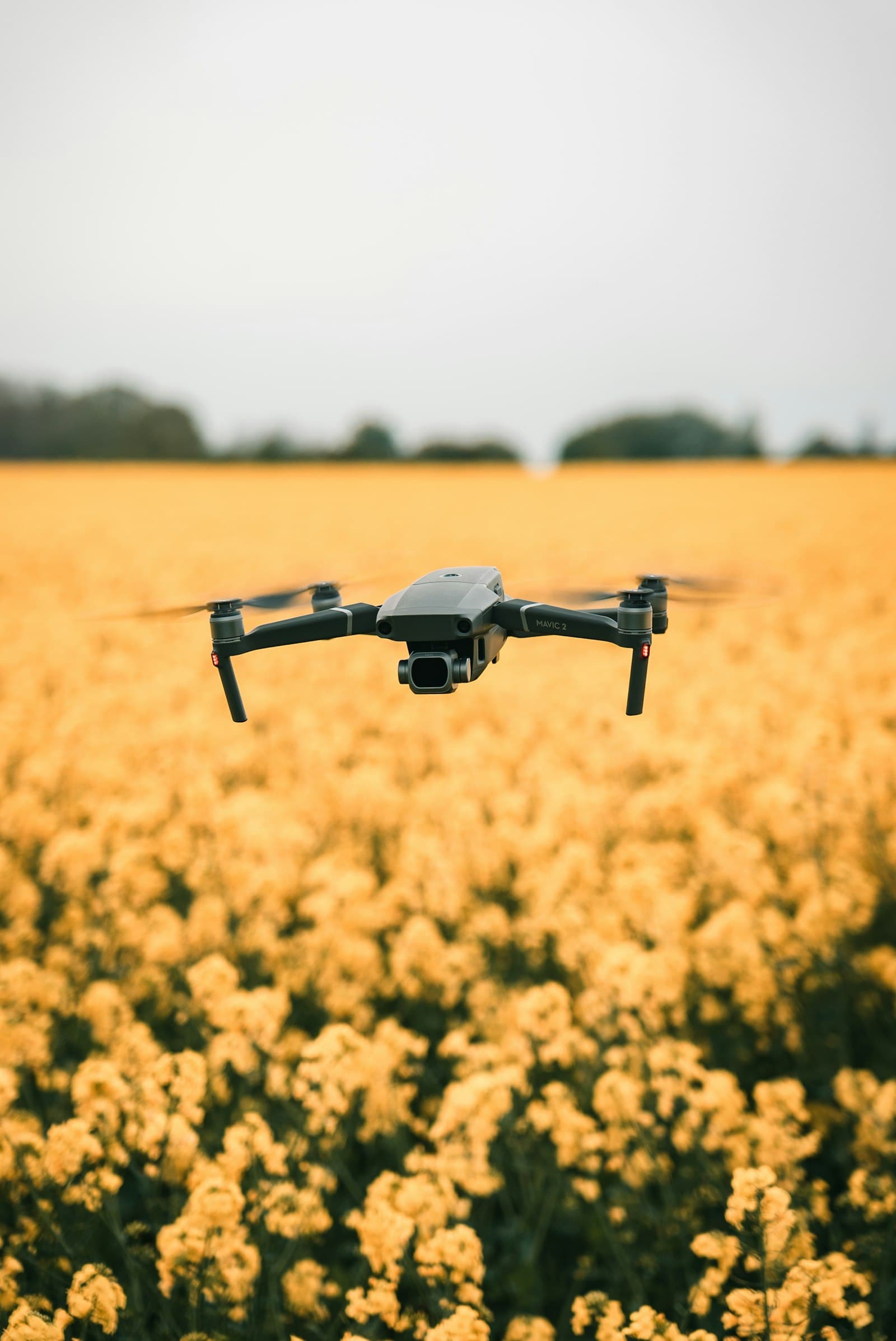
Drone Spraying: Hire It, Don't Buy It
A spray drone covers an acre in 8 minutes on a tenth of the water. At Rs 6-10 lakh, the maths only works past about 50 acres.
Vaibhav Dhama4 min readA battery-powered drone sprays a full acre in 7–10 minutes on roughly a tenth of the water a knapsack uses, and keeps the operator entirely out of the chemical cloud — reaching standing, tall and waterlogged crops no ground machine can enter.
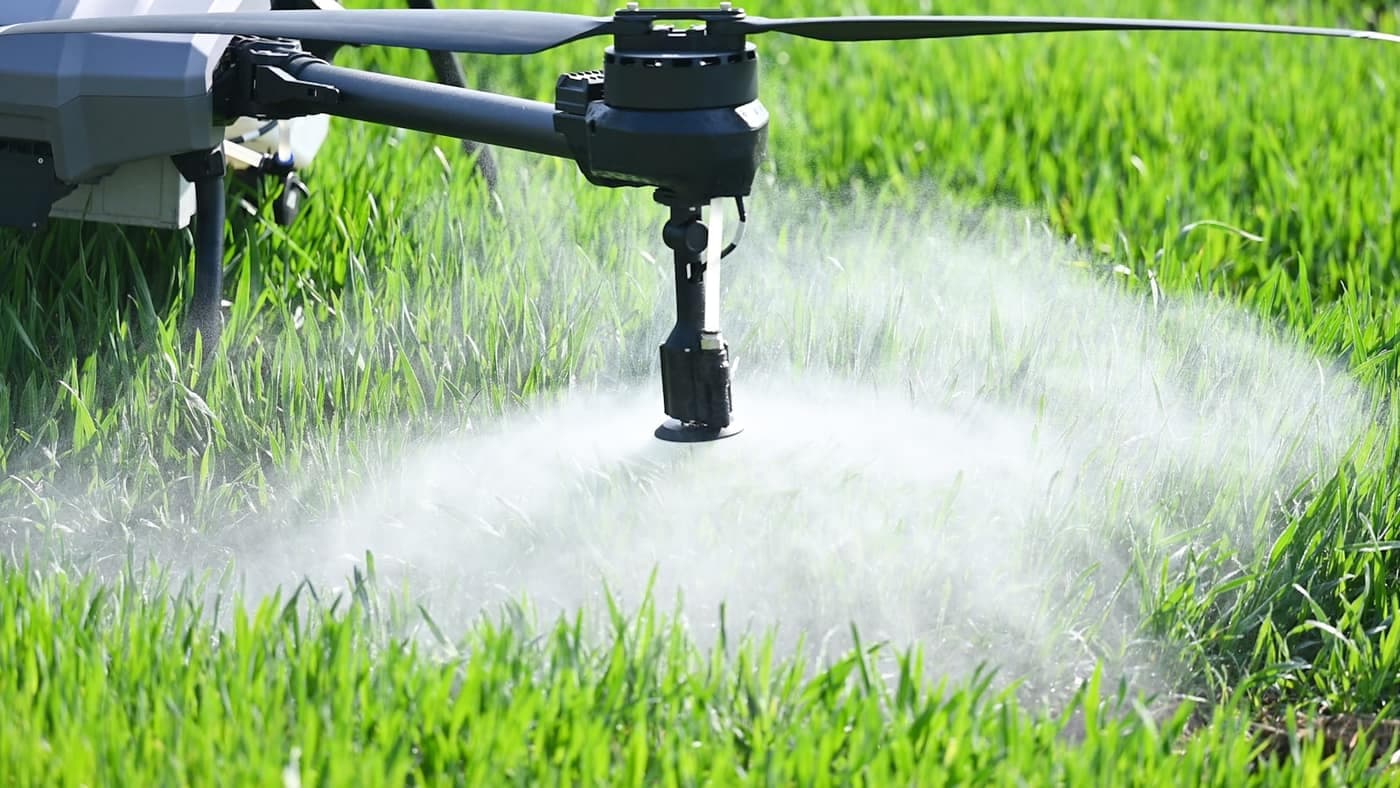
Drone spraying is the fastest-growing agri-technology on Indian fields right now — not because it is the cheapest way to spray, but because it does two things no ground sprayer can: it reaches a crop nobody can walk or drive into, standing paddy, tall cotton, a waterlogged field, and it keeps the operator entirely out of the spray cloud. This page exists to answer what comes before hiring or buying one — how the drone actually works, what it costs to hire against what it costs to own, the DGCA licence a pilot needs, and what Namo Drone Didi actually pays for.
It is written to sit alongside the Agri Technology hub, which places drone spraying against every other technology genuinely paying on an Indian holding. This page assumes a spray drone is the technology in question and goes deeper — the parts, a spraying flight start to finish, the crops it suits best, and the honest arithmetic on why hiring beats owning for all but the largest holdings.
The numbers a farmer checks before hiring or buying one.
A fine mist released from above the canopy, not walked or driven through the crop.
A spray drone carries a tank of diluted pesticide, herbicide or foliar nutrient on a multi-rotor airframe, releasing it through nozzles beneath the arms as it flies a pre-planned pattern a few feet above the canopy. Because the spray comes from above instead of being walked or driven through the crop, it reaches standing paddy, tall cotton and waterlogged fields no knapsack or tractor boom can enter — and it clears a full acre in 7–10 minutes.
The other half of the saving is the water: a drone atomises the mix into a fine spray and applies it at roughly a tenth of the volume a knapsack uses per acre, because it only needs to carry what a battery can lift, not what a person can carry on their back. None of this works without the correct nozzle and droplet size for the target pest — see components below — and without checking wind before every flight, covered under common problems.
Six components, from the airframe to the app that plans the flight.
Airframe & rotors
The multi-rotor frame and motors that lift the tank and hold the drone steady a few feet above the canopy — most agricultural models use four, six or eight rotors for the extra lift a full tank needs.
Battery
A swappable pack powers roughly 8–10 minutes of flight per charge. Most operators carry several charged spares to keep spraying through the day instead of waiting for one pack to recharge.
Spray tank & pump
A 10–16 litre tank holds the diluted mix, fed by a small pump to the nozzles at a rate matched to the drone’s forward speed, so the dose per acre stays constant however fast it flies.
Nozzles
Mounted beneath each arm, releasing the spray as a fine, even mist — the nozzle sets the droplet size, and the wrong one under- or over-doses the crop, just as on a ground sprayer.
Flight controller & GPS/RTK
Holds the drone on its planned flight path and altitude automatically, and on better units follows the canopy’s actual height over uneven ground — so the operator directs the mission rather than steering it by hand.
Ground control app
A tablet or phone app where the operator maps the field boundary, sets the flight pattern and spray rate, and starts, pauses or lands the flight.
Six stages from mapping the field to logging the finished job.
Walk or fly the field boundary once to mark it in the ground control app, noting power lines, trees and any obstacle the flight path has to avoid.
Mark the boundary a few metres inside the actual field edge — drift on the outer pass is where most collisions with a bund-side tree happen.
Confirm wind speed is within the drone’s rated limit — typically under 10–15 km/h for even coverage — and mix the chemical to the label dose, filtered before it goes into the tank.
Spraying above the rated wind speed drifts a meaningful share of the dose off the target crop, whatever the label dose says.
Set litres-per-acre, flight speed and altitude in the app to match the label dose, then let the software generate the flight path over the mapped boundary.
Fly a short test pass on plain water first if the field or crop is new to the operator, to confirm the pattern matches the field shape before spraying chemical.
The drone flies the planned pattern a few feet above the canopy, releasing the mist through the nozzles at the set rate — a full acre typically takes 7–10 minutes.
A battery lasts roughly one tank’s worth of spraying; on anything beyond a couple of acres, the operator lands, swaps to a charged battery and a refilled tank, and continues the same mission.
Rinse the tank and lines with clean water after the last pass of the day, log the area sprayed and chemical used, and put batteries on charge for the next flight.
Standing, tall or densely canopied crops earn back the hire cost fastest.
Standing water rules out every ground machine — the crop drone spraying was built for.
A tall, dense canopy late in the season that a knapsack or boom struggles to walk or drive through.
Large, flat sown area where a drone clears many acres in a single morning.
A tall canopy on a full-year crop, where aerial access saves an otherwise difficult ground pass.
Closely sown and low-growing, where even aerial coverage beats an uneven manual pass.
A tall, wide-leaved canopy later in the season, similar to cotton in why ground access gets hard.
A low, spreading canopy on a large sown area — fast, even coverage in a single flight.
A high-value crop where the labour saved on repeated sprays pays for the hire cost quickly.
The numbers that actually decide whether a drone is worth booking or buying.
The full technology-wide comparison, including drip irrigation and precision farming, is on the Agri Technology hub. This table keeps to the three ways a farmer actually applies a foliar spray.
| Feature | Knapsack | Tractor boom | Drone |
|---|---|---|---|
| Coverage per acre | ~45–60 minutes | ~10–15 minutes | 7–10 minutes |
| Water use per acre | 100–200 litres | 100–150 litres | ~10 litres |
| Operator exposure | Direct — walks through the treated crop | Low — seated in or behind the tractor cab | None — operator stays outside the field |
| Reaches standing/waterlogged crop | No — cannot walk through standing water or a tall dense canopy | No — needs the crop low enough to clear the boom | Yes — the reason drones exist for paddy and tall cotton |
| Investment | ₹1,200–4,500 | Tractor-mounted, moderate to high | ₹6–10 lakh to own; ₹400–700/acre to hire |
| Licence to operate | None | None beyond a tractor driving licence | DGCA Remote Pilot Certificate to own and fly |
| Subsidy | Not applicable | 40–50% under SMAM (state-wise) | 80% under Namo Drone Didi (Women SHGs); SMAM support for others |
Adoption should follow the arithmetic, not the novelty of the drone itself.
The honest answer for almost every individual farmer is to hire, not own. At ₹6–10 lakh for the drone itself, plus a DGCA-certified pilot, spares and insurance, ownership only pays for itself past roughly 50 acres of personal spraying a year — most Indian holdings are far smaller than that. Hiring a certified operator at ₹400–700 an acre gets the same 7–10-minutes-an-acre coverage and the same water saving, without the licence, the capital or the maintenance.
Where owning genuinely makes sense is a Custom Hiring Centre, an FPO, or a Women SHG under Namo Drone Didi (see [subsidy](#subsidy) below) — an entity spraying hundreds or thousands of acres a season across many farmers, where the drone is a service business rather than a tool for one holding.
Two separate government routes fund a drone — they are not interchangeable.
Two separate government routes fund a spray drone, and they are not interchangeable. Namo Drone Didi is a Central Sector Scheme that puts an 80%-subsidised drone (capped at ₹8 lakh) in the hands of a Women Self Help Group, who then earn income renting it out to farmers nearby for spraying — a farmer cannot apply for this subsidy individually, only hire the resulting service. See the full Namo Drone Didi scheme page for eligibility and how an SHG applies.
Separately, the Sub-Mission on Agricultural Mechanization (SMAM) funds drone purchase for FPOs, Custom Hiring Centres and agricultural graduates at up to 40–50% of the cost, state-wise — the route an individual entrepreneur or FPO actually looking to run a spraying service uses, rather than Namo Drone Didi, which is reserved for Women SHGs.
What the DGCA actually requires of the pilot and the drone.
Flying an agricultural drone legally in India needs two separate approvals — one for the pilot, one for the drone itself. The pilot needs a DGCA Remote Pilot Certificate, earned through roughly a week of training at an authorised Remote Pilot Training Organisation (RPTO), covering both flying and safe agricultural application.
The drone itself must be DGCA type-certified and registered on the Digital Sky platform with a Unique Identification Number (UIN) before it can legally fly for hire — an unregistered drone or an uncertified pilot risks a fine and the drone being grounded. None of this is the farmer’s problem when hiring a service: the certification sits with the operator, not the customer.
Four problems that account for most of the coverage a poorly flown mission loses.
Spray drift in wind
Uneven coverage at the field edge
Nozzle clogging mid-flight
Short flight time forcing constant battery swaps
The buying and flying mistakes that quietly cost more than the drone itself.
Buying a drone below ~50 acres of personal use
At ₹6–10 lakh plus licence, spares and maintenance, ownership rarely pays back below roughly 50 acres of personal spraying a season — hiring at ₹400–700 an acre almost always wins for a smaller holding.
Flying without a DGCA Remote Pilot Certificate
An uncertified pilot or an unregistered drone risks a fine and the drone being grounded — and without a certified operator, a service is not legally allowed to spray for hire at all.
Spraying in high wind or the heat of the day
Wind above the drone’s rated limit drifts chemical off the target crop, and midday heat raises evaporation loss before the droplet even lands — early morning or evening spraying loses far less of the dose.
Using the wrong nozzle or droplet size for the pest
A drone’s downward rotor wash pushes droplets well into the upper canopy, but the wrong droplet size still under-covers the underside of lower leaves — a real gap for pests like whitefly that live there.
Skipping calibration when the chemical or field changes
Flight speed, altitude and spray rate were set for a specific dose and canopy — carrying them over to a different chemical or field without recalibrating quietly over- or under-doses the crop.
Applying to Namo Drone Didi as an individual farmer
Namo Drone Didi funds Women Self Help Groups, not individual farmers — an individual or FPO wanting to buy a drone should look at the SMAM subsidy route instead, covered in the [subsidy](#subsidy) section above.
Compare, check the weather and run the numbers before you book or buy.
Economics, subsidy, licensing and the mistakes to avoid — everything above, in reading order.
Drone spraying releases a fine mist of pesticide, herbicide or foliar nutrient from a battery-powered multi-rotor drone flying a few feet above the canopy, instead of a person or tractor walking or driving through the crop. Because the spray comes from above, it reaches paddy standing in water, cotton too tall and dense to walk through, and any waterlogged field no ground machine can enter — and it clears a full acre in 7–10 minutes.
Adoption has grown fastest not because a drone is cheap — at ₹6–10 lakh it is not — but because hiring one is: ₹400–700 an acre, roughly what hiring labour for a knapsack spray already costs, for a fraction of the time and none of the operator’s exposure to the chemical. That hire economics, covered in full below, is the real reason this has become the fastest-growing agri-technology on Indian fields.
A spray drone is six parts working as one system: an airframe and rotors providing lift, a battery powering the flight, a tank and pump holding and metering the mix, nozzles releasing it as a fine spray, a flight controller holding the planned path and altitude, and a ground control app where the operator plans and runs the mission — see the components section above for what each one actually does.
The chain is only as good as its weakest link, the same as any sprayer. The wrong nozzle under- or over-doses the crop regardless of how sophisticated the flight controller is; an unfiltered tank mix clogs a nozzle mid-flight and leaves a visible streak in an otherwise even pass. Buying the drone is the easy part — flying it correctly every time is what actually delivers the coverage the specification sheet promises.
A flight follows six stages: mapping the field boundary, checking wind and preparing the tank mix, calibrating the spray rate and flight plan, flying the mission, swapping batteries and tanks between passes on anything beyond a couple of acres, and cleaning and logging at the end of the day — the full timeline above walks through each one with the mistake that most often derails it.
Wind is the single largest variable an operator controls that a ground sprayer never has to think about in the same way — a knapsack or boom sprayer physically cannot drift chemical off-target the way an aerial mist can in the wrong wind. Checking wind speed before every flight, not just the first one of the day, is the habit that separates an even, on-target job from a wasted pass.
Standing water, tall dense canopies and large flat sown areas are where drone spraying earns its cost back fastest — paddy, cotton and sugarcane are the clearest fits, alongside wheat, maize, soybean and groundnut on the strength of sheer coverage speed over a large area.
It is a weaker fit for a small, irregularly shaped plot where the flight-planning overhead outweighs the time saved, or for a crop where the pest problem sits mainly on the underside of lower leaves — see the mistakes section on droplet size and coverage gaps below.
The economics section above sets out the arithmetic plainly: at ₹6–10 lakh plus licensing, ownership rarely pays back below roughly 50 acres of personal spraying a season, while hiring at ₹400–700 an acre gets the same coverage and water saving with none of the capital risk or maintenance.
Ownership starts to make sense once the acreage sprayed is a business rather than one holding’s own fields — a Custom Hiring Centre, an FPO, or a Women SHG under Namo Drone Didi, spraying for many farmers across a season. For everyone else, the honest recommendation is to hire.
The subsidy section above explains the two routes that actually exist: Namo Drone Didi funds a Women Self Help Group at 80% of the drone package cost, capped at ₹8 lakh, in exchange for the SHG renting out spraying services to farmers nearby — see the full scheme page for eligibility and how an SHG applies.
An individual entrepreneur, FPO or Custom Hiring Centre wanting to buy a drone for a service business uses the Sub-Mission on Agricultural Mechanization (SMAM) instead, which funds up to 40–50% of the cost state-wise — a different scheme, a different applicant, and a route most farmers reading this page will actually use if they intend to own rather than hire.
The licence section above covers what the DGCA actually requires: a Remote Pilot Certificate for the pilot, earned through roughly a week of training at an authorised Remote Pilot Training Organisation, and separately, type-certification and Digital Sky registration for the drone itself.
None of this is a farmer’s concern when hiring a service — the certification sits entirely with the operator being paid for the job. It only matters directly to a farmer, FPO or SHG that intends to own and fly a drone themselves.
Beyond the mistakes listed above, the pattern underneath most of them is treating a drone as a tool that works correctly on its own once bought, rather than a system that needs wind checked, nozzles matched to the pest, calibration redone for every new chemical or field, and the pilot properly certified.
A second, quieter mistake is an individual farmer applying to Namo Drone Didi expecting a personal subsidy — the scheme funds Women SHGs as service providers, not individual ownership, and the SMAM route above is the correct one for an individual or FPO buyer.
As a general rule: standing water, a tall or dense canopy, or a large flat area where speed matters most, is the clearest case for booking a drone — and for almost every individual holding, booking rather than owning is the right call. The Technique Comparison Tool sets drone spraying side by side against every other technique this site profiles, on cost, labour and the farm size it suits.
Where the plot is small and easily walked, or the real problem is pest identification rather than spray coverage, a knapsack or the Crop Protection Hub is the better starting point — a drone applies the fix faster, it does not diagnose what to apply in the first place.
Long-form writing on drone spraying, with the numbers included.
Drone spraying uses a battery-powered agricultural drone to release pesticide, herbicide or foliar nutrient as a fine mist from a few feet above the crop canopy, instead of a person or tractor walking or driving through the field. It covers a full acre in 7–10 minutes on roughly a tenth of the water a knapsack sprayer uses, and keeps the operator entirely out of the spray cloud.
Hiring a drone service typically costs ₹400–700 per acre including the operator, broadly comparable to hiring labour for a knapsack spray but in minutes instead of hours. Buying a drone outright costs ₹6–10 lakh, before any Namo Drone Didi or SMAM subsidy.
For almost every individual farmer, hiring wins — ownership at ₹6–10 lakh plus licensing and maintenance rarely pays back below roughly 50 acres of personal spraying a season. Owning makes sense mainly for a Custom Hiring Centre, FPO or Women SHG spraying for many farmers as a service business.
Yes, to own and fly one — a DGCA Remote Pilot Certificate, obtained through roughly a week of training at an authorised training organisation, plus a DGCA type-certified and Digital Sky-registered drone. A farmer hiring a drone service needs no licence themselves; the certification belongs to the operator.
A drone applies roughly 10 litres of diluted spray per acre against 100–200 litres for a knapsack — close to a 90% reduction — because it atomises the mix into a finer mist and only carries what the battery can lift.
Standing-water and tall or dense-canopy crops benefit most — paddy, cotton and sugarcane are the clearest fits, alongside wheat, maize, soybean and groundnut for sheer coverage speed over a large flat area. A small, irregularly shaped plot gets less benefit from the flight-planning overhead.
Namo Drone Didi funds a Women Self Help Group at 80% of the drone package cost, capped at ₹8 lakh — a group scheme, not an individual application. Separately, the SMAM scheme funds FPOs, Custom Hiring Centres and agricultural graduates buying a drone at up to 40–50% of the cost, state-wise.
For foliar sprays on the upper canopy, yes — often better, because the rotor downwash pushes droplets into the canopy. It is weaker where thorough coverage of the underside of lower leaves matters, such as for whitefly or mealybug, so the right droplet size and nozzle choice for the target pest still matters.
A single battery typically powers 8–10 minutes of flight, roughly one tank’s worth of spraying, before it needs swapping for a charged spare. With enough charged batteries kept in rotation, an operator commonly covers 25–40 acres or more in a working day.
It is safer for the operator than manual spraying, since the person stays outside the treated field rather than walking through the chemical cloud — but mixing and handling the concentrated chemical before it goes into the tank still needs the same gloves and basic PPE as any other sprayer.
Cost, coverage and subsidy figures follow the Namo Drone Didi scheme documents and general industry estimates, not a quote for any one drone model or state — confirm before buying or hiring. Read more at /editorial-policy.