
Solar Irrigation Pump
Irrigate on sunlight instead of diesel or an unreliable feeder — a standalone pump up to 7.5 HP, roughly 60% subsidised under PM-KUSUM, with zero recurring fuel or power bill for the 25 years its panels last.
- Up to 7.5 HP
- ~60% PM-KUSUM Subsidy
- Zero Recurring Fuel Cost
- 25-Year Panel Life
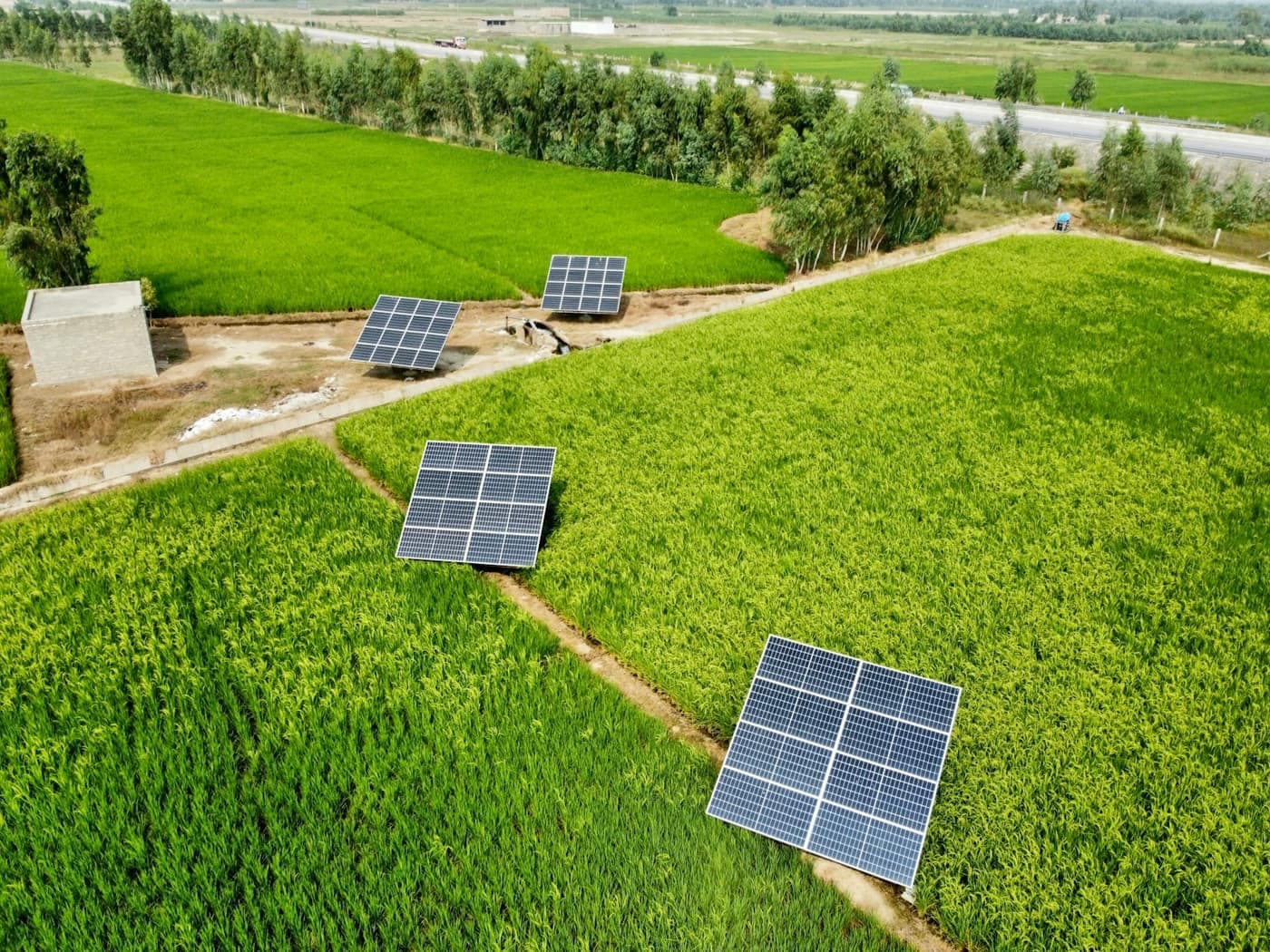
A solar irrigation pump replaces the two things that make Indian irrigation expensive and unreliable — diesel and a weak grid feeder — with a panel array that turns sunlight straight into water lifted from a borewell, open well or canal. For land with no dependable power connection, it is the difference between irrigating when the crop needs it and irrigating whenever the feeder happens to have supply. This page exists to answer the questions that come before buying one: how the system is actually built, what size pump a given borewell and field actually need, what PM-KUSUM pays for, and where a solar pump quietly loses efficiency if bought or installed carelessly.
It sits alongside the PM-KUSUM scheme page, which covers the subsidy and all three components — A (sell power), B (standalone pump) and C (solarise an existing pump) — in full policy detail. This page assumes a farmer has already decided a solar pump is the right call and goes deeper into the hardware: the parts, the HP sizing, the installation sequence, and the mistakes that cost more than the paperwork they were meant to save.
Solar irrigation pump at a glance
The numbers a farmer checks before applying.
- Pump Capacity
- Up to 7.5 HP, off-grid (Component B)
- PM-KUSUM Subsidy
- ~60% — 30% central + 30% state, typical
- Farmer Share
- Roughly 40% of benchmark cost
- Running Cost
- ₹0 recurring — no diesel, no power bill
- Panel Lifespan
- ~25 years
- Maintenance
- Wipe panels weekly, check controller each season
How a solar irrigation pump actually works
Sunlight in, water lifted — no fuel tank and no meter reading involved.
A solar irrigation pump converts sunlight into the electricity that runs the motor lifting water — no battery, diesel tank or grid connection required in between. Panels wired in an array generate DC current through the day; a pump controller (usually a variable-frequency drive, or VFD) converts and regulates that current to match the motor's needs as sunlight intensity rises and falls with cloud cover and the time of day, so the pump runs at a variable but steady speed rather than switching on and off with every passing cloud.
The motor-pump set itself is either submersible — lowered into a borewell, the common choice for deep groundwater — or surface-mounted, used for an open well, pond or canal where the water sits close to ground level. Because output tracks sunlight directly, a solar pump runs fastest through the middle of the day and slows at the edges of daylight; this is normal, not a fault, and is exactly why the sizing section below matters — an undersized pump does not "catch up" once the sun weakens.
The parts of a solar pump system
Six components, from the panel array to the pipe that delivers water to the field.
Solar PV panel array
Photovoltaic panels mounted on a fixed or seasonally-adjustable stand, sized in kW to match the motor's power draw — the single biggest cost item and the part rated for roughly 25 years of output.
Pump controller / VFD
Converts the panel array's variable DC output into the current the motor needs, and regulates pump speed as sunlight rises and falls through the day — the part that keeps the motor from stalling on a weak morning.
Motor-pump set
Submersible for a borewell, surface-mounted for an open well, pond or canal. Rated in HP to match the array; an HP mismatch either starves the motor or wastes panel capacity.
Mounting structure
A fixed-tilt or manually seasonal-tilt frame that holds the panels at the angle for maximum sun exposure through the year — galvanised steel is standard, to survive field conditions for the panel's full life.
Delivery pipeline
Pipe carrying lifted water from the pump to the field, tank or existing irrigation network — sized to the pump's discharge rate, the same way a grid-pump installation would be.
Protection & earthing kit
Surge protection for the panels and controller, a dry-run cutoff that stops the motor when the source runs low, and an earthing kit — the difference between a motor lasting its rated life and burning out in one dry-running season.
Choosing the right pump capacity
HP is decided by how deep the water is and how far it has to travel, not by field size alone.
PM-KUSUM Component B funds solar pumps from 1 HP up to 7.5 HP. The right size is set by two numbers most farmers already know from their existing pump or borewell report — total dynamic head (how far up and along water has to travel) and the discharge the source can actually sustain — not by field area alone. These are typical, indicative bands from MNRE-empanelled vendor spec sheets; an empanelled vendor confirms the exact size for your site during the installation process below.
1 HP – 2 HP
- Depth
- Shallow open well or pond, up to ~15 m head
- Discharge
- ~200–350 litres/hour
- Coverage
- Up to 1 acre, drip or a small kitchen-garden plot
3 HP
- Depth
- Borewell up to ~30 m head
- Discharge
- ~600–700 litres/hour
- Coverage
- Up to 2 acres on drip; around 1 acre on flood
5 HP
- Depth
- Borewell up to ~45 m head
- Discharge
- ~1,000–1,200 litres/hour
- Coverage
- Up to 4 acres on drip; around 2 acres on flood
7.5 HP
- Depth
- Borewell up to ~70 m head — the cap under Component B
- Discharge
- ~1,500–1,800 litres/hour
- Coverage
- Up to 6 acres on drip; around 3 acres on flood
Getting a solar pump under PM-KUSUM, step by step
Six stages from checking eligibility to the pump lifting its first bucket of water.
1. Check eligibility and pick a component
Confirm your land has no reliable grid connection for irrigation (Component B) — or that you already have a working grid-connected pump to solarise (Component C) — and check your state's implementing agency has a quota currently open.
The [PM-KUSUM scheme page](/government-schemes/pm-kusum) has a full eligibility checker if you are unsure which component fits.
2. Apply through the state agency
Register on the National Portal for PM-KUSUM (pmkusum.mnre.gov.in) or apply directly through your state's renewable energy implementing agency, which runs the scheme on the ground, not MNRE centrally.
3. Site verification and sizing
An empanelled vendor or the agency verifies your land, water source and existing pump details, and confirms the HP the site actually needs against its borewell depth and discharge.
A vendor who skips checking your borewell's actual discharge before sizing the panel array is the single most common reason a farmer ends up with an underperforming system.
4. Pay your share
Once selected, pay the farmer's contribution — roughly 40% of the benchmark cost — as per the demand letter from the implementing agency or empanelled vendor, directly or through arranged financing.
5. Installation and commissioning
The empanelled vendor installs the panel array, controller, motor-pump set and delivery pipeline, then commissions and test-runs the system before handover.
Confirm the site has clear, unshaded sun exposure through the day — trees, buildings or even a tall wall casting a shadow across even a corner of the array cuts output disproportionately.
6. Subsidy release and AMC begins
The central and state subsidy is released to the vendor on verified completion, and the comprehensive maintenance period most vendors include starts from the commissioning date — check its length before signing.
Solar vs diesel vs grid-electric pump
The numbers that actually decide whether switching to solar is worth it.
The three ways an Indian farm actually powers an irrigation pump today, compared on the numbers that decide whether switching is worth it — not on any one vendor's claims.
| Feature | Diesel | Grid-electric | Solar |
|---|---|---|---|
| Running cost | Fuel every hour run — the single largest recurring irrigation cost | Per-unit tariff where metered; free/flat in some states, but supply-hour limited | ₹0 recurring — sunlight is free once installed |
| Upfront cost (before subsidy) | ₹15,000–40,000 for pump and engine | ₹10,000–25,000 for pump and wiring, plus a grid connection cost where none exists | ₹1.5–4 lakh depending on HP, before PM-KUSUM subsidy |
| PM-KUSUM subsidy | Not covered | Not covered directly — Component C solarises the pump instead | ~60% typical (30% central + 30% state) |
| Reliability | Works whenever fuel is available, regardless of weather or grid | Depends on the feeder's notified supply hours and voltage | Depends on sunlight — strongest through 6–7 sun-hours a day |
| Maintenance | Frequent — oil changes, filters and engine wear from continuous running | Low — motor servicing only | Low — weekly panel wipe-down and a seasonal controller check |
| Environmental cost | Emissions and fuel-spillage risk at every refill | None at the point of use | None at the point of use |
| Component lifespan | Engine typically 5–8 years with upkeep | Motor 10+ years with servicing | Panels ~25 years; motor-pump set 5–7 years before replacement |
| Best suited to | Any site, if the recurring fuel budget is acceptable | Sites with a genuinely reliable feeder connection | Land with no reliable grid power and good, unshaded sun exposure |
PM-KUSUM subsidy on solar pumps
What Component B and C actually pay for, and how to claim it.
PM-KUSUM Component B funds a standalone, off-grid solar pump up to 7.5 HP for land with no reliable grid connection; Component C solarises a pump you already run on the grid, letting you irrigate on solar power by day and sell surplus back to the DISCOM. Both carry the same subsidy structure — the difference is whether you are buying a new pump or adding panels to one you already own.
The subsidy is a capital subsidy on the equipment, released to the empanelled vendor on verified installation — not paid upfront and not handed to the farmer directly — so budgeting for the farmer's roughly 40% share first is the realistic way to plan the application.
- Subsidy rate30% central financial assistance plus at least 30% state subsidy on Components B and C — roughly 60% typical, leaving the farmer's share at around 40%. Central assistance rises to 50% in hilly, North-Eastern and island states.
- Component B — standalone pumpA new, off-grid solar pump up to 7.5 HP, for land with no reliable grid power connection for irrigation.
- Component C — solarise your pumpAdds solar panels to a grid-connected pump you already have — irrigate on solar by day, sell unused power back to the DISCOM.
- Equipment sourceMust be installed by a state-empanelled vendor under the implementing agency's notified rate contract — a claim on a non-empanelled installation is rejected.
- Documents requiredAadhaar, land record, bank passbook for the farmer's payment, and — for Component C — existing pump and connection details.
- Scheme windowPM-KUSUM currently runs till 31 March 2026, demand-driven through state-notified capacity and pump quota, not a fixed yearly allocation.
Common solar pump problems
Five problems that account for most of the output a poorly maintained system loses.
Reduced output on cloudy or monsoon days
- Symptoms
- Discharge visibly slower than on a clear day, or the pump barely running at all under heavy cloud cover.
- Causes
- Normal behaviour — output tracks sunlight directly, and a solar pump has no battery buffer to draw on when irradiance drops.
- Solutions
- Schedule irrigation for clear-sky days where the crop stage allows it, and treat the pump's rated discharge as a clear-day figure, not a guaranteed daily volume.
Controller / VFD faults
- Symptoms
- The pump not starting despite good sunlight, or running erratically and cutting out repeatedly.
- Causes
- A controller undersized or mismatched for the panel array's actual output, moisture ingress into the controller housing, or a loose wiring connection.
- Solutions
- Keep the controller housing sealed and dry, have an empanelled vendor confirm the controller rating matches the array during installation, and get any wiring fault checked immediately rather than working around it.
Motor burnout from dry running
- Symptoms
- A sudden, permanent stop mid-season, with the motor hot to the touch when checked.
- Causes
- The water source running dry or the borewell yield dropping below the pump's draw, with no dry-run protection fitted to cut the motor automatically.
- Solutions
- Insist on a dry-run cutoff at installation — it is a small addition against the cost of a burnt-out motor — and have the borewell's actual yield checked if this happens more than once.
Panel soiling reducing output
- Symptoms
- A gradual decline in discharge over weeks, with no change in weather, sunlight hours or the source.
- Causes
- Dust, bird droppings or crop residue settling on the panel surface, which is common on an open field installation and worsens through a dry season.
- Solutions
- Wipe panels down with a soft cloth and water weekly during dry months, and after any dust storm — output typically recovers immediately once the surface is clean.
Theft or damage to remote installations
- Symptoms
- Missing panels, cut cabling, or a controller box forced open, usually discovered on the farmer's next visit to a distant plot.
- Causes
- A panel array installed in an isolated field with no fencing or visible presence, which is an easier target than equipment near a homestead.
- Solutions
- Fence the installation where the field is genuinely remote, check on it more often during peak theft-risk periods, and confirm what the vendor's warranty or your own insurance actually covers before an incident, not after.
Mistakes to avoid
The buying and installing mistakes that quietly cost more than the system itself.
Sizing the pump to field area instead of head and discharge
Two farmers with the same field size can need very different HP if one's borewell is twice as deep or yields half as much water — head and discharge decide the size, not acreage.
Buying from a non-empanelled vendor to save time
The PM-KUSUM subsidy claim is rejected outright on an installation from a vendor not empanelled under your state's rate contract — the shortcut costs the entire subsidy, not just a delay.
Skipping a shading check before installation
A tree, wall or building casting even a partial shadow across one corner of the array can cut the whole string's output disproportionately — check the site at different times of day before panels go up, not after.
Not fitting dry-run protection
A borewell running dry or below the pump's draw burns out an unprotected motor within a single dry-running episode — the cutoff costs far less than a motor replacement.
Treating the AMC period and its length as unimportant
Vendors vary on how many years of comprehensive maintenance are included after commissioning — checking this before signing avoids paying out of pocket for a controller or motor fault soon after installation.
Not budgeting for the farmer's ~40% share before applying
The subsidy is released to the vendor on verified completion, not upfront — a farmer who has not arranged the ~40% share or financing in advance stalls the application at the payment step.
Related calculators
Size the system and check the numbers before you apply.
- Pump Size CalculatorDischarge and total head in — the horsepower to actually buy, the same formula an empanelled vendor uses.
- Water Requirement CalculatorTotal season water and daily average for your crop, area and soil — check the pump's discharge is enough.
- PM-KUSUM Eligibility CheckerAnswer a few questions on the scheme page to see which component — B or C — actually fits your situation.
- Profit CalculatorSee where the farmer's ~40% share sits against the season's full cost of cultivation.
The complete guide to solar irrigation pumps
Component B vs C, the real economics against diesel, installation and the mistakes to avoid — everything above, in reading order.
What is a solar irrigation pump, and why farmers are switching
A solar irrigation pump lifts water using electricity generated on-site by a photovoltaic panel array, instead of diesel burned in an engine or power drawn from the grid. For the large share of Indian farmland with no dependable feeder connection, it turns irrigation from something scheduled around when the grid happens to have supply into something scheduled around what the crop actually needs — and it removes the single largest recurring cost most diesel-pump farms carry.
PM-KUSUM (Pradhan Mantri Kisan Urja Suraksha evam Utthaan Mahabhiyan) is the scheme that makes this switch affordable for most farmers: Component B funds a new standalone pump up to 7.5 HP, and Component C solarises a pump already running on the grid. The PM-KUSUM scheme page covers both, plus Component A (selling solar power from a small plant), in full policy detail.
Component B vs Component C — which one fits
The choice is decided by what a farmer already has, not preference. Land with no reliable grid power connection for irrigation at all is the clear case for Component B — a new, standalone, off-grid pump sized to the site. A farm that already runs a working grid-connected agriculture pump is the case for Component C instead, which adds a panel array to the existing pump rather than replacing it, letting the farmer irrigate on free solar power during daylight and sell what is not used back to the DISCOM.
Both carry the same roughly 60% subsidy structure — 30% central plus at least 30% state, more in hilly, North-Eastern and island states — so the decision genuinely comes down to whether a grid connection already exists at the pump, not which component pays better.
How the system works, in practical detail
Sunlight hitting the panel array generates DC current through the day, which a pump controller — usually a variable-frequency drive — converts and regulates to match what the motor needs as sunlight intensity rises through the morning, peaks around midday and falls off by evening. There is no battery in the standard system: the pump runs only while the sun is out, at a speed that tracks irradiance rather than a fixed rate, and stops when the sun sets. This is the normal operating pattern, not a fault — see the common problems section for what actually indicates something is wrong.
The motor-pump set is submersible for a borewell — the common case for groundwater-fed farms — or surface-mounted for an open well, pond or canal where water sits close to ground level. Everything downstream of the pump — the delivery pipeline, and whatever drip, sprinkler or flood system it feeds — works exactly as it would on a diesel or grid-electric pump; solar changes what powers the pump, not what the water does once it is lifted.
Sizing the pump correctly
HP is set by total dynamic head — how far up and along water travels from source to discharge point — and the discharge the source can actually sustain, not by the size of the field being irrigated. Two neighbouring farms with identical acreage can genuinely need different pump sizes if one borewell is twice as deep or yields half the water of the other, which is why the sizing cards above are given as depth-and-discharge bands, not acreage bands.
An empanelled vendor confirms the exact HP for a specific site during the installation process, but arriving at that conversation already knowing the borewell's approximate depth and discharge — from an existing pump's nameplate or a borewell completion report — makes the sizing conversation faster and catches an obviously wrong recommendation before it is installed.
PM-KUSUM subsidy and the real cost to the farmer
The subsidy explained in full in the subsidy section above changes the arithmetic of switching to solar more than the sticker price suggests: a system costing ₹1.5–4 lakh before subsidy, depending on HP, typically comes down to roughly 40% of that for the farmer once the ~60% combined central-and-state subsidy applies — before counting the diesel or power bill it removes for the rest of the pump's working life.
The subsidy is released to the empanelled vendor on verified completion, not paid to the farmer upfront, so the farmer's ~40% share needs to be budgeted or financed before applying, not arranged after selection — the PM-KUSUM scheme page covers financing options in more detail.
Solar vs diesel vs grid — the real economics
Diesel has the lowest barrier to entry and the highest recurring cost — a farm running a diesel pump through a full irrigation season is paying for fuel on every single hour the engine runs, a cost that only rises with fuel prices. A grid-electric pump is cheap to run where the feeder is reliable and metered fairly, but a large share of rural feeders do not offer that reliability, which is precisely the gap Component B exists to close.
A solar pump inverts the trade-off: a materially higher upfront cost, brought down substantially by the PM-KUSUM subsidy, against a recurring running cost of zero for as long as the panels perform — typically around 25 years, against a motor-pump set that itself needs replacing roughly every 5–7 years. The full comparison, feature by feature, is in the table above.
Installation and what to check before signing off
Beyond the step-by-step process above, the two checks worth doing personally rather than trusting the vendor's word are the shading assessment and the discharge confirmation — a partially shaded array underperforms disproportionately, and a pump sized against an assumed rather than measured borewell discharge either starves on a genuinely deep source or wastes panel capacity on a shallow one.
A dry-run cutoff and a proper earthing kit are small line items against the cost of the equipment they protect; confirming both are actually fitted, not just quoted, is worth the few minutes it takes during commissioning.
Maintenance: the difference between rated output and real output
A solar pump's rated output assumes clean, unshaded panels and a correctly matched controller — neither of which happens automatically over years in an open field. Wiping panels down weekly during dry months, checking the controller housing stays sealed against moisture, and having it inspected each season catches the common problems above before they become a mid-season failure.
The comprehensive maintenance period most vendors include after commissioning is worth checking in years, not assuming — a system with two years of AMC covered and one bought with five is a materially different total cost of ownership over the panel's 25-year life.
Is a solar pump right for your farm?
As a general rule: land with no reliable grid power connection, a known or checkable borewell depth and discharge, and clear, unshaded sun exposure through the day is the clearest fit for Component B. A farm already running a working grid-connected pump, in a state where the DISCOM buys back surplus solar power, is the clearer fit for Component C instead.
Where a reliable, fairly-metered grid connection already exists and the feeder genuinely delivers supply hours that match the irrigation schedule, the case for switching is weaker — the comparison table above and the PM-KUSUM eligibility checker both work through the same questions an implementing agency would ask.
Frequently asked questions
What is a solar irrigation pump?
A solar irrigation pump lifts water using electricity generated on-site by a photovoltaic panel array, instead of diesel or grid power. Panels generate DC current through the day, a controller regulates it to run the motor, and the pump lifts water at a speed that tracks sunlight — fastest around midday, stopping after sunset, with no fuel bill or meter reading involved.
What is the difference between PM-KUSUM Component B and Component C?
Component B funds a new, standalone, off-grid solar pump up to 7.5 HP for land with no reliable grid power connection. Component C instead adds solar panels to a pump you already run on the grid, letting you irrigate on free solar power by day and sell surplus power back to the DISCOM. Both carry roughly the same subsidy rate — the right one depends on whether a grid connection already exists at the pump.
How much subsidy is available for a solar pump under PM-KUSUM?
Typically around 60% combined — 30% central financial assistance plus at least 30% state subsidy — leaving the farmer's share at roughly 40% of the benchmark cost. Central assistance rises to 50% in hilly, North-Eastern and island states, which can lower the farmer's share further depending on the state's own subsidy top-up.
What size solar pump do I need?
Size is set by total dynamic head (how far water travels from source to discharge) and the discharge your source can sustain, not by field area — see the [sizing section](#sizing) above for typical HP bands by borewell depth. An empanelled vendor confirms the exact size for your site during the application process.
How do I apply for a PM-KUSUM solar pump?
Register on the National Portal for PM-KUSUM (pmkusum.mnre.gov.in) or apply directly through your state's renewable energy implementing agency, which runs the scheme on the ground. After site verification and sizing, you pay your roughly 40% share, an empanelled vendor installs and commissions the system, and the subsidy is released to the vendor on verified completion.
Does a solar pump work on a cloudy day or at night?
Output drops on a cloudy day and stops at night in the standard system, which has no battery buffer — this is normal operation, not a fault. Irrigation scheduling needs to work around clear-sky hours the way it would around a limited-supply grid feeder, treating the rated discharge as a clear-day figure rather than a guaranteed daily volume.
What documents are needed to apply?
Aadhaar card, land record showing ownership or right to use the site, a bank passbook for the farmer's payment, and — for Component C — details of the existing pump and grid connection being solarised. The [PM-KUSUM scheme page](/government-schemes/pm-kusum) has the full document list.
How much maintenance does a solar pump need?
Low, but not zero — panels need wiping down weekly during dry months to clear dust and bird droppings, and the controller housing and dry-run protection are worth checking each season. Most vendors include a comprehensive maintenance period after commissioning; checking its length before signing is worth doing, since it affects total cost of ownership over the panel's roughly 25-year life.
What happens if the pump is installed by a vendor who is not empanelled?
The PM-KUSUM subsidy claim is rejected outright on an installation from a vendor not empanelled under your state's notified rate contract — only equipment installed through an empanelled vendor qualifies, which is worth confirming before signing any quotation.
Is a solar pump worth it if I already have a reliable grid connection?
The case is weaker where the feeder genuinely delivers reliable, fairly-metered supply that matches the irrigation schedule — Component C can still add value there by letting surplus daytime solar power be sold back to the DISCOM, but the urgency is lower than for land with no dependable grid power at all, which is what Component B specifically exists to serve.
Subsidy rates, component definitions and the application process follow MNRE's PM-KUSUM comprehensive guidelines; HP sizing and running-cost comparisons are general, indicative estimates, not a quote for any one site or vendor — confirm with an empanelled vendor before buying. Read more at /editorial-policy.