Safe Pesticide Spraying Practices
The pesticide label is a legal instruction, not a suggestion. Most spraying injuries trace back to skipping what the label already said.
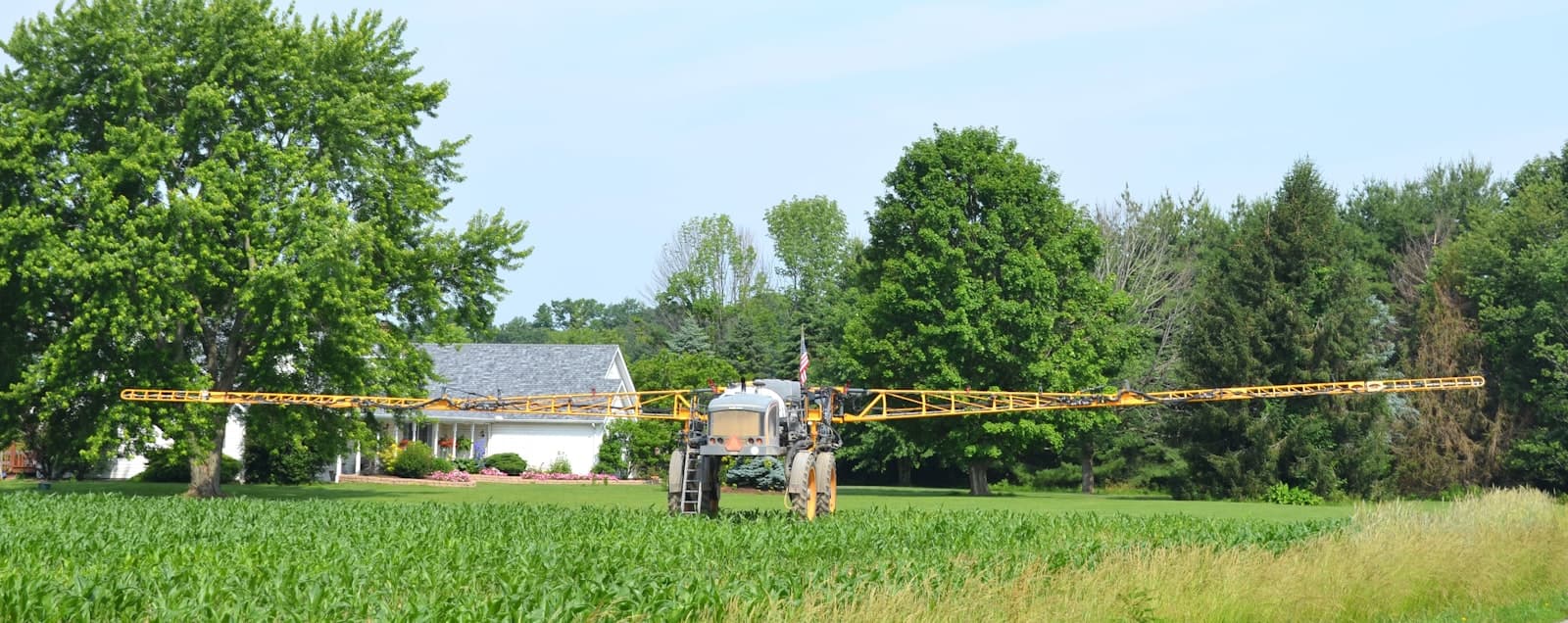
Most pesticide-related harm on a farm — to the person spraying, to the crop, or to the person eating it later — traces back to skipping an instruction the label already gave. Safe spraying is less about extra caution and more about actually following what is already printed on the bottle.
Timing: early morning or evening, not midday
Spray in the cooler, calmer hours — early morning or evening. Midday heat increases evaporation and drift, wastes more of the spray before it reaches the leaf, and coincides with peak pollinator activity, which matters directly during flowering when bees and other pollinators are working the crop. Wind above roughly 10–15 km/h at any time of day risks the spray drifting onto a neighbouring crop, a water source, or a person well outside the intended field — check conditions before starting, not partway through.
Protective equipment is not optional
The product label specifies the protective gear required for that specific chemical, and it is legally binding, not a recommendation. At minimum this typically means gloves, a mask or respirator appropriate to the chemical class, long sleeves, and boots — chemical-resistant gloves in particular, since bare-hand mixing and handling is one of the most common sources of pesticide exposure.
Mixing and dosing: more is not more effective
Both under-dosing and over-dosing cause real problems — under-dosing can fail to control the pest while accelerating resistance, and over-dosing wastes money, increases residue risk, and can damage the crop itself. Measure to the label's specified rate using calibrated equipment, and never mix two chemicals together without confirming they are compatible — an incompatible mix can reduce effectiveness or create a genuinely hazardous reaction.
The pre-harvest interval is not negotiable
Every pesticide label specifies a pre-harvest interval (PHI) — the minimum time that must pass between the last application and harvest. Harvesting or selling before that window closes risks chemical residue above safe limits on produce that is about to be eaten, which is a real health question for the buyer and a real liability question for the seller.
Disposal and storage
Never rinse equipment or dispose of leftover spray mix near a well, pond, or any water source — pesticide residue in a water source affects everyone who draws from it, not just the field it was meant for. Triple-rinse empty containers before disposal, and store unused pesticide in its original, labelled container, locked away from food, feed and anywhere a child could reach it.
If exposure happens
Wash exposed skin immediately with soap and water, remove contaminated clothing, and seek medical attention for anything beyond minor contact — bringing the product label to the doctor is genuinely useful, since it tells them exactly what they are treating rather than leaving them to guess.
The one sentence version
Nearly every safe-spraying rule — timing, protective gear, dose, disposal, and the pre-harvest interval — is already printed on the label; the discipline that matters most is actually reading and following it, not memorising a separate set of precautions.
Frequently asked questions
What wind conditions are unsafe for spraying?
As a general guide, spraying above roughly 10–15 km/h wind risks the spray drifting onto a neighbouring crop, a water source, or a person — well beyond the intended field. Early morning is usually calmer than midday, which is one of several reasons it is the preferred spraying window.
What is the pre-harvest interval, and why does it matter?
It is the minimum time that must pass between the last pesticide application and harvest, specified on the product label for each crop. Harvesting or selling produce before this interval has passed risks chemical residue above safe limits — it is not a suggestion, it is the reason the interval is printed on the label at all.

Written by
Vaibhav Dhama
Founder, Technical Kisan
Vaibhav Dhama is the founder of Technical Kisan. He writes from Baghpat, Uttar Pradesh, and builds each guide on ICAR and state agricultural university guidance, official government scheme notifications, and live mandi-price data.
- Writes from Baghpat, Uttar Pradesh
- Software developer (BTech, 2021)
- Not a trained agronomist — confirm with your KVK
Discussion is coming soon
We are building a comments section where you can ask a question about this guide and see what other farmers in your district are doing.
For now, write to us at [email protected] — we read every message.