
Beekeeping — Complete Management Guide
A colony that pays for itself twice — once in honey, once in free pollination — seasonal management, swarming, honey extraction, colony health and the schemes that fund an apiary.
- Updated:
- 3 August 2026
Quick snapshot
- Initial investment
- ₹40,000–1.5 lakh for a 20–50 box starter apiary
- Difficulty
- Low–Moderate — needs basic colony-management training
- Break-even period
- 6–8 months to the first honey extraction
- Daily management
- Low — weekly inspection, seasonal hive moves
- Suitable climate
- Needs floral sources nearby (mustard, litchi, eucalyptus)
- Production
- ~20–25 kg honey per colony per year
- Expected ROI
- Good, and higher still counting pollination value
- Market demand
- Steady and growing, raw/organic honey premium
Breeds
Species choice is really a choice between a commercial honey producer and a hardy local bee — India's wild rock bee is a honey-hunting target, not something you keep in a box.
| Breed | Purpose | Typical yield | Climate suitability | Difficulty |
|---|---|---|---|---|
| Apis mellifera (European/Italian bee) | Commercial honey production | 25–40 kg/colony/year | Best with migratory management for continuous floral supply | Moderate — more active management needed |
| Apis cerana indica (Indian bee) | Traditional/local honey | 8–10 kg/colony/year | Well adapted to Indian conditions, hardier locally | Low |
| Apis dorsata (rock bee) | Wild honey harvesting only | High per wild colony, but not hive-manageable | Wild and forest-associated | Not applicable — not domesticated |
| Stingless bee (meliponiculture) | Niche, very high-value honey | 250 g–1 kg/colony/year, at a premium price | Tropical, low sting risk | Low |
Pollination value, seasonal management & swarming
The things that make beekeeping unlike every other livestock enterprise on this site — starting with the fact that half its value is not honey at all.
Why a colony pays twice over
Honey is only half the return — a colony also pollinates the fruit, vegetable and oilseed crops within its flight range for free, and that pollination value on a nearby mustard, sunflower or fruit orchard often exceeds what the honey itself sells for. This is why beekeeping is frequently paired with, not competing against, crop farming.
Seasonal & migratory management
Moving hives to follow flowering — mustard in winter, litchi in spring, eucalyptus and multi-floral sources through summer — keeps a continuous nectar flow instead of one short honey flush and months of nothing. Even a non-migratory apiary benefits from being sited where at least one major bloom is within flight range.
Swarming season management
A strong colony building up fast in spring can decide to swarm — the queen leaves with roughly half the workers, taking a large chunk of the colony's honey-producing capacity with her. Checking for queen cells and proactively splitting a crowded hive captures that growth as a new colony instead of losing it to a tree branch.
Honey extraction & processing
Honey is ready to extract once bees have capped most of a frame with wax — extracting too early leaves the moisture content too high and the honey ferments in storage. After extraction, straining removes wax fragments, and the emptied comb goes straight back to the colony to be refilled rather than replaced.
Feed
A healthy apiary feeds itself from nectar and pollen most of the year — supplementary feeding exists only to carry a colony through a lean patch.
- Natural nectar & pollenThe primary and preferred food source whenever a floral bloom is within flight range.
- Sugar syrup (dearth period)A 1:1 sugar-water syrup prevents starvation during the lean season when no significant bloom is available.
- Pollen substitute pattiesUsed when natural pollen is scarce, to keep brood-rearing going without a protein gap.
- Clean water source nearbyBees need water to regulate hive temperature and dilute stored honey — an apiary without one nearby will forage further and work harder for it.
Colony health & pest management
Bees are not vaccinated — colony health here comes down to regular inspection and hygiene, and one disease (American foulbrood) is serious enough to require destroying the hive by regulation.
Varroa mite
- Deformed wings on newly emerged bees
- Visible mites on adult bees
- Gradual colony weakening
Approved miticide strips used on a set schedule, and a brood break during requeening, which interrupts the mite's reproduction cycle.
Read the full guideAmerican foulbrood
- Sunken, perforated brood cappings
- Foul smell from the brood comb
- Ropey, discoloured larval remains
No cure — regulations in most beekeeping regions require burning infected hives and equipment to stop it spreading to neighbouring apiaries. Never share comb or equipment between colonies without inspection.
Read the full guideWax moth
- Webbing across the comb
- Tunnels through the wax
- Weakened or abandoned comb
A strong, well-populated colony defends its own comb, so this mostly strikes weak hives or stored spare comb — keep stored comb in a lit, ventilated space, since wax moth thrives in dark, still storage.
Read the full guide
Hive & apiary setup
The hive itself, plus a handful of handling tools, is nearly the entire equipment list for this enterprise.
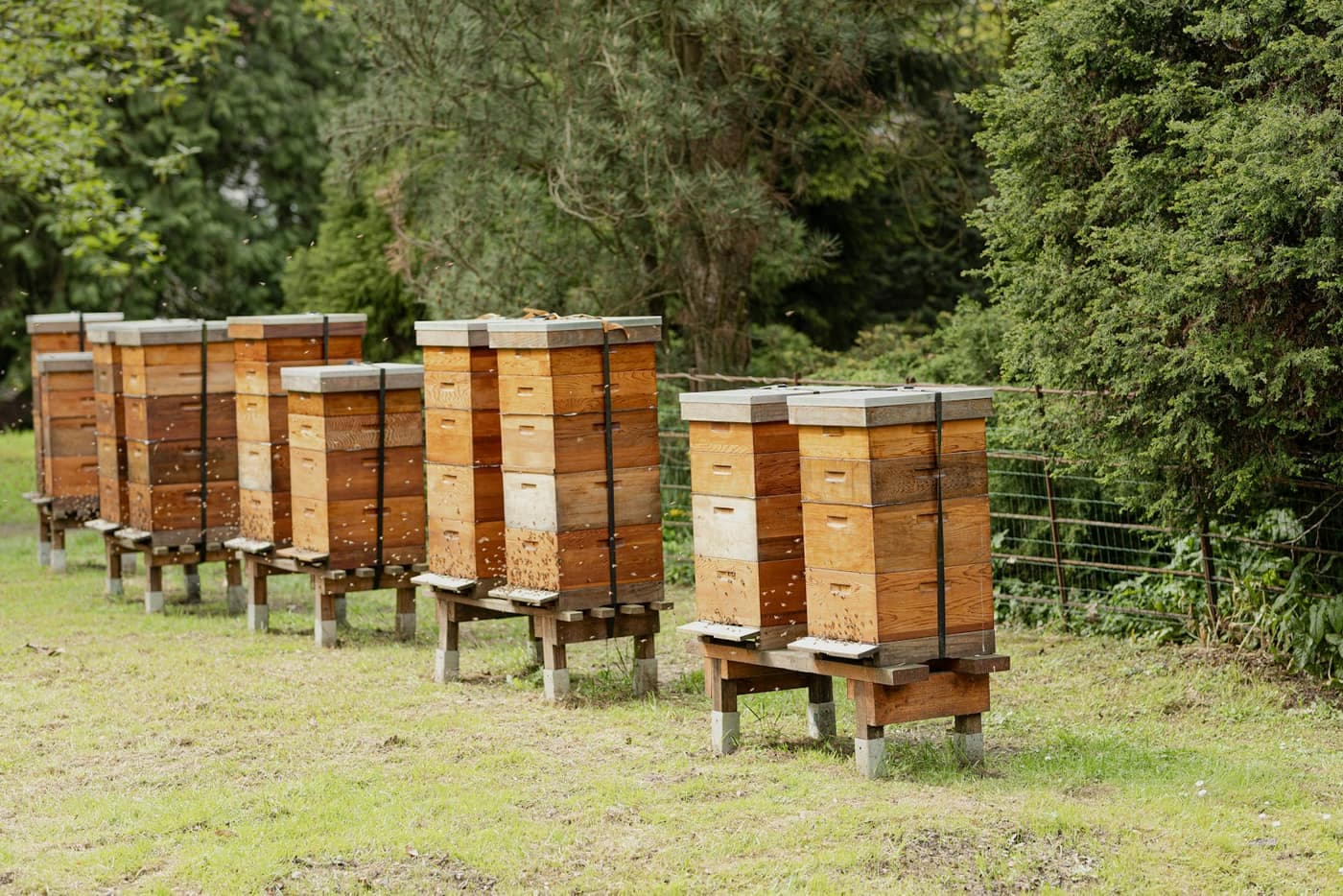
Langstroth hive boxes
The standard movable-frame hive, which allows inspection and honey extraction without destroying the comb.
₹1,500–2,500 per box
Bee veil, gloves & smoker
Basic protective and handling equipment for safe, calm hive inspection.
₹2,000–4,000 for a starter set
Queen excluder & honey extractor
Keeps the queen out of honey supers so brood and honey stay separate; the extractor is often shared or rented locally rather than bought per apiary.
Apiary site with shade and water access
Hives need partial shade, a windbreak, and clean water nearby — siting near a major floral source matters as much as the hive itself.
Economics
- Initial investment
- ₹40,000–1.5 lakh for a 20–50 box starter apiary
- Break-even period
- 6–8 months to the first honey extraction
- Monthly running cost
- Low — mainly sugar syrup during the dearth period
- Expected ROI
- ₹3,000–6,000 net per box per season from honey and wax, before counting pollination value
- These are indicative ranges for a typical starter apiary, not a project report — actual returns depend heavily on floral availability, migratory management and local honey prices.
- The pollination value a colony delivers to nearby crops is real income for the wider farm even when it never shows up as a beekeeping sale — worth factoring in for a farmer who keeps bees alongside other crops.
Other livestock enterprises
- Dairy FarmingFeed is 65–70% of the cost of producing milk, which means green fodder is not a nicety — it is the margin. Growing your own fodder is usually worth more than upgrading the breed.
- Goat FarmingA doe kids roughly every 8 months, often with twins, which is why goat numbers compound faster than any other livestock enterprise. Low feed cost and low land need make it the easiest entry point into livestock for a smallholder.
- PoultryBroiler and layer are two different businesses wearing the same feathers — broiler is a 5–6 week cash cycle bet on feed conversion, layer is a year-long bet on sustained daily egg output. Picking the wrong one for your cash-flow horizon is the most common poultry mistake.
- FisheriesBiofloc raises fish at ten times the stocking density of an earthen pond in the same footprint, by turning the tank's own waste into feed for the fish — the trade-off is a much less forgiving system if aeration or water quality slips.
- Buffalo FarmingBuffalo milk runs 6–7% fat against a crossbred cow's 3.5–4%, which is most of the reason it commands a higher price at the dairy gate — the trade-off is a longer calving interval and a slower-maturing animal.
- Sheep FarmingAn Indian sheep enterprise is almost always a meat business with wool as a byproduct, not the other way round — domestic wool rarely covers shearing cost, while mutton demand is steady and largely recession-proof.
- Pig FarmingA sow farrows 8–12 piglets at a time and can farrow twice a year, which makes pig farming the fastest-compounding meat enterprise on this list — the constraint is almost never biology, it is finding a buyer network outside a few regional markets.
Frequently asked questions
Is beekeeping profitable on its own, without owning land?
Yes — beekeeping needs no land of its own, only a site with shade, water access and a major floral source within flight range, which is why it suits a farmer with little spare land as well as one with plenty. A 20–50 box starter apiary typically nets ₹3,000–6,000 per box per season from honey and wax alone.
How much does pollination actually add beyond the honey?
Often more than the honey itself — a colony pollinates fruit, vegetable and oilseed crops within its flight range for free, and the yield boost this gives a nearby mustard, sunflower or fruit orchard is frequently the larger part of a colony's total value, even though it never appears as a beekeeping sale.
What should I do if a colony starts preparing to swarm?
Check for queen cells during spring buildup, and if a hive is getting crowded, split it into two before the bees decide to do it themselves — a proactive split captures the colony's growth as a second hive instead of losing half the bees and their honey-producing capacity to a swarm.
When is honey actually ready to extract?
Once bees have capped most of a frame with wax — this is the bees' own signal that the moisture content is low enough for storage. Extracting before capping is complete leaves the honey too wet, and it can ferment in storage.
How serious is American foulbrood for a small apiary?
Serious enough that most beekeeping regions require burning infected hives and equipment by regulation, since there is no cure and it spreads easily between colonies and apiaries that share equipment. Regular inspection and never swapping comb or equipment between hives without checking is the main prevention.
Is there a subsidy for starting an apiary?
Beekeeping is covered under the broader livestock and allied-activity support the National Livestock Mission (NLM) and the Kisan Credit Card (KCC) provide, though the funding landscape for apiculture specifically has shifted across schemes over the years — check the current NLM guidelines and your state horticulture/beekeeping department for the scheme active right now. See the schemes below for the general livestock credit and subsidy routes.
Still deciding?
The FAQs above cover the common questions. For advice tuned to your exact land, climate and market access, your nearest Krishi Vigyan Kendra or state veterinary/animal husbandry department is the authoritative next step.