Drip Irrigation: Cost, Subsidy, Payback
Drip cuts water use 40-60% and lifts yield 20-50%. With PMKSY subsidy at 55%, the real question is which crops pay it back fastest.
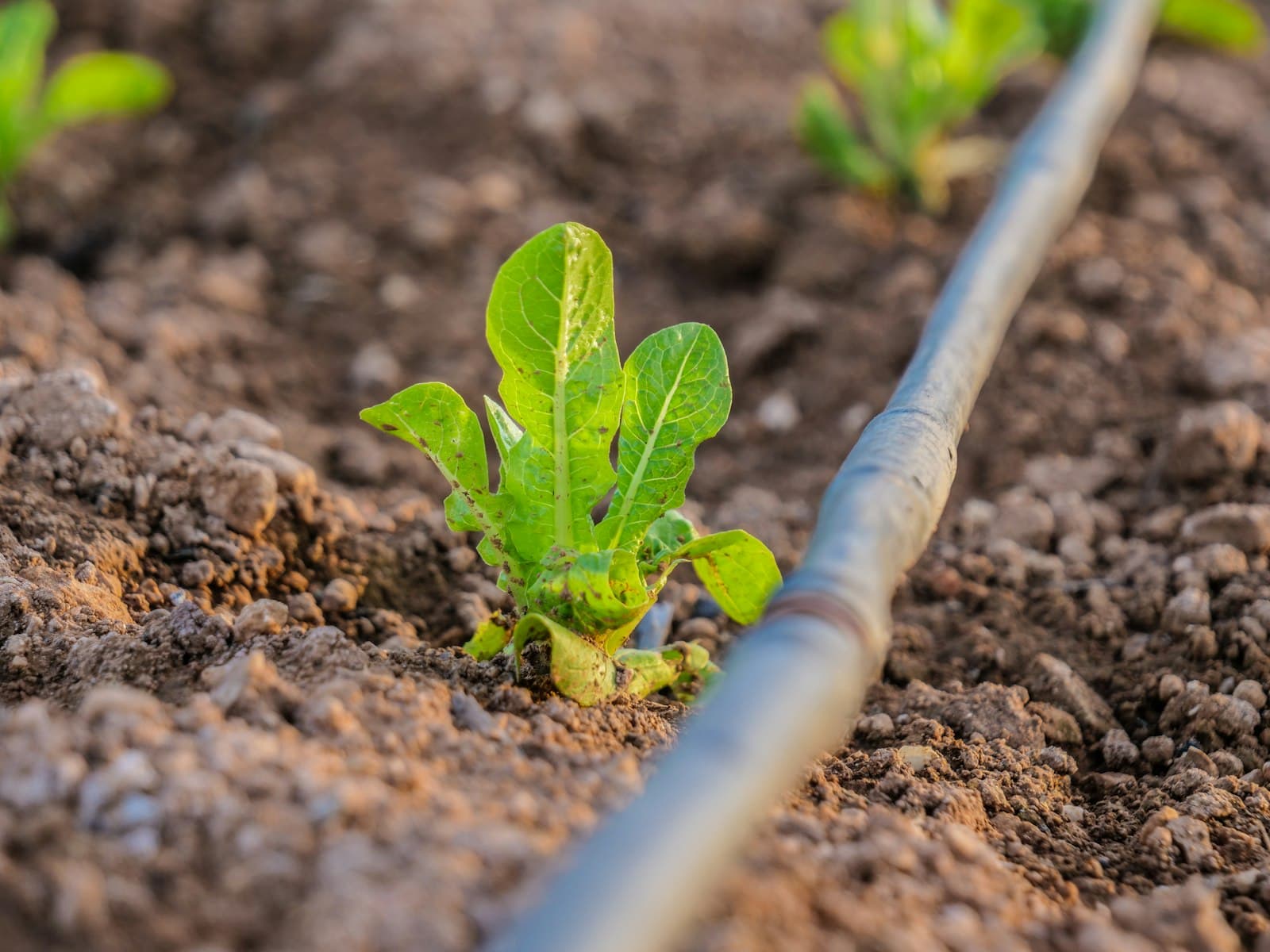
Every pitch for drip irrigation leads with the same number: 40–60% less water. It is true, and for most farmers it is also the least interesting thing about drip.
Water is not what you are short of on the day you decide. Cash is. So the useful question is not "does drip save water" — it does — but "on which crop does it pay itself back before I feel the cost".
What you actually get
Three things happen when you move from flood to drip, and only one of them is water.
Water use drops 40–60%. Water goes to the root zone instead of the whole field. Nothing evaporates off bare soil between rows, and nothing runs off the low end.
Yield rises 20–50% on row crops. This is the part people underestimate. Flood irrigation swings the root zone between saturated and dry. Drip holds it steady, and a crop that is never water-stressed and never waterlogged simply produces more.
Fertiliser efficiency rises about 30%. Once the pipes are in, fertigation is nearly free — you are putting nutrient into the water that is already going exactly where the roots are. No broadcast, no runoff, no fixation in soil the roots never reach.
The subsidy is the whole business case
Under Per Drop More Crop (PDMC) — funded through PMKSY until 2021-22, and a component of PM-RKVY since October 2024:
- Small and marginal farmers (under 2 ha): 55%
- Other farmers: 45%
Several states add their own top-up on this — Maharashtra, Gujarat, Karnataka, Andhra Pradesh and Tamil Nadu among them — which can push the effective subsidy past 75%. Check your state horticulture or micro-irrigation portal, because the central number is the floor, not the ceiling.
To apply, you will need: land records, an Aadhaar card, a bank passbook, a soil and water test report, and a quotation from an empanelled supplier. Two things matter here and both are commonly got wrong:
- The supplier must be empanelled. A system from a non-empanelled vendor is not eligible, however good it is.
- Get sanction before you install. Retrospective claims are routinely rejected. Approval first, pipe second.
Where drip pays back fast — and where it does not
The payback is a straightforward function of crop spacing and crop value. Wide rows mean fewer laterals, so lower cost per hectare. High value means the yield gain is worth more.
| Crop | Cost/ha (before subsidy) | Typical payback |
|---|---|---|
| Sugarcane | ₹60,000 – ₹75,000 | 1–2 seasons |
| Cotton | ₹65,000 – ₹80,000 | 1–2 seasons |
| Tomato, chilli | ₹85,000 – ₹1,10,000 | 1 season |
| Banana, grapes | ₹90,000 – ₹1,20,000 | 1 season |
| Wheat, paddy | ₹1,00,000+ | Rarely worth it |
The last row is the honest one. Closely-spaced cereals need a lateral every 30–40 cm, which is where the cost lives, and the crop value does not justify it. Drip your cash crops. Leave your cereals on flood or sprinkler. Anyone telling you to put wheat under drip is selling pipe.
The maintenance nobody mentions at the point of sale
A drip system fails in exactly one way: the emitters clog. Salts precipitate, algae grow, silt settles. And a clogged emitter looks fine from the road — you find out when a patch of the field starts wilting.
Three habits keep a system alive for a decade:
- Flush the laterals by opening the end caps, once a month during the season.
- Acid treatment once a season. Run dilute hydrochloric or phosphoric acid through the lines to dissolve carbonate scale. This is the one most people skip, and it is the one that matters most in hard-water areas.
- Clean the filter every single week. Not "when it looks dirty". Weekly.
Do these and the mainline lasts seven to ten years, the laterals three to five. Skip them and you will be replacing emitters in year two and telling everyone that drip does not work.
The short version
Drip is not a water-conservation gesture. On a cash crop with a subsidy behind it, it is an investment with a one-to-two-season payback and a decade of life — provided you get the sanction before you install, buy from an empanelled supplier, and flush the lines like you mean it.
Frequently asked questions
How much subsidy is available on drip irrigation?
Under PMKSY–Per Drop More Crop, small and marginal farmers get 55% of the system cost and other farmers get 45%. Several states top this up further from their own budget, so the effective subsidy can exceed 75% in places like Maharashtra, Gujarat and Karnataka.
How much does a drip system cost per hectare?
Between ₹60,000 and ₹1,20,000 per hectare before subsidy, depending on crop spacing. Wide-spaced crops such as sugarcane and cotton cost less per hectare than closely-spaced vegetables, because they need fewer laterals.
Which crops are worth putting under drip first?
Wide-spaced, high-value row crops — cotton, sugarcane, tomato, chilli, banana, grapes. These give you both the biggest water saving and a crop value high enough to repay the system in one or two seasons.
How long does a drip system last?
Seven to ten years for the mainline and submains, and three to five years for the laterals and emitters, provided you flush the lines and run an acid treatment once a season. Skip the maintenance and emitters clog within two years.

Written by
Vaibhav Dhama
Founder, Technical Kisan
Vaibhav Dhama is the founder of Technical Kisan. He writes from Baghpat, Uttar Pradesh, and builds each guide on ICAR and state agricultural university guidance, official government scheme notifications, and live mandi-price data.
- Writes from Baghpat, Uttar Pradesh
- Software developer (BTech, 2021)
- Not a trained agronomist — confirm with your KVK
Discussion is coming soon
We are building a comments section where you can ask a question about this guide and see what other farmers in your district are doing.
For now, write to us at [email protected] — we read every message.