Seed Treatment: Rs 40 an Acre, Skipped
Forty rupees of fungicide protects an acre against soil-borne disease no later spray can fix - the highest return on an Indian farm.
There is a strange gap in Indian farming. A grower will spend ₹3,000 an acre on urea, ₹2,500 on pesticide sprays across the season, and ₹1,800 hiring a rotavator — and then skip a ₹40 seed treatment because it takes twenty minutes and a bucket.
The ₹40 buys protection against the diseases you cannot do anything about later.
Why it cannot be fixed afterwards
Soil-borne pathogens attack at germination — in the days before the seedling has broken the surface, when you cannot see it, cannot reach it and do not yet know anything is wrong.
Smuts. Root rot. Damping-off. Wilt. By the time you notice thin, patchy emergence, the infection happened two weeks ago and the plants that were going to die are already dead. There is no foliar spray for a seedling that never came up.
Seed treatment is the only point in the crop cycle where these are addressable at all. Miss it and you are not choosing to treat later — you are choosing not to treat. The seed treatment decision hub has a dose calculator and a product-by-product timeline if you want to work out your own mix before you start.
The order, and why it is not negotiable
If you are using more than one product, the sequence matters, and getting it wrong wastes the money you just spent.
1. Fungicide first
- Carbendazim or Thiram at 2 g per kg of seed, or
- Trichoderma viride at 5–10 g per kg of seed — but see the warning below
Coat the seed evenly. Shade-dry for 30 minutes.
For a fully traditional, chemical-free route instead, see beejamrit seed treatment.
2. Insecticide second
Imidacloprid at 5 ml per kg of seed protects against early sucking pests and termites in the first few weeks. This matters most in maize, cotton and pulses.
Shade-dry again.
3. Biological inoculant last
Rhizobium for pulses, Azotobacter or Azospirillum for cereals, PSB for phosphorus mobilisation. 20–25 g per kg of seed.
These go on last, and here is the reason:
Never mix a chemical fungicide with a biological inoculant. The fungicide kills the inoculant. You have paid for both and destroyed one of them. If you want the biological, either apply it last after the chemical has fully dried, or use Trichoderma alone and skip the chemical fungicide entirely.
That single mistake — throwing Rhizobium and Carbendazim into the same bucket to save a step — is the most common seed-treatment error in the country.
How to actually do it
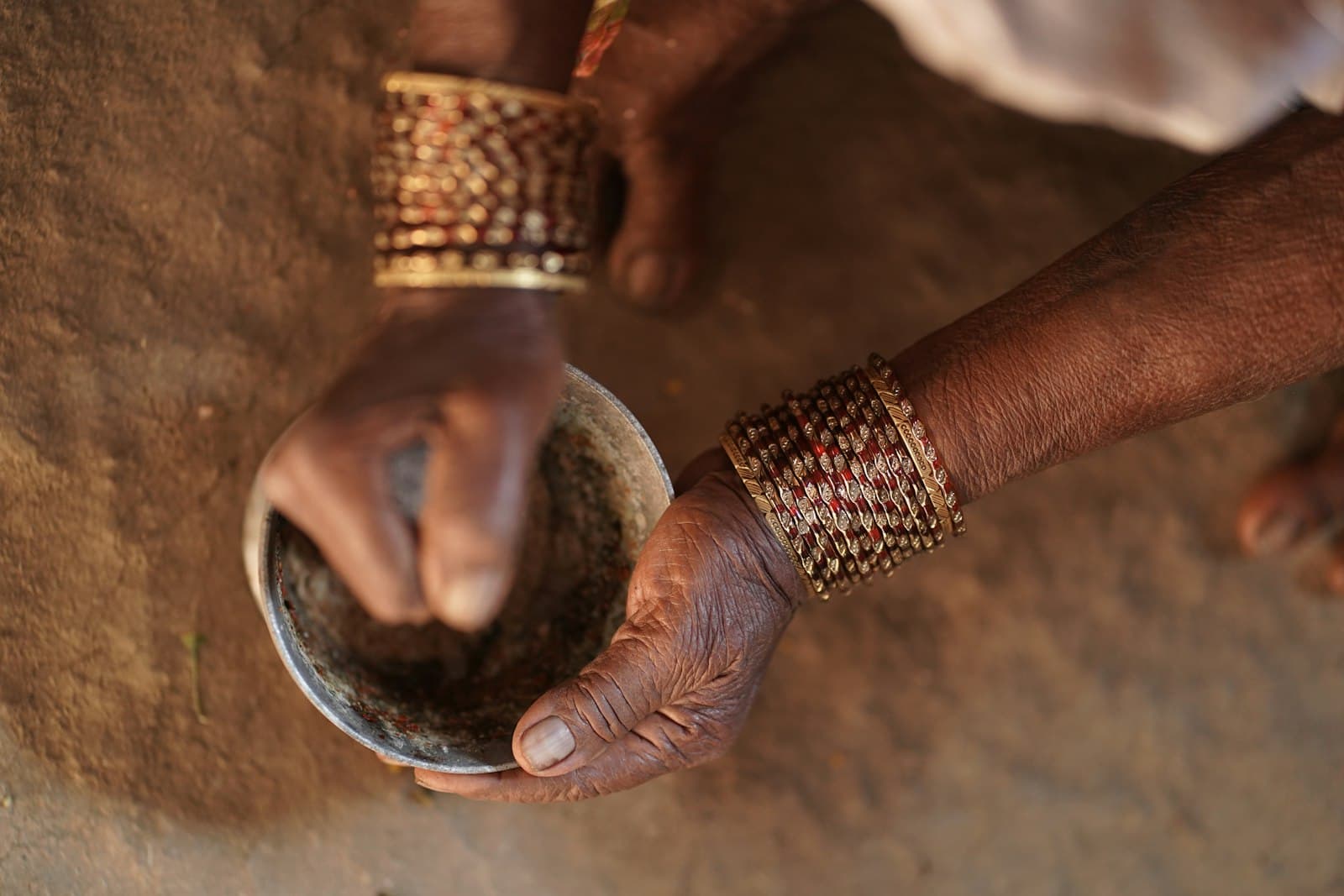
You do not need equipment. A drum, a tarpaulin, or even a large plastic bag will do.
- Spread the seed on a clean tarpaulin, or put it in a drum.
- Make a slurry — most products need a small amount of water to stick.
- Add the product, then roll or turn until every seed is coated evenly. Uneven coating means untreated seed, which means gaps.
- Shade-dry for 30 minutes. Never in direct sun — heat kills both the biological and, in some cases, the seed.
- Sow the same day. Treated seed does not store well.
Wear gloves. These are pesticides, and you are handling them by hand.
Do the germination test first
Before you treat anything, find out whether the seed is worth treating — see the germination test guide for the full method.
Count out 100 seeds. Roll them in a damp cloth. Keep it moist and warm. Open it after seven days and count how many have germinated.
- 85% or above — good. Sow at the normal rate.
- 80–85% — acceptable. Raise the seed rate a little.
- Below 80% — raise the seed rate proportionally.
- Below 60% — do not sow it. Replace the lot.
Ten minutes, a cloth, and 100 seeds will tell you more about your coming crop than anything else you can do in the week before sowing.
One caveat about certified seed
Certified seed is often already treated at source. Treated seed is dyed — pink, green, blue — precisely so you can tell. Check the tag.
If it is treated, do not treat it again; a double dose can hurt germination. If the tag does not say, treat it.
The arithmetic
₹40 an acre. Twenty minutes. Against a crop worth ₹40,000–₹80,000 an acre and a disease you cannot touch once the seed is in the ground.
There is no better trade available on the farm.
Frequently asked questions
What is the correct order for seed treatment?
Fungicide first, then insecticide, then biological inoculant last. The chemical products would kill a biological inoculant applied before them, so the biological always goes on at the end, and the seed is shade-dried between steps.
Can I use Trichoderma and a chemical fungicide together?
No. A chemical fungicide will kill Trichoderma. Choose one or the other. If you want the biological, use Trichoderma alone at 5–10 g per kg of seed.
How much does seed treatment cost?
Around ₹30–₹60 per acre of seed. Against a crop worth tens of thousands of rupees an acre, it is the cheapest insurance available.
Should certified seed also be treated?
Certified seed is often already treated — check the tag and the colour, as treated seed is dyed. If it is treated, do not treat it again. If the tag does not say so, treat it.

Written by
Vaibhav Dhama
Founder, Technical Kisan
Vaibhav Dhama is the founder of Technical Kisan. He writes from Baghpat, Uttar Pradesh, and builds each guide on ICAR and state agricultural university guidance, official government scheme notifications, and live mandi-price data.
- Writes from Baghpat, Uttar Pradesh
- Software developer (BTech, 2021)
- Not a trained agronomist — confirm with your KVK
Discussion is coming soon
We are building a comments section where you can ask a question about this guide and see what other farmers in your district are doing.
For now, write to us at [email protected] — we read every message.