


Skip to content
Technical Kisanखेती, तकनीक के साथ
Raised Bed Farming (Bed Planting)Medium DifficultyMedium InvestmentWater Saving

Raised Bed Farming — Complete Guide for Indian Farmers

Sow on raised beds roughly 67.5 cm apart with a furrow between them, instead of a flat field. Water moves through the furrow, not over the crop, so drainage improves and every irrigation wets the same root zone with less water.
Best for:
Wheat, cotton and maize on irrigated land
6 min read
Updated:
3 August 2026
Compare Techniques
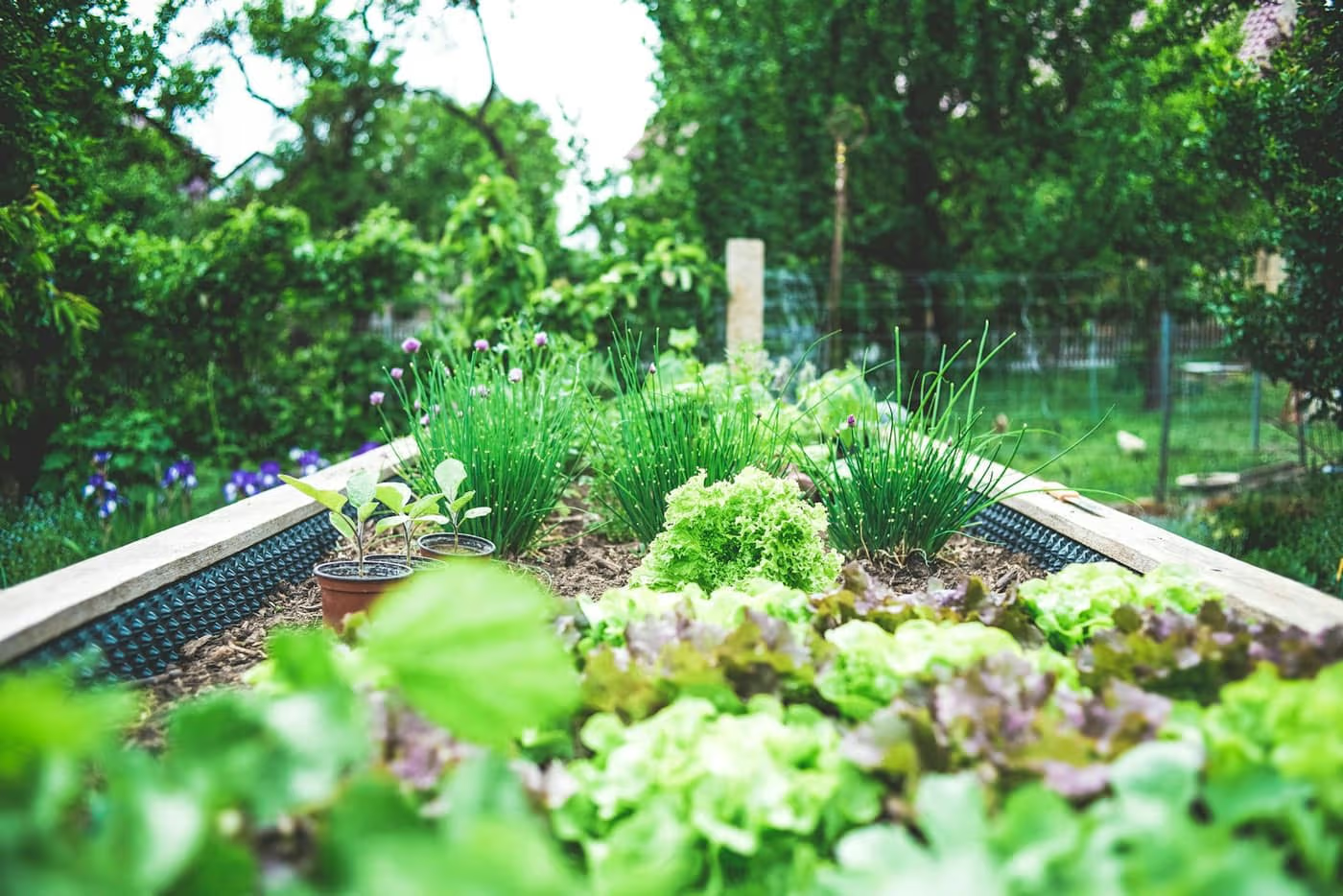
A raised bed planted with mixed leafy greens and herbs in a garden

At a Glance

The quick decision panel — everything you need before reading a single paragraph further.

Difficulty
Medium — needs a bed planter
Investment
Medium — implement hire or purchase
Cost Savings
25–30% less water cost
Yield Improvement
5–15%
Water Saving
25–30% vs flat sowing
Labour Saving
Faster, more even irrigation
Best Season
At sowing, any irrigated season
Suitable Crops
Wheat, cotton, maize, sugarcane
Suitable States
Punjab, Haryana, Madhya Pradesh
Equipment Required
Tractor-mounted bed planter

Quick Benefits

What actually changes on your farm once this is in place.

  • Water Conservation

    Furrow irrigation wets only the root zone, cutting water use 25–30% against a flat, flooded field.

  • Higher Yield

    Better drainage and aeration at the root routinely add 5–15% on wheat and cotton.

  • Better Resource Utilization

    The same canal or borewell turn irrigates more area per hour through furrows than flooding.

  • Reduced Risk

    Raised beds shed excess water fast in a heavy-rain year, cutting waterlogging losses.

  • Lower Fuel Consumption

    Fewer, shorter irrigation turns mean less pump-running time and diesel or electricity.

  • Sustainable Farming

    Uses less water per quintal produced, easing pressure on a falling water table.

How It Works

The practice broken into the steps you will actually follow, in order.

  1. Form beds and furrows

    A tractor-mounted bed planter shapes beds roughly 67.5 cm apart with a furrow between them in one pass.

  2. Sow on the bed shoulders

    Seed goes on the bed top or shoulder, in 2–3 rows depending on the crop, never in the furrow itself.

  3. Irrigate through the furrow

    Water runs along the furrow and wicks sideways into the bed, wetting the root zone without flooding the crop.

  4. Maintain the bed shape

    Re-form eroded bed shoulders after a couple of irrigations so water keeps flowing where it should.

  5. Harvest and re-form for the next crop

    Beds can often be reused for the next season's crop with light reshaping instead of starting flat again.

Should You Use This Technique?

An honest read before you spend a rupee or an hour on it.

Recommended If

  • You have assured irrigation and want to cut water use without changing the source
  • Your soil is heavy or drainage is often a problem
  • You grow wheat, cotton, maize or sugarcane
  • You already use a tractor and can access a bed planter
  • You want a real yield gain, not just a cost saving

Not Recommended If

  • You farm a very small, non-mechanised plot where a bed planter is impractical
  • Your soil is light and sandy, where furrow flow is uneven and hard to control
  • You are fully rainfed with no irrigation control at all
  • The crop is very short-duration, where the bed-forming cost is hard to recover
  • No labour is available to maintain bed shoulders through the season

Cost & Profit Analysis

This technique against conventional practice, head to head, per acre.

  • Bed forming

    Conventional total
    ₹0/ha
    This technique, total
    ₹1,600/ha
  • Irrigation (season)

    Conventional total
    ₹7,500/ha
    This technique, total
    ₹5,300/ha
  • Seed

    Conventional total
    ₹3,200/ha
    This technique, total
    ₹2,400/ha
  • Weeding

    Conventional total
    ₹4,500/ha
    This technique, total
    ₹3,000/ha

Conventional total

₹15,200/ha

This technique, total

₹12,300/ha

A net saving of roughly ₹2,900/ha on inputs alone, before counting the 5–15% yield gain that better drainage and aeration typically add.

Expected Results

What farmers already using this technique typically measure.

  • 5–15%

    Yield Increase

  • 25–30%

    Water Saved

  • 20–25%

    Seed Saved

  • ~30%

    Weeding Cut

  • ₹5,000–₹8,000/ha

    Income Increase

Suitable Crops

Where this technique earns its keep the fastest.

Suitable States

Where this is already common field practice, not a pilot.

  • Jammu and Kashmir
  • Himachal Pradesh
  • Punjab
  • Uttarakhand
  • Haryana
  • Delhi
  • Uttar Pradesh
  • Rajasthan
  • Bihar
  • Jharkhand
  • West Bengal
  • Sikkim
  • Assam
  • Arunachal Pradesh
  • Meghalaya
  • Nagaland
  • Manipur
  • Mizoram
  • Tripura
  • Gujarat
  • Madhya Pradesh
  • Chhattisgarh
  • Maharashtra
  • Odisha
  • Goa
  • Telangana
  • Andhra Pradesh
  • Karnataka
  • Kerala
  • Tamil Nadu
  • Puducherry
  • Ladakh
  • Chandigarh

Commonly practised here

Equipment Required

What you need to run this — most is available on hire through a Custom Hiring Centre.

  • Bed Planter

    Shapes beds and sows seed on the bed shoulders in one tractor pass — the one implement this technique depends on.

    Approx. cost: ₹45,000–₹90,000 (or hire per acre)

  • Ridger / Bed Shaper

    Re-forms bed shoulders mid-season once irrigation starts wearing them down.

    Approx. cost: ₹15,000–₹30,000

Common Mistakes

What goes wrong most often, and the fix, before it costs you a season.

  • Spacing beds too narrow for the crop

    Why it happens
    Farmers copy a spacing they saw elsewhere without adjusting it for their own crop and soil.
    Possible impact
    Roots on adjacent beds compete, and the yield gain the wider bed was supposed to give disappears.
    Fix
    Use roughly 67.5 cm bed-to-bed spacing for wheat, wider for cotton and maize — check your KVK's local recommendation.
  • Letting furrows silt up between irrigations

    Why it happens
    Bed maintenance is skipped to save a tractor pass mid-season.
    Possible impact
    Water stops flowing evenly along the furrow, and the far end of the bed goes under-watered.
    Fix
    Re-run a light ridger pass after 2–3 irrigations to clear silt and restore furrow flow.
  • Sowing seed in the furrow instead of the bed shoulder

    Why it happens
    The planter is not correctly calibrated for bed geometry before the first pass.
    Possible impact
    Seed sown in the furrow gets waterlogged at the very first irrigation and rots.
    Fix
    Check planter row placement against the bed shape on a short test strip before sowing the full field.
  • Over-irrigating because the furrow "looks dry" on top

    Why it happens
    Farmers judge moisture by the visibly dry furrow surface rather than root-zone moisture in the bed.
    Possible impact
    The bed interior is already saturated while more water is still being run, wasting the exact saving this technique is meant to deliver.
    Fix
    Check soil moisture at root depth inside the bed, not the furrow surface, before deciding to irrigate again.

Seasonal Timeline

Where this technique sits in the crop cycle, start to harvest.

  1. Land Preparation

    Beds and furrows are formed here, with the bed planter, before or at sowing.

    This technique matters most here

  2. Sowing

    Seed goes on the bed shoulders in 2–3 rows, never in the furrow.

  3. Vegetative Stage

    Furrow irrigation and inter-row weeding both happen easily along the furrow line.

  4. Flowering

    Even root-zone moisture from furrow irrigation reduces flower drop from water stress.

  5. Harvest

    Beds are re-formed lightly for the next crop rather than levelled flat and remade from scratch.

Problems & Solutions

The field issues that come up most, and how to stay ahead of them.

Uneven wetting along a long furrow
Cause
The furrow slope is too flat or too steep for the field length, so water either pools at the top or runs off before reaching the far end.
Fix
Shorten furrow runs on a flat field, or add a check every 30–40 metres to slow the flow on a sloped one.
Prevention
Match furrow length to field slope at the planning stage, not after the first irrigation shows the problem.
Bed shoulders eroding and collapsing
Cause
Repeated irrigation without maintenance gradually washes the shoulder soil into the furrow.
Fix
Re-ridge with a light pass as soon as shoulders visibly round off, before they collapse fully.
Prevention
Build slightly firmer, well-compacted shoulders at the initial bed-forming pass.
Weeds concentrating on the bed top
Cause
The bed top stays consistently moist and undisturbed between furrow irrigations, favouring weed growth.
Fix
A shallow inter-row hoeing along the bed top after each irrigation keeps weeds from establishing.
Prevention
Apply a pre-emergence herbicide at sowing if hand-weeding labour is limited.
Crop lodging on wide beds in wind-prone areas
Cause
Wider row spacing on a bed can leave stems slightly less mutually supported than dense flat sowing.
Fix
Choose a lodging-resistant variety, or tighten row spacing slightly within the bed for tall crops like wheat.
Prevention
Balance bed width against local wind exposure and the variety's known lodging risk before sowing.

Economics

The numbers that decide whether this pays for itself, and how soon.

  • Initial Investment

    ₹0 (hired) or ₹45,000–90,000 (owned bed planter)

  • Additional Income

    ₹5,000–₹8,000/ha from the yield gain

  • Estimated Savings

    ₹2,900/ha per season on water, seed and weeding

  • ROI

    40–65% in the first season

  • Payback Period

    1–2 seasons (hired) / 3–4 seasons (owned, on 5+ ha)

Government Support

The schemes that fund the machinery and inputs behind this technique.

Related Farming Tools

Run the real numbers on your own field with these calculators.

Frequently Asked Questions

What is raised bed farming?

Raised bed farming (bed planting) sows crops on beds roughly 67.5 cm apart with a furrow between them, instead of a flat field. Irrigation water runs through the furrow and wicks sideways into the bed, wetting the root zone without flooding the crop.

How much water does raised bed farming save?

Typically 25–30% less than flat, flooded sowing, because furrow irrigation wets only the root zone instead of the entire field surface.

Which crops suit raised bed farming best?

Wheat, cotton, maize and sugarcane are the most common, especially on heavier soils where drainage is a recurring problem on flat fields.

Do I need to buy a bed planter?

Most farmers hire one through a Custom Hiring Centre rather than buying — the per-acre hire cost is usually recovered within the same season through water and seed savings.

Does raised bed farming increase yield?

Yes, typically 5–15%, mainly from better drainage and root aeration compared to a flat, sometimes waterlogged field.

How wide should the beds be?

Roughly 67.5 cm bed-to-bed spacing is standard for wheat; cotton and maize are usually sown on somewhat wider beds. Your nearest KVK can confirm the exact spacing for your soil and crop.

Can raised beds be reused for the next crop?

Yes — beds are usually re-formed with a light pass rather than levelled flat and rebuilt from scratch, which cuts the bed-forming cost in subsequent seasons.

Does raised bed farming work on rainfed land?

It works best where you control the irrigation timing, since the whole benefit comes from furrow irrigation. On fully rainfed land the drainage benefit still helps in a heavy-rain year, but the water-saving benefit does not apply.

Still deciding?

The FAQs above cover the common questions. For a choice tuned to your exact soil, crop and holding size, your nearest Krishi Vigyan Kendra is the authoritative next step.